


A second chance tarot spread gives six different questions a place on the table. It can help you explore hopes, your own actions, what has changed and how you would respond if trying again is not possible. It cannot establish what another person feels, reconstruct missing facts or promise a reunion.
You can use it for an ex, a missed connection or something that faded before it began. The useful question is not simply “Will they come back?” It is “What would a respectful second attempt involve, and is there room for one?”
Before you draw: boundaries come first
If someone has said no, asked for no contact or blocked you, do not use the spread to override that boundary. A hopeful card is not permission to contact them through another account, a friend or a different channel. You can still use the questions privately for closure, without planning an approach.
If the relationship involved fear, control or threats, the priority is support and safety rather than deciding which card authorises another chance. In the United States, the National Domestic Violence Hotline is available at 1-800-799-7233 or by texting START to 88788. Use a safer device if your browsing may be monitored; call 911 in immediate danger in the US.
Set up one thoughtful reading
- Write a question about your part. Try “What would a thoughtful second attempt require of me, and how will I care for myself if it does not happen?” Avoid building the reading around an assumption that the other person will return.
- Record the known facts first. Note what was actually said or done, any stated boundaries and what you do not know. Keep this record separate from the cards. If memory is uncertain, write “I am not sure,” rather than letting a card supply the missing event.
- Choose the reading rules. Use one six-card draw. Decide before shuffling whether you will read reversals; reading upright is fine. You can take a quiet breath, set an intention or use a brief prayer if that belongs in your practice.
- Lay out two rows of three. Place cards 1, 2 and 3 across the top from left to right. Place 4, 5 and 6 directly below them. Read all six before deciding what, if anything, to do next.
Second Chance Tarot Spread
The top row looks back at your experience. The bottom row looks ahead at present changes, what a different approach would require and how you will handle a no. No position is assigned to reading the other person’s secret thoughts.
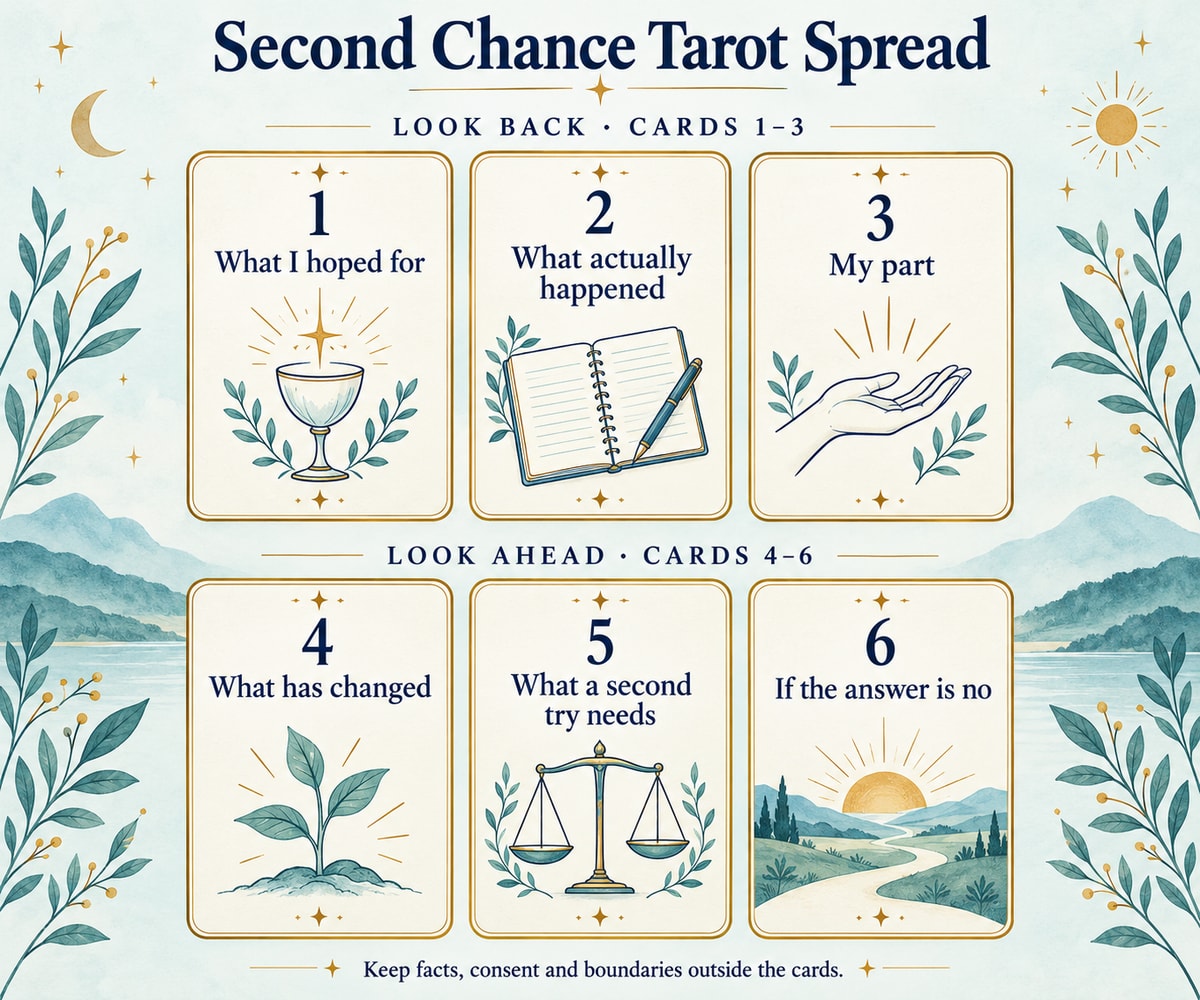
Read the six positions in order
These examples use Rider-Waite-Smith-style imagery as reflective prompts, not fixed instructions or a yes/no code. Use your own deck’s guide when the imagery differs. Waite’s description of Temperance, for example, discusses the image of mixing and harmonising; turning that into a question about pace is a reading choice, not proof of an outcome.
1. What I hoped for
Question: What did I want from this person or moment at the time?
The Ace of Cups can invite reflection on a fresh emotional beginning; the Ten of Cups can bring an image of harmony or a shared life. Neither means your hopes were excessive or caused the connection to end.
Keep separate: Name the hope without treating it as a promise the other person made.
2. What actually happened
Question: What took place, as plainly as I can say it?
Write the facts before interpreting this card. The Five of Swords might prompt you to examine a conflict, the Eight of Cups a departure, or the Four of Cups a missed opportunity. Those are lenses to consider, not evidence that an event occurred or that you know why someone acted.
Keep separate: Keep “they did not reply” separate from “they were afraid of their feelings.” The first may be observable; the second is a guess.
3. My part
Question: What did I do, or not do, that shaped the outcome?
The Seven of Swords can prompt a question about what you avoided saying; the Knight of Wands can invite you to review your pace. These are possible prompts, not verdicts that you were deceptive, careless or responsible for everything that happened.
Keep separate: Take responsibility for your own choices without taking responsibility for another person’s harm or refusal.
4. What has changed
Question: What is different now, in me and in my life?
The Wheel of Fortune may draw your attention to changing cycles, while the Six of Swords may suggest looking at distance or transition. Check those themes against actual developments: different circumstances, a completed commitment or a change you have practised consistently.
Keep separate: A change-themed card does not prove change. A repeated card does not prove nothing has changed; it may simply return your attention to a theme.
5. What a second try needs
Question: What would I have to do differently, and can I?
Temperance can invite patience and a more measured pace; Justice can prompt fairness, accountability and a direct conversation. Translate the idea into something specific you can do, such as acknowledging a mistake without asking for reassurance in return.
Keep separate: A renewed relationship needs willing participation from both people. You cannot do their part for them or earn their consent through a better reading.
6. If the answer is no
Question: What is my plan if they are not interested or it is not possible?
The Star can support reflection on hope beyond this particular outcome. The Three of Pentacles can prompt a return to a project, community or shared practical work. Neither requires finding a new partner immediately or pretending disappointment does not hurt.
Keep separate: Plan how you will respect a no, accept no response and support yourself without another round of messages or card draws.
Turn the reading into three kinds of notes
Give facts, interpretations and actions separate lines in your journal. That helps you avoid turning a meaningful image into information you do not actually have. This short example is imagined, not a report of a real reading.
- What I know
- An imagined example: we stopped speaking after an argument. They asked for space. I do not know whether they want contact.
- What I interpret
- If Temperance appears in position 5, I might consider pacing and emotional balance. That interpretation does not cancel the request for space.
- What I will do
- I will respect the boundary and write an unsent note about my own responsibility. I will not send it or treat the card as permission to restart contact.
Our guide to reflecting on your past with tarot develops this distinction between remembered events and the meanings you explore through a card.
What if contact is genuinely open?
If there is no stated boundary against contact and you decide an approach is appropriate, use what you know about the situation, not a card alone. A message can acknowledge your part and give the other person genuine freedom not to respond. It should not demand a second chance because the cards, fate or your spiritual connection say you belong together.
A response that is unclear does not need another spread to decode it into a yes. Let their words and behaviour matter. A refusal or continued silence is a reason to stop pursuing the conversation, not to keep looking for a more favourable interpretation.
If a repeated card or difficult feeling sends you back to the deck
Notice the urge before drawing again. A repeated card can return your attention to an unresolved theme, but it does not establish that the other person is thinking about you or that the universe is demanding another attempt. You are allowed to finish with uncertainty.
Close the reading by choosing one action under your control: keep a boundary, write an unsent reflection, ask a trusted person for support or return to something in your own life. There is no need to schedule repeated readings until a reassuring card appears. If the wording of your question keeps assuming a reunion, our guide to asking love questions offers alternatives.
A second chance is not the only meaningful outcome
The spread has room for hope and for a no. Its value is in helping you think more clearly about your own choices while leaving the other person free to make theirs.
For other relationship layouts and card examples, continue to Love Tarot Readings: A Grounded Guide.