

Quick guide
A great tarot reading is mostly built before the cards come out. You arrive with one clear question about your own situation, you have chosen a format that suits you, and you know what a reader can and cannot do. Then you listen, take notes, and decide the next day what, if anything, to act on. The limits, stated once: a reading cannot see the future, read another person’s mind, confirm a pregnancy, diagnose an illness, pick lottery numbers, or guarantee an outcome. What it can do is give you a structured conversation about a decision, a relationship, or a stuck stretch of life, with 78 illustrated cards as prompts. In the US, readings are sold by phone, video, live chat, and in person. Networks commonly bill by the minute; independent readers commonly charge a flat session fee. Neither is better; they suit different people. What separates a good experience from a bad one is the reader’s conduct. A good reader asks about your question, explains the cards, and leaves choices with you. A reader who diagnoses, frightens you, or wants money to remove a curse is not one to keep.
Start with the question, not the reader
Most disappointing readings begin with a vague or impossible question. “Will he come back?” asks the cards to know another person’s mind, which they cannot, and leaves you nothing to act on. “What do I want from this relationship, and what am I willing to do about it?” gives a reader something to work with and gives you a decision to make. Before you book, write your question in one sentence and test it: is it about me, can I influence it, and would any answer change what I do next.
Good questions are open and specific: instead of “Should I take the job?” try “What am I not weighing about this offer?” Health, legal, and money questions belong with a doctor, lawyer, or adviser; a reading can help you think about those conversations, not replace them. The guide to questions you should never ask covers the dead ends in full.
Choosing a reader: phone, video, chat, or in person
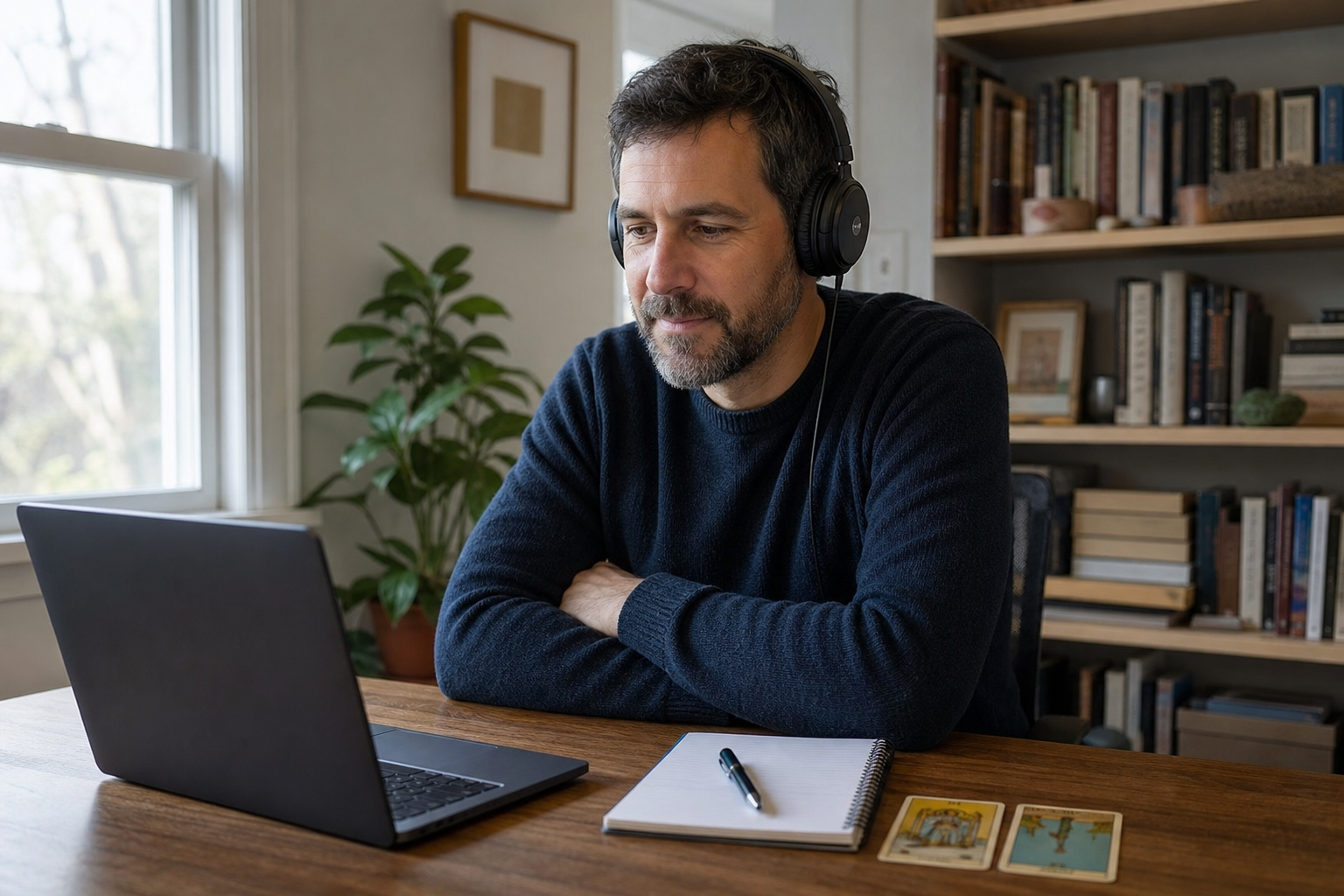
There is no best format, only a best fit. Phone readings are private and easy to book at short notice, but you cannot see the cards. Video puts the cards on screen and a face in front of you, and needs a quiet room and a decent connection. Live chat suits people who think in writing and want a transcript; it is slower, and tone is easier to misread. In-person readings are the most immersive and usually the most expensive.
Whatever the format, look for a plain description of what the reader does, prices stated up front, reviews that describe specific readings rather than miracles, and an easy way to end the session. Someone who writes about tarot as a tool for reflection is a safer bet than someone promising to reveal your destiny. The companion on getting the best tarot card reading has a short checklist for comparing profiles.
| Format | Suits | Watch for | Typical billing |
|---|---|---|---|
| Phone | Privacy, short notice, talking a problem through | You cannot see the cards; ask the reader to name each one | Per minute, commonly about $1 to $10; intro minutes often free |
| Video | Seeing the spread, longer sessions, learning the cards | Needs a quiet room and a stable connection | Per minute on networks; independents commonly $40 to $150 per session |
| Live chat | Thinking in writing, keeping a transcript | Slower pace; tone can misread | Per minute, often a little cheaper than voice |
| In person | Immersion, seeing the deck, local recommendations | Higher cost; travel; fewer choices outside cities | Flat fee, commonly $50 to $200 for 30 to 60 minutes |
| Email or recorded | No live pressure; rereading at leisure | No follow-up questions; slower turnaround | Flat fee, commonly $20 to $80 |
What a good reader does, and does not do
Conduct matters more than style, deck, or reputation. A good reader spends the first minute or two on your question and reshapes it with you if it is vague. They name the cards, describe the pictures, and explain the traditional meaning before connecting it to your situation. They speak in possibilities rather than verdicts, check whether an interpretation fits, and leave the decision with you. A hard-looking card is something to talk about, not a sentence.
A good reader will
- Ask what you want from the session before shuffling
- Name and describe each card so you can follow along
- Separate a card’s traditional meaning from their interpretation
- Say plainly what a reading cannot know
- Let you end the session without pressure
A good reader will not
- Claim to see your future or another person’s thoughts
- Diagnose an illness, a pregnancy, or a mental health condition
- Tell you to stop a medication or skip an appointment
- Say you are cursed, blocked, or carrying energy that costs money to clear
- Ask for gift cards, wire transfers, or payment off the platform
- 1. PrepareWrite one question about your own situation and what you would do with any answer.
- 2. ChoosePick a format that fits you, read the reader’s profile for tone, and note the price.
- 3. SitListen, ask what each card shows, and take notes rather than judging as you go.
- 4. ActSleep on it, reread your notes, and decide which one step, if any, you will take.
What to expect, minute by minute
A typical live reading runs 20 to 45 minutes and has a shape. Knowing it stops the first minutes from feeling awkward and helps you notice when a session drifts. The timeline below is a 30-minute reading; per-minute network readings compress the same steps into whatever time you buy.
- Minutes 0 to 3, framing: the reader asks what brought you here. Give your one-sentence question and a little context. A good reader may suggest sharper wording.
- Minutes 3 to 6, shuffle and spread: the reader lays out a spread, often three cards for one question or a larger pattern for a broader one. Ask what each position means.
- Minutes 6 to 20, the cards: the reader works through each card: the image, its traditional meaning, and how it might relate to your question. Take notes here.
- Minutes 20 to 30, conversation and close: you ask follow-ups such as “How would that look in practice?” rather than “So will it happen?” The reader sums up one or two themes; you note them and end the call. A close that turns into a sales pitch is a warning sign.
Costs and formats in the US market
Prices vary widely, so these are ranges you will commonly see, not rules. Readings sold through large networks by phone, chat, or video commonly bill by the minute, at rates commonly between about one and ten dollars a minute depending on the reader’s experience and demand; many networks give new customers a few introductory minutes free or at a reduced rate. Independent readers, online or in person, commonly charge a flat fee, often between about 40 and 150 dollars for 30 to 60 minutes; well-known readers and big-city studios charge more, and recorded or email readings commonly cost less.
Two habits keep spending sane. Decide the total you will pay before you connect, and convert it into minutes if the reader bills that way. Then treat a reading as a one-off purchase, not a subscription; booking a second reading because the first did not say what you hoped is the moment to stop. The review of the PsychicOz network shows how one platform’s billing and reader vetting work in practice.
Taking notes and acting afterward
The value of a reading is easy to lose within a day. Keep a notepad open and write three things for each card: its name, a phrase about the picture, and the reader’s main point. If the session is by video or chat, ask whether you may screenshot the spread or keep the transcript. At the end, write the one or two themes the reader closed on, in your own words.
Then leave it until the next day. Reread the notes beside your original question and ask: what did I already know, what surprised me, what do I disagree with, and what one step this week would I be glad about either way. A reading is useful when it changes how carefully you think, not when it tells you what will happen. The guide to tarot accuracy explains why readings feel accurate and where that feeling comes from.
Red flags and scams
Most readers are honest people doing work they care about. A few use the setting to frighten and extract money, and the pattern is easy to recognize: a cheap or free reading, then a sudden discovery that you carry a curse, a block, negative energy, or a generational attachment. Removal costs money, the price rises each session, and payment moves to gift cards, wire transfers, or cash apps that cannot be reversed. Curse detection and removal is a scam every time. Leave the moment it appears.
Quieter warning signs: diagnosing illness or pregnancy, telling you to stop a medication, claiming to know what another person secretly thinks, escalating fear to keep you on the line, or insisting only they can help. If you have paid a scammer, contact your card issuer or payment app at once and report it to the Federal Trade Commission. Vague statements that feel personal are a known effect that psychologists call the Barnum effect; a good reader works with it, a bad one exploits it.
Key takeaways
- Write one question about your own situation before you book; it matters more than the choice of reader.
- Phone, video, chat, and in person each suit different people; the reader’s conduct matters more than the format.
- Networks commonly bill per minute; independents commonly charge a flat fee. Decide your total before you connect.
- A good reader names the cards, explains meanings, and leaves choices with you. One who predicts, diagnoses, or frightens is not one to keep.
- Curse removal, escalating fees, and gift-card payments are scams. Leave and report fraud to the FTC.
Related reading
- Getting the best tarot card reading: a quick checklist
- Getting the best tarot reading: preparing your question
- Talking to a reader remotely: what to expect
- How accurate are tarot card readings?
- PsychicOz psychic network reviews: real or fake?
- Tarot questions you should never ask
- Using a yes or no tarot reading
Frequently asked questions
1. How do I prepare a question for a tarot reading?
Write it in one sentence before you book. Check that it is about you, that you can influence it, and that any answer would change what you do next. Open questions work best: what am I not weighing about this decision, what would I need to feel secure here. Avoid questions about another person’s thoughts, health, or guaranteed results.
2. Is a phone reading as good as an in-person reading?
It can be. Conduct matters far more than format. Phone readings are private, easy to book, and often cheaper; you cannot see the cards, so ask the reader to name and describe each one. In-person readings are more immersive and usually cost more. Choose whichever lets you relax and take notes.
3. What is a typical price for a tarot reading in the United States?
Prices vary widely. Network readings by phone, chat, or video commonly bill per minute, often between about one and ten dollars a minute, with introductory minutes for new customers. Independent readers commonly charge a flat fee, often between about 40 and 150 dollars for 30 to 60 minutes. Decide your total before you connect.
4. How long should a tarot reading last?
Most live readings run 20 to 45 minutes. One focused question can be handled in 15 to 20 minutes with a three-card spread; a broader review might take 45. Longer is not better. If a reader keeps extending the session or says you need more time to hear the answer, end it.
5. What does a good reader do at the start of a session?
They ask what you want from the reading, listen, and often suggest sharper wording. They say which spread they will use and what each position means. This framing takes a few minutes and is a good sign. A reader who describes your future before asking a single question is guessing.
6. Can a tarot reader tell me what someone else is thinking?
No. A reading cannot read another person’s mind, and questions like whether a partner is faithful or whether an ex still cares set you up to act on a guess. A good reader reframes toward your own choices: what you want, what you would do either way, and how to ask the person directly. That reframing marks a reader worth keeping.
7. What are the red flags during a reading?
Any curse, block, or attachment that costs money to remove. Fees that climb session by session. Requests for gift cards, wire transfers, or payment off the platform. Diagnoses of illness or pregnancy, instructions to stop a medication, claims about another person’s secret thoughts, or fear used to keep you talking. Each is reason enough to leave.
8. Is curse removal ever legitimate?
No. Curse detection and removal is a scam in every form, including blocks, energy clearings, and generational attachments. The pattern is a cheap first reading, an alarming discovery, and rising fees paid in ways that cannot be reversed. If you have paid, contact your card issuer or payment app immediately and report the fraud to the Federal Trade Commission.
9. Should I tell the reader details about my situation?
Share enough context for the reader to understand your question, and no more than you are comfortable with. A reader who knows you are choosing between two jobs can use the cards more usefully than one guessing. You need not test the reader by withholding everything, and you never need to share medical, financial, or identifying details.
10. What should I take notes on?
For each card, write its name, a phrase about the picture, and the reader’s main point. At the end, write the one or two closing themes in your own words. Ask whether you may screenshot the spread or keep the chat transcript. Short notes you will actually reread beat a full transcript you never open again.
11. How should I act on a reading afterward?
Wait until the next day. Reread your notes beside the question you wrote beforehand and ask: what did I already know, what surprised me, what do I disagree with, and what one step this week would I be glad about either way. Take that step. Treat the rest as material for thinking, not instructions.
12. What if the reading felt wrong or did not fit?
Say so during the session; a good reader will adjust rather than insist. Afterward, note what did not fit and why. Readings are interpretations of illustrated cards, and a mismatch is normal. Do not book another reading immediately to get a better answer; that habit turns a one-off purchase into a costly loop.
13. Can a reading predict the future?
No. Cards are illustrations with traditional meanings that trace to the Rider-Waite-Smith deck of 1909 and, before that, Italian card games. A reading can help you think about a situation and notice what you are avoiding; it cannot see events before they happen. Readers who promise timing, outcomes, or guarantees are selling what the practice cannot deliver.
14. Why do readings often feel so accurate?
Partly because good readers listen well, and partly because of a well-documented effect: general statements that could apply to almost anyone feel personally true when addressed to you. Psychologists call this the Barnum effect. The feeling is not proof of anything, but it does not make a reading useless; the useful part is the thinking it prompts.
15. Are free tarot readings worth it?
Free introductory minutes on a network let you hear a reader’s style before paying. Decide in advance whether you will buy more time, because the free minutes end mid-conversation by design. A free reading that turns into an alarming discovery about your energy or luck is a scam setup. Free samples from independent readers are rarer and short.
16. Is it better to see the same reader again or try different ones?
For an ordinary question, one reading is enough. If a reader’s conduct was good and you have a new question months later, returning is reasonable. Avoid a standing habit of readings for every decision, or returning because the last answer disappointed you. A reader who encourages you to think for yourself will not mind either way.
17. What should I do if a reader tells me to stop taking medication?
End the session and do not follow the advice. Medication decisions belong with the prescriber, and stopping some medicines suddenly is dangerous. No card knows anything about your treatment. A reader who gives medical instructions has stepped outside what a reading can do; report them to the platform if there is one, and tell your doctor if it worried you.
18. Can I get a good reading for a relationship question?
Yes, if the question is about you: what do I want here, what am I avoiding saying, what would I need to feel respected. Questions about a partner’s secret feelings or actions cannot be answered. If a relationship involves fear, control, or threats, a reading is the wrong tool; contact the National Domestic Violence Hotline at 1-800-799-7233 or text START to 88788.
Evidence note: Tarot is treated here as a tool for reflection and structured conversation, not prediction. A reading cannot see the future, read another person’s mind, confirm a pregnancy, diagnose an illness, pick lottery numbers, or guarantee an outcome. Prices are ranges commonly seen in the US market and change over time. Curse removal for money is a scam; report fraud to the FTC. Health questions go to a doctor; in a crisis, call or text 988.
‘Prepare questions’? Why not just ask the cards what they want for dinner? Seems like we’re trying too hard here… 😂🍽️
This article provides a balanced view on tarot readings, emphasizing both skepticism and openness. It’s crucial to approach such experiences thoughtfully to get the most out of them.
Honestly, I don’t see the point in all this psychic nonsense. It feels like a waste of time and money. Just live your life instead of seeking advice from cards. 🤨
‘Be a part of the session’? Sounds like they’re asking you to do half the work while they sit back and take your money. What a racket! 🤑
‘Trust your psychic’? Yeah, right! As if anyone would actually do that without some serious proof first. Good luck with that one! 😂
Great tips! I’ve been curious about tarot readings, and now I feel more prepared. Can’t wait to dive into this mystical experience! ✨💖
While I understand people enjoy this stuff, it’s important to remember that psychics are not infallible. It’s okay to be skeptical; just don’t let it ruin the fun for you! 🤔
I loved this article! It made me feel so much better about my upcoming tarot reading. I’m excited to explore what insights I might gain! 🌟😊