

Quick guide
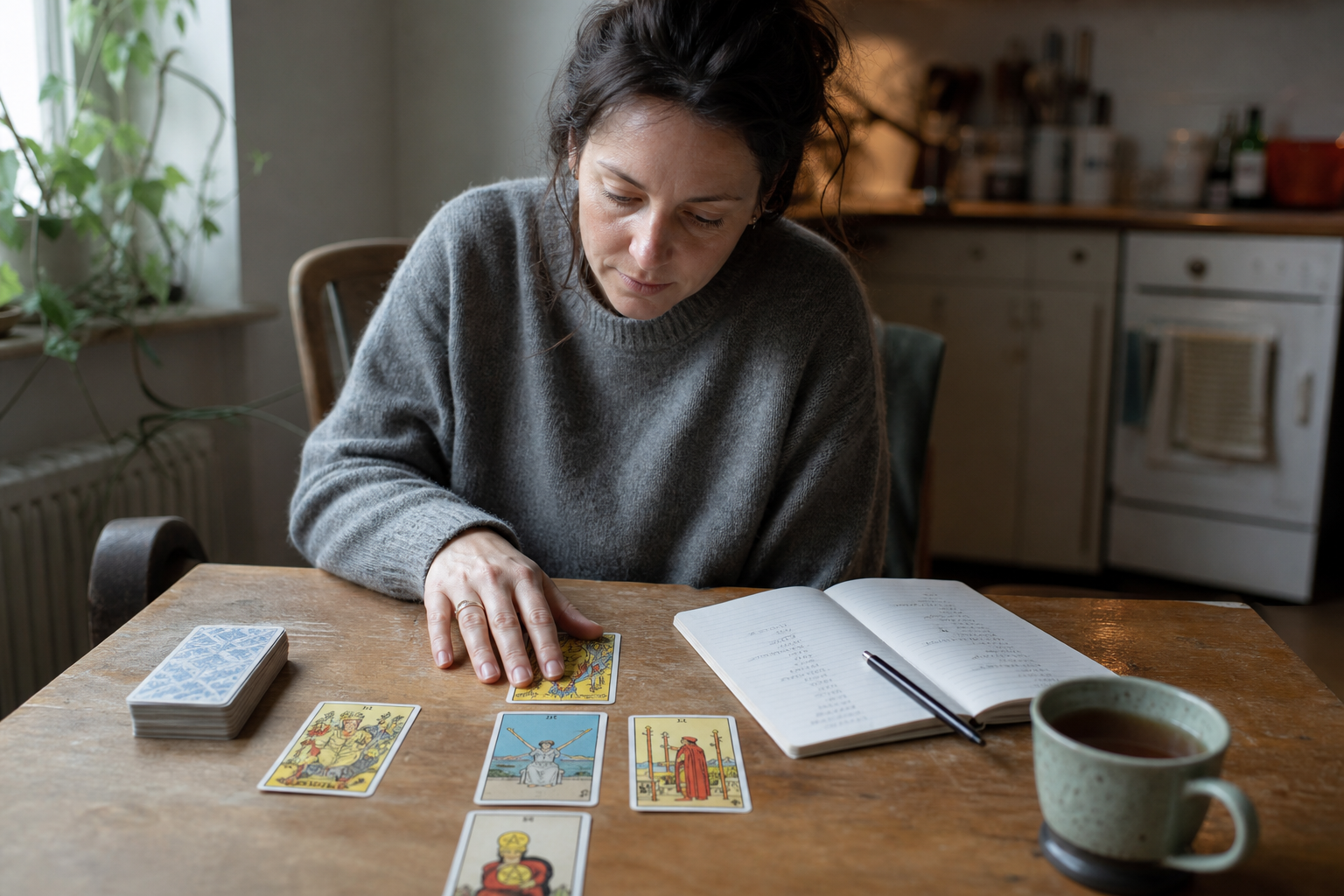
A tarot card reading for hard decisions works best when you treat it as a structured pros-and-cons exercise, not as a way to find out what will happen. You name the choice, lay out a small spread, and let each card act as a prompt that pulls a hidden worry, hope or cost into the open. The five-card decision spread below gives every card a job: the situation, option A, option B, what you are not seeing, and the next concrete step. Tarot cannot predict the outcome of either path, tell you what another person will decide, or replace advice from a doctor, lawyer or financial adviser. What it can do is slow you down, organise your thinking and show you which option you keep defending. By the end you should have a written list of reasons, a date for deciding, and a clearer sense of what you already want.
Most hard decisions are hard for one of two reasons. Either both options carry real costs and you cannot weigh them, or you already know what you want and you are afraid to say it out loud. A tarot reading does not remove either problem, but it gives you a table, a set of pictures and a few minutes of focused attention, which is more than most of us give a decision before we make it. This guide shows you how to run a decision reading as a thinking tool, which spread to use, what the cards that keep turning up in these readings are usually asking, and when to put the deck away and call a professional instead.
Why a decision reading is really a pros-and-cons exercise
Write a pros-and-cons list on a blank page and you will usually fill it with the reasons you have already rehearsed. The list confirms what you walked in believing. Tarot interrupts that pattern because the cards are chosen by chance and you have to make sense of them. When the Five of Pentacles lands in the position for “the job I want to take”, you are forced to ask what the cold, the loss and the two figures outside the lit window have to do with that job. Sometimes nothing, and you say so and move on. Sometimes it is the pay cut you have been quietly minimising. The card did not know anything; it simply made you look.
That is the whole method. Each card is a question you would not have asked yourself. Your answers, written down, become a pros-and-cons list that is more honest than the one you would have produced unprompted. Psychologists call the habit of noticing only the evidence that supports what we already think confirmation bias, and a random prompt is one of the simplest ways to work around it. Tarot has been used this way for a long time, although not from the start: the deck began as a trick-taking card game in northern Italy in the 1430s, and its use for reflection and fortune-telling came centuries later, as Britannica’s history of tarot explains.
A decision reading in four steps
- Name the choiceWrite the decision as two or three clear options, not as “what should I do”.
- Lay the spreadShuffle, draw five cards and place them in the positions described below.
- Sort what surfacesFor each card, write one pro, one con or one thing you had not considered.
- Decide and date itRead your list, choose, and set a date to act so the reading does not become a loop.
The cards supply the prompts; you supply the facts and the decision.
How to phrase the decision before you shuffle
The quality of a decision reading is set before the first card is turned. “Should I move?” is too loose to work with, because the cards have nothing to attach to. Rewrite the question as options with actions in them. “Option A: accept the Denver offer and move in March. Option B: stay, and ask for a raise in my current role by the end of the month.” Now each card has a concrete thing to comment on.
Next, write down what you already know, because the reading should not be used to rediscover facts. The salary difference, the deadline for answering, who else is affected and what they have said, what it would cost to reverse the choice later. Put these on the page before you shuffle. The reading is for the part of the decision that facts have not settled: what you fear, what you want, and what you have been avoiding.
Finally, keep the question about your own action rather than the result. “What do I need to see clearly about option A?” is a question the cards can prompt. “Will option A work out?” is not, because no card knows the future. If what you really want is a quick yes or no, a single-card draw is a different tool with different limits, and we cover it in the yes or no reading guide.
The five-card decision spread, position by position
- Card 1, the situation as it stands. Place it in the centre. Read it as a description of the pressure you are under right now, not as a verdict on you. The Four of Pentacles here might mean you are holding on tightly; the Eight of Wands might mean the decision is arriving faster than you would like.
- Card 2, option A. To the left of the centre. This card describes what you would need to accept, give up or carry if you chose this path. It is not a rating of the option. The Tower in this position does not mean option A ends in disaster; it asks what would have to be dismantled for option A to happen.
- Card 3, option B. To the right. The same question for the other path. Compare cards 2 and 3 side by side and notice which one you immediately started explaining away.
- Card 4, what you are not seeing. Above the centre. Treat this as the card that stands in for the friend who tells you the uncomfortable thing. The card you argue with hardest is often the most useful one here.
- Card 5, the next concrete step. Below the centre. Not the outcome and not the final answer, but the smallest action you could take this week that would make the decision easier. The Page of Pentacles might suggest a conversation about money; the Hermit might suggest a weekend with the phone off.
Here is how a reading like this can run. Someone is choosing between a secure salaried job and going freelance. Card 1 is the Two of Swords: a blindfolded figure holding two blades in balance, which they recognise as the stalemate they have been in for a year. Card 2, the salaried job, is the Ten of Pentacles, and they write “security, family, but also the sense that this is my parents’ idea of success”. Card 3, freelancing, is the Seven of Pentacles, and they write “slow growth, a lot of waiting, a harvest that might come”. Card 4 is the Five of Cups: three cups spilled, two still standing behind the figure. They sit with it and admit that they have been treating the freelance idea as a way to grieve a job they lost two years ago. Card 5 is the Three of Pentacles, and they decide the step is to take on one paid freelance project while keeping the job, and to review in three months. Nothing in that reading was predicted. All of it was decided.
Cards that often appear in decision readings
Some cards turn up in decision readings again and again, partly because their images are about choice itself. The table lists the ones readers meet most, what each tends to raise, and the question it is worth writing at the top of your page when it appears.
| Card | What it tends to raise | The question it asks you |
|---|---|---|
| Two of Swords | A stalemate held in place by not looking | What am I refusing to look at directly? |
| Seven of Cups | Too many options, some of them fantasies | Which of these options actually exists? |
| Two of Wands | Planning, looking outward, staying versus expanding | What would I do if I were sure I could? |
| Justice | Fairness, consequences, weighing both sides | Who else pays for this choice, and is that fair? |
| The Hanged Man | Pausing, a different angle, the cost of waiting | What does waiting cost me, and what does it buy? |
| The Chariot | Commitment, direction, being pulled two ways | Which option could I commit to fully? |
| Ace of Swords | Clarity, one clean idea, cutting through noise | What is the single fact that settles this? |
| Eight of Cups | Walking away from something that was once enough | Is leaving a loss, a relief, or both? |
Three more deserve a mention. Judgement, with its figures rising to a trumpet call, usually raises the question of what you learned the last time you made a choice like this. The Queen of Swords asks what you would tell a friend who brought you this exact decision, which is often the clearest advice you will get. The Emperor asks which rules, commitments or responsibilities the decision has to fit inside, and whether you have been pretending they do not exist. None of these cards tells you which option is right. Each one hands you a question that is worth answering in writing.
Turning the spread into a pros-and-cons page
The reading only earns its keep when it becomes a page you can act on. Here is how to convert five cards into a list.
- Two columns per option. Give option A and option B their own pros and cons columns, and write the card that prompted each entry in brackets so you can trace where a thought came from.
- One line per card, minimum. Every card must produce at least one entry somewhere. If a card produces nothing, say what it reminded you of and why you dismissed it. Dismissals are information too.
- Mark facts and feelings separately. “The new job pays 12 percent more” is a fact. “I would feel like a beginner again” is a feeling. Both belong on the list, but only facts can be checked, so label them.
- Score only what you can verify. If you want to weight the entries, weight the facts. Weighting a feeling you had while looking at the Moon card gives it a false precision.
- Notice which option you defended. Reread your notes and underline every sentence that begins with “but”. The option with the most defences is often the one you want, and the defences are what you fear about wanting it.
- Keep the page. Date it and put it in your tarot journal. In a month you will be able to see whether the worries that felt enormous actually materialised.
When tarot is the wrong tool
A decision reading is a thinking aid, and some decisions should not be made with a thinking aid alone. Put the cards away when the choice falls into any of these categories.
- Medical decisions. Whether to start or stop a treatment, change a medication, or go ahead with a procedure. A card cannot see a test result. Those questions go to a doctor, a pharmacist or a second clinical opinion, and the reading can at most help you write down the questions you want to ask them.
- Legal decisions. Whether to sign, sue, settle, or respond to a letter. The Justice card is not legal advice. A lawyer or a legal aid service is.
- Money with real stakes. Investing savings, taking on debt, lending to family, quitting a job without a cushion. No spread can forecast a market or an income. A licensed financial adviser or a nonprofit credit counsellor can look at the actual numbers.
- Someone else’s choices. Whether a partner will propose, whether a manager will promote you, whether a friend is lying. Cards do not read minds. The only reliable way to learn what another person will decide is to ask them, and a reading cannot substitute for that conversation.
- Decisions shaped by fear or threats. If the choice involves someone who frightens or controls you, this is a safety matter, not a tarot matter. In the United States the National Domestic Violence Hotline is 1-800-799-7233, or text START to 88788. In immediate danger, call 911.
- Decisions made in a very low mood. If you are struggling to see any option as bearable, the problem is the mood, not the options, and a reading will only reflect it back. Call or text 988 in the US to talk to someone, and come back to the decision when you have support.
Decisions about change, and the readings that help
Many hard decisions are really decisions about change: leaving, starting, ending, moving. These readings have a particular shape, because the cards that show up most often are the ones that picture change directly. Death, the Tower, the Eight of Cups and the Six of Swords all describe an ending or a crossing, and people who are already afraid of the change tend to read them as warnings. Read them instead as descriptions of the kind of change in front of you. Death describes something that is over and is not coming back. The Tower describes a structure that has to come down before anything else is possible. The Six of Swords describes a quiet crossing that is sad and necessary at the same time. Our companion pages on using tarot cards for change and finding change in tarot cards go through these cards one at a time.
There is also a gentler use of the deck for change, which is checking whether you are ready for a decision you have already made. Draw one card in the morning for a week and ask what it shows you about the choice. If the week’s cards keep pointing to the same unresolved fear, that fear needs a plan before you act. If the cards keep landing as a shrug, you have probably decided and are waiting for permission. The permission comes from you, not from the deck. The short guide to making good choices with tarot cards expands on this daily check-in.
After the reading: making the decision stick
The most common way a decision reading fails is not a wrong answer but no answer. The reading becomes a loop: you shuffle again the next day, draw a different spread, prefer the new cards, and repeat until you are more confused than when you started. Three habits prevent this.
First, one reading per decision. If you need to revisit the question, revisit the written page from the first reading rather than drawing new cards. Second, set a date. Write the day by which you will have chosen at the top of the page, and tell one person. Third, choose a step, not just an option. Card 5 exists for this reason. A decision that has a next action attached to it is harder to undo in your head.
It also helps to notice what a hard decision is doing to the rest of your life. Lying awake running the options, snapping at people, losing the ability to enjoy things: these are signs that the decision has become a source of stress rather than a problem to solve, and the deck is not the right tool for that part. The tarot and mental wellness guide explains where a reading can help with everyday stress and where it should hand over to a professional.
Key takeaways
- A decision reading is a structured way to build an honest pros-and-cons list; it does not forecast which option will turn out well.
- Write the decision as concrete options with actions in them before you shuffle, and record the facts you already know.
- The five-card decision spread assigns each card a job: situation, option A, option B, the blind spot, and the next step.
- Cards like the Two of Swords, Seven of Cups, Justice and the Hanged Man are prompts about choice itself; write the question each raises and answer it.
- Medical, legal, high-stakes money and other people’s decisions belong with professionals or with the person involved, not with the cards.
Related reading
- Making Good Choices With Tarot Cards
- Using Tarot Cards for Change
- Finding Change in Tarot Cards
- Using a Yes or No Tarot Reading
- Tarot and Mental Wellness
- 5 Tips for a Great Tarot Card Reading
- How Accurate Are Tarot Card Readings?
Frequently asked questions
1. Can a tarot reading tell me which decision is right?
No. A reading cannot see the future or compare outcomes. It can help you lay out what you know, what you fear and what you want, and that usually makes the right decision easier to see for yourself.
2. How many cards should I use for a decision reading?
Five is a good number: one for the situation, one for each of two options, one for a blind spot and one for the next step. Three cards (option A, option B, what you are missing) work when the choice is simple.
3. What is the best question to ask tarot about a decision?
Ask about your own action and understanding, not the result. “What do I need to see about option A?” works; “Will option A succeed?” does not, because no card can know that.
4. Which tarot cards mean I should say yes to a choice?
None of them. Cards like the Chariot, the Ace of Swords and the Two of Wands are traditionally read as prompts about commitment and clarity, but they describe a state of mind, not an instruction.
5. What does the Two of Swords mean in a decision reading?
In the Rider-Waite-Smith image a blindfolded figure balances two swords. Readers treat it as a stalemate kept in place by not looking, so the question it raises is what you are avoiding seeing.
6. What does the Seven of Cups mean when I am choosing between options?
It shows seven cups full of tempting but unreal things. In a decision reading it usually prompts you to check which of your options actually exist and which are daydreams.
7. Is it bad to get the Tower or Death when asking about a decision?
No. These cards describe endings and structures coming down. In an option position they ask what would have to end for that option to happen, which is useful information rather than a warning.
8. Can I do a decision reading for myself, or do I need a reader?
You can do it yourself, and for a pros-and-cons exercise that is often better because you know the facts. A reader can help by asking questions you would skip, but they cannot know your situation better than you do.
9. How often can I ask the cards about the same decision?
Once. Repeated readings on one question tend to produce a pile of contradictory cards from which you pick the ones you like. Revisit your written notes instead of drawing again.
10. Should I use reversed cards in a decision spread?
It is your choice. Reversals add a second layer of prompts, such as a blocked or excessive version of the card, but beginners often find upright-only readings clearer for decisions.
11. Can tarot help me decide whether to leave my job?
It can help you list what the job gives you, what it costs you and what you are afraid of. It cannot tell you whether a new job will appear or whether you will regret leaving, so the money side needs real numbers.
12. Can tarot help with relationship decisions?
It can prompt you to be honest about what you want and what you tolerate. It cannot tell you how the other person feels or what they will do, and if fear or control is part of the picture, a hotline or counsellor is the right call.
13. Should I use tarot for a medical or legal decision?
No. Use it only to write down the questions you want to ask the professional. The decision itself needs a doctor, lawyer or qualified adviser who can see the facts.
14. What if the cards contradict what I want to do?
Write down the contradiction and ask what the card could be pointing at. If you find nothing real, note that you dismissed it and proceed. The cards are prompts, not vetoes.
15. What if I get a card I do not understand?
Describe the picture in plain words and ask how that scene relates to the option. If it still means nothing, leave it and move on. A forced meaning is worse than no meaning.
16. How do I avoid reading only what I want to see?
Write every card’s prompt before you decide what it means for your choice, label facts and feelings separately, and underline every sentence in your notes that starts with “but”. Those sentences show where you are defending an option.
17. What should I do after a decision reading?
Turn the cards into a dated pros-and-cons page, pick a decision deadline, tell one person, and take the small step from card 5 within the week. Then stop reading on that question.
18. Does a decision reading work if I am very stressed?
Usually not well, because a low mood colours every card. If you cannot see any option as bearable, get support first; in the US you can call or text 988 at any time.
Evidence note: The card meanings in this guide are traditions attached to the Rider-Waite-Smith deck (1909) and the guidebooks that follow it, not findings about how decisions turn out. Tarot has not been shown to predict events or read another person’s mind, and no reading should replace medical, legal or financial advice. The history of tarot as a 1430s Italian card game is drawn from Britannica, and the description of confirmation bias from Britannica’s science reference. If a decision feels unbearable or you are having thoughts of harming yourself, call or text 988 in the United States; if someone frightens or controls you, the National Domestic Violence Hotline is 1-800-799-7233.