

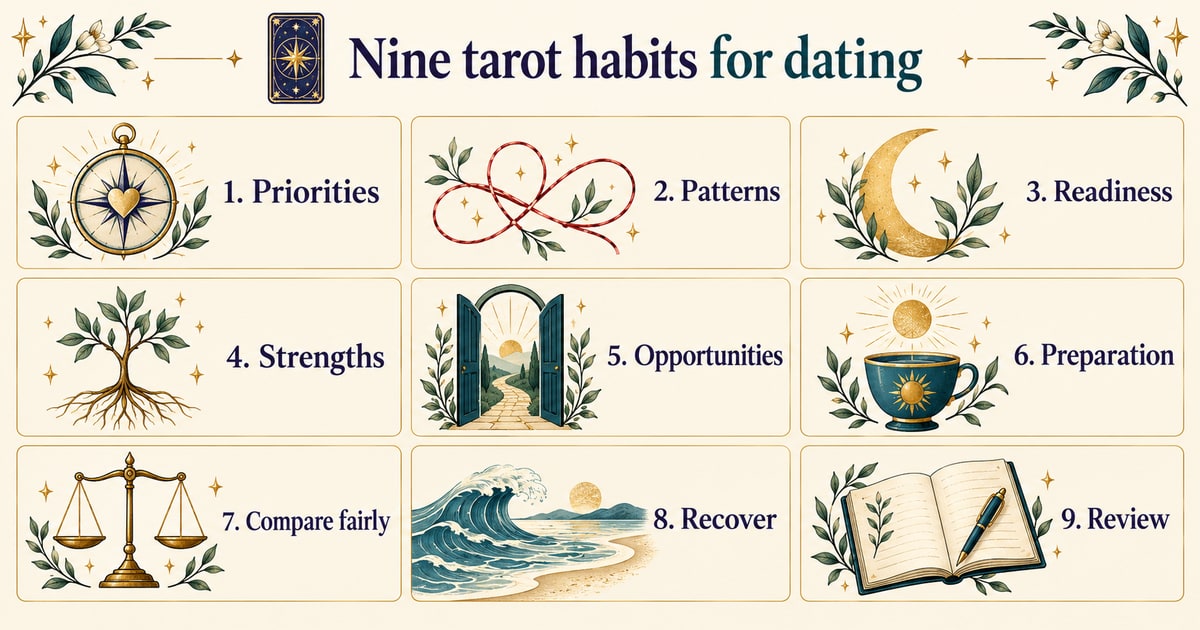
A love reading can begin with your own choices. If “soulmate” describes the kind of connection you hope for, tarot can give that hope a thoughtful place in your journal. These nine small habits explore priorities, patterns and everyday dating decisions. They do not identify a destined person, reveal someone’s private feelings or establish when love will arrive.
Choose the habit that fits today. Each uses one card as a reflective prompt, followed by something you can notice, ask or do away from the deck. There is no need to complete all nine at once.
Make one draw useful
You can use a familiar deck or its guidebook. The examples below draw on Rider–Waite–Smith interpretations; different decks and readers may approach the pictures differently. Treat an association as a possible lens, not an instruction you must obey.
- Choose one question. Pick a habit below that matches a real situation. You can write the question rather than saying it aloud.
- Draw once and describe. Shuffle, turn one card and notice a detail before checking its meaning. Write what it brings to mind, including anything that does not fit.
- Finish with one sentence. Record an observation and a manageable next step. Put the deck away instead of redrawing until you receive reassurance.
For help getting comfortable with the deck, see our guide to shuffling tarot cards.
Nine habits for dating with intention
1. Name your top priority
Ask: “Which quality matters most to me in a relationship?” The Queen of Pentacles may bring reliability to mind; the Knight of Cups may suggest romance. Neither means that a particular person is approaching.
Translate the quality into something observable: “Reliability means keeping plans or letting me know when they change.” Your non-negotiables come from your values and needs, not from whichever card appears.
2. Notice a recurring pattern
Ask: “What would I like to notice sooner?” Think about previous connections, messages or expectations; you do not need three past relationships to do this. The Seven of Cups might prompt a distinction between an exciting possibility and what someone has actually offered. A reversed Lovers could raise a question about mismatched values.
Write one pattern without blaming yourself for another person’s behavior. Then choose a question you could ask earlier next time.
3. Check your current capacity
Ask: “What pace would feel manageable now?” The Four of Swords can invite rest; the Five of Cups can make space for disappointment or grief. They do not declare you unready or require you to be completely healed before connecting with someone.
Consider time, energy and interest. Your next step might be a short coffee date, fewer app conversations or a break you choose for yourself.
4. Recognize what you bring
Ask: “What strength can I bring to a connection?” Strength may suggest patient courage, while the Seven of Pentacles may evoke steady effort. Find a real example: listening carefully, apologizing sincerely or making room for a different opinion.
Write that example rather than a perfect-partner description. Mutual care matters; your strengths do not oblige you to carry the entire relationship.
5. Make room for opportunities
Ask: “Where could I enjoy meeting people?” The Three of Cups may suggest friendship and shared celebrations; the Three of Pentacles may suggest a class or collaborative project. These are possibilities to consider, not locations the cards have predicted.
Choose an activity you would value even without meeting a partner. Check its practical details, and leave other participants free to want friendship rather than romance.
6. Prepare for a date
Ask: “How would I like to show up?” The High Priestess might remind you to listen to yourself as well as the other person. The Sun might suggest openness, without requiring a cheerful performance.
Pick one intention, such as asking a genuine question or saying what you enjoy. Arrange a meeting place, transport and boundaries that feel comfortable. A favorable card is not a reason to override discomfort.
7. Compare experiences fairly
Ask: “What quality deserves my attention in both connections?” Draw one card for that shared lens, not a separate verdict on each person. If it suggests reciprocity, write two short notes about actual exchanges: who asks questions, follows through and makes room for your preferences?
Compare the experiences and what you still need to learn, not which person received a “better” card. Respect any exclusivity agreements and avoid treating people as interchangeable options.
8. Recover from a letdown
Ask: “What would help me take care of myself now?” The Eight of Cups may offer an image of leaving something behind. It does not mean you failed, must end a relationship or should suppress sadness.
Choose a gentle action: contact a friend, return to an enjoyable routine or stop checking an unanswered message. Someone declining a connection is not a puzzle you must solve with more readings.
9. Review what you have learned
Ask: “What have I learned about dating this month?” Read your earlier notes alongside the card. Look for changes in your choices and experiences, not a secret code in repeated symbols.
Keep one habit that helped and adjust one that did not. A quiet month or an unanswered question is not evidence that love has passed you by.
From a card to a real question
An imagined example: Before a second date, you choose habit 6 and draw the High Priestess. The picture reminds you that you left the first meeting unsure about the other person’s availability. You write: “I want to listen, but I also want to ask what kind of relationship they are looking for.”
The useful next step is that conversation. Their answer and subsequent behavior matter more than assigning hidden meaning to the card.
Let the reading have an ending
Note the date, question, card and next step, then return to your day. You can revisit the note after the conversation or activity has happened. If you feel pulled to check every message through the deck, step back and talk the situation through with someone you trust.
For a broader look at relationship questions, visit Love Tarot Readings: A Grounded Guide. If you want a longer reflective exercise on another day, the eight-card love spread includes a question for every position.
Persistent low mood deserves support beyond a reading. Consider a trusted person or qualified counselor. In the United States, call or text 988 for support with emotional distress or suicidal thoughts. If there is immediate danger, contact emergency services.