
Quick guide
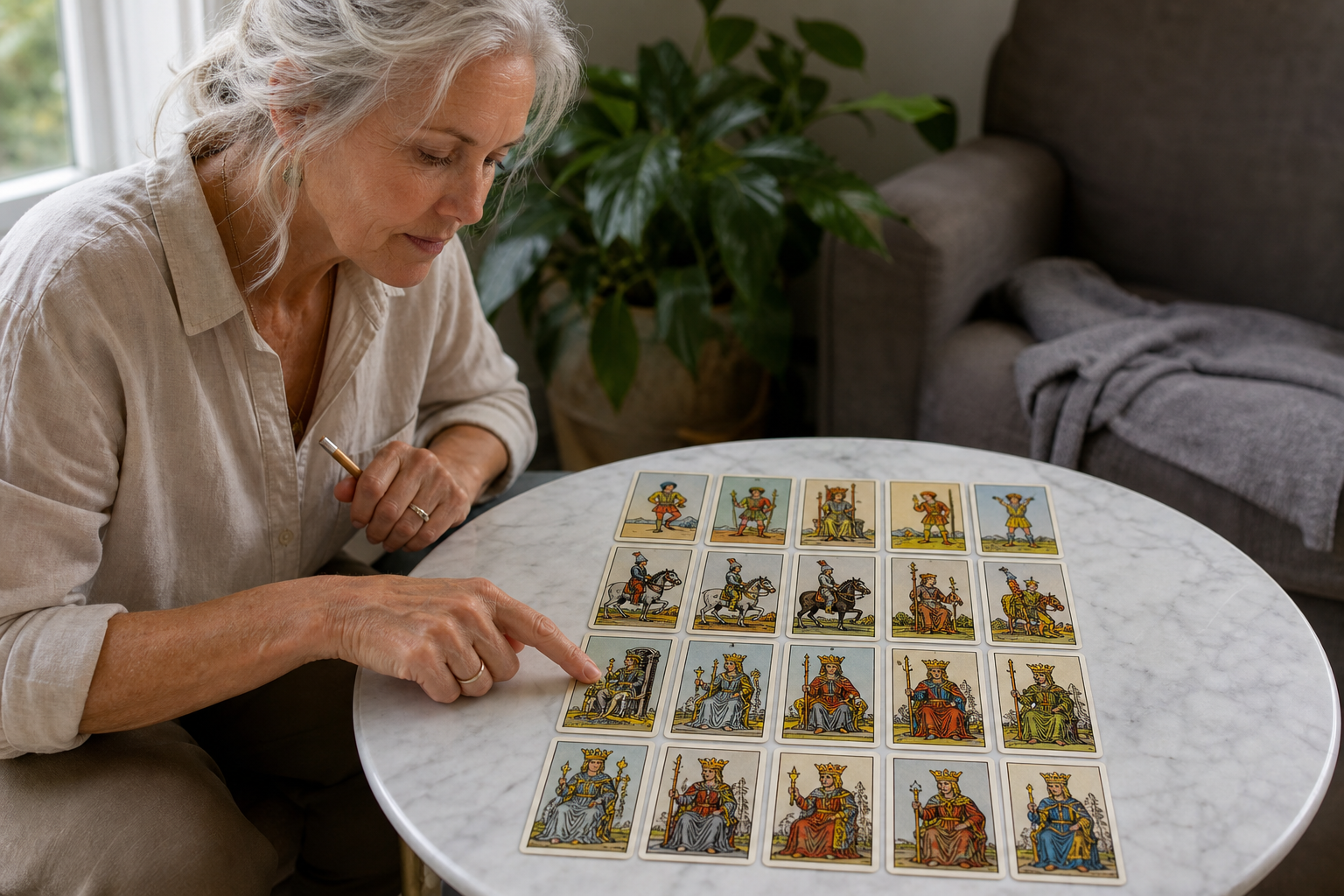
The tarot court cards are the sixteen people cards of the Minor Arcana: a Page, a Knight, a Queen and a King in each of the four suits. They are the cards most readers find hardest, because a court card can be read three different ways: as a person in your life, as a role you are playing right now, or as a mood or approach the situation calls for. Once you know the rank logic (Pages learn, Knights act, Queens hold, Kings direct) and the suit logic (Wands for energy, Cups for feeling, Swords for thought, Pentacles for practical life), every one of the sixteen becomes readable. A court card never tells you who someone is, what they feel about you or whether a particular person is about to arrive. It is a description you try on and test against what you already know. This page lays out all sixteen in a single table, explains the three ways to read them, and covers the old practice of choosing a significator.
Every tarot deck has a small crowd in it. Sort the cards by type and you find twenty-two trumps, forty numbered pip cards and sixteen figures on thrones, horses and hillsides. Those sixteen are the court cards. They are older than any reading tradition: the first Italian decks of the 1430s already had a King, Queen, Knight and Page in each suit, as Britannica’s history of tarot records, and ordinary playing cards later dropped the Knight to leave the familiar Jack, Queen and King. When readers in the eighteenth and nineteenth centuries attached meanings to the cards, the court cards were usually treated as literal people, described by hair colour and age. Modern practice is more flexible and more useful, and it is the approach this page follows.
Why the court cards feel difficult
A numbered card shows a scene, and the scene suggests a story. The Five of Pentacles has two figures in the snow outside a lit window; you can see the hardship and the help nearby. A court card shows a single person sitting or riding, and the picture gives you a character rather than an event. That is why beginners often freeze on the Queen of Pentacles or the Knight of Cups. The fix is to stop asking what will happen and start asking who or what this card is describing. Three answers are possible, and the rest of this page is about how to choose between them.
Four questions for any court card
- Which rank?Page, Knight, Queen or King tells you the stage: learning, acting, holding or directing.
- Which suit?Wands, Cups, Swords or Pentacles tells you the area: energy, feeling, thought or practical life.
- Who or what?Decide whether the card is a person, a role you are playing or a mood the situation needs.
- Where in the spread?A court card in a past position is usually a role or influence; in an advice position it is usually an approach to take.
Answer those four and the card is read. Everything else is detail.
All sixteen court cards at a glance
The table gives one short phrase per card in the Rider-Waite-Smith tradition. Read across a row to see how a rank changes with the suit, and down a column to see how a suit grows from Page to King.
| Rank | Wands (fire) | Cups (water) | Swords (air) | Pentacles (earth) |
|---|---|---|---|---|
| Page | Enthusiasm, a new idea, a message about a project | A new feeling, sensitivity, a creative message | Curiosity, questions, keeping watch | A student, a practical opportunity, a first step |
| Knight | Adventure, energy, acting on impulse | Romance, an offer, following the heart | Speed, directness, charging ahead | Steady work, routine, reliability |
| Queen | Warmth, confidence, independence | Compassion, intuition, emotional steadiness | Clear judgement, honesty, independence | Practical care, security, nurturing |
| King | Leadership, vision, bold decisions | Emotional balance, diplomacy, calm | Authority, truth, logical decisions | Stability, wealth managed well, success |
Rank logic: what Pages, Knights, Queens and Kings share
The four ranks describe four relationships with the suit’s energy, and Pamela Colman Smith drew them so you can tell at a glance. Pages stand on the ground holding the suit symbol and looking at it. Knights are on horseback, and the horse tells you the pace: the Wands horse rears, the Cups horse walks, the Swords horse gallops and the Pentacles horse stands still. Queens sit on thrones, often turned slightly to one side, holding the symbol close. Kings sit facing forward with the symbol held out, ready to use.
| Rank | Stage | What it tends to describe | Visual cue in the RWS deck |
|---|---|---|---|
| Page | Learning | A beginner, a message, a first attempt, curiosity | Standing, studying the suit symbol |
| Knight | Acting | Movement, pursuit, a decision put into motion, sometimes excess | On horseback, in motion |
| Queen | Holding | Mastery turned inward: care, understanding, steady influence | Seated, symbol held close |
| King | Directing | Mastery turned outward: authority, decisions, responsibility | Seated facing forward, symbol held out |
Rank is not age and it is not gender. A sixty-year-old starting to learn the piano is a Page of Cups in that part of their life. A teenager running a fundraiser with real authority is a King of Pentacles for the afternoon. The old rule that Queens are women and Kings are men is a leftover from the fortune-telling parlours of the 1800s and most readers have dropped it.
Suit logic: what Wands, Cups, Swords and Pentacles add
The suit tells you the area of life, or the style of the person, that the card is describing. Wands court cards are energetic, ambitious and quick to start things. Cups court cards are warm, intuitive and attentive to feelings. Swords court cards are analytical, direct and concerned with truth. Pentacles court cards are practical, patient and focused on what works. Put rank and suit together and you have a character you can picture: the Knight of Pentacles is a person or an approach that works steadily, while the Knight of Wands is one that moves fast and changes direction. If you want the suits in more depth, the Suit of Swords guide includes a comparison of all four.
Three ways to read a court card
1. As a person in your life
This is the oldest reading and still the most common. The card describes someone by temperament rather than by appearance: a manager who is all decisions and no small talk might be the King of Swords, a friend who always knows how you feel before you say it might be the Queen of Cups. Two cautions keep this honest. First, the card describes how that person shows up in this situation, not who they are in full. Second, the reading cannot tell you what the person thinks or feels; it can only prompt you to notice what you already know about them. Psychologists have a name for the tendency to fit a vague description to someone and then find proof of it: confirmation bias. A court card read as a person works best when you treat the match as a question rather than an answer.
2. As a role you are playing
Often the most useful reading is that the card is you, in a particular role. Draw the Page of Pentacles while asking about a new job and the card describes you as the learner who has to start at the beginning. Draw the Queen of Wands while asking about a family argument and the card describes you as the confident one who sets the tone. This reading turns the card into a mirror. The question to ask is whether the role fits, and if so, whether it is the right one for the situation.
3. As a mood or approach
The third reading treats the card as advice about how to act. The Knight of Swords in an advice position says move fast and say it plainly. The King of Cups says stay calm and listen. The Page of Wands says try it before you talk yourself out of it. This is the reading to use when the card lands in a position labelled advice, approach or what to do, and it is the reading that most often leads to an actual decision.
Significators: choosing a card to stand for you
In the Celtic Cross as A. E. Waite described it in 1910, the reader began by choosing a court card to represent the person asking, placed it in the centre, and laid the rest of the spread over it. That card is called the significator. Waite’s method matched the card to the person’s age and colouring, which is why older books tell you that fair-haired people are Cups or Wands and dark-haired people are Swords or Pentacles. Modern readers who use a significator choose it in one of three ways instead.
- By temperament. Pick the court card whose character you most recognise in yourself. Someone who is practical and steady might choose the Queen of Pentacles; someone who is restless and ambitious might choose the Knight of Wands.
- By the question. Choose the card that fits the role you are in for this reading. A question about learning a skill suggests a Page; a question about leading a team suggests a King of the relevant suit.
- By random draw. Shuffle the sixteen court cards, draw one, and let it describe how you are showing up today. Many readers prefer this because it gives information rather than confirming a self-image.
- Or skip it. Plenty of experienced readers never use a significator. Leaving all sixteen in the deck means a court card can appear naturally and tell you something you did not choose.
Reading a court card in a spread
Suppose a three-card spread for a question about a stalled project turns up the Knight of Pentacles, the Eight of Wands and the King of Wands. Read it as roles and approaches: you have been working steadily but slowly (Knight of Pentacles), things are about to move faster (Eight of Wands), and the way through is to make a bold decision and lead (King of Wands). Read the same cards as people and the Knight might be a careful colleague and the King a manager who wants a result. Both readings are legitimate. The one to keep is the one that gives you something to do.
- Decide the mode before you read the meaning. Say out loud whether this card is a person, a role or an approach. Changing your mind halfway through is where muddled readings come from.
- Let the position decide when you are unsure. Past and present positions suit roles and people; advice and outcome positions suit approaches.
- Use the horse, the throne and the gaze. A Knight facing out of the spread is leaving; a Queen looking toward another card is paying attention to it. Smith’s drawings reward close looking.
- Pair court cards with the pips beside them. The Queen of Swords next to the Three of Swords describes someone handling grief with honesty; next to the Ace of Swords she describes a clear decision being made.
- Do not use a court card to decide what another person feels. The Knight of Cups does not mean someone is in love with you. Tarot cannot read anyone’s mind, and the card is a prompt about romance as a theme.
- Do not assign gender or age by the picture. Queens can describe men, Kings can describe women and Pages can describe grandparents. Read the temperament.
- Do not treat a court card as a prediction that someone will arrive. No card forecasts a new person. If the card describes a quality you are hoping to meet, that is useful information about you.
- Do not rely on a court card for legal, medical or money decisions. The King of Pentacles is a prompt to think about security, not financial advice. Those questions belong with a qualified professional.
Key takeaways
- There are sixteen court cards: a Page, Knight, Queen and King in each of Wands, Cups, Swords and Pentacles.
- Rank gives the stage (learning, acting, holding, directing) and suit gives the area (energy, feeling, thought, practical life). Together they describe a character.
- Every court card can be read three ways: as a person, as a role you are playing or as an approach to take. Choose the mode before you read the meaning.
- A significator is a court card chosen to stand for the person asking. Pick it by temperament, by the question or by random draw, or skip it altogether.
- Court cards never reveal who someone is, what they feel or whether they are coming. They are descriptions to test, not facts about other people.
Related reading
- The King of Wands card meaning
- The Queen of Swords card meaning
- What Do the Sword Cards Mean? Suit of Swords, Ace to King
- The Fool’s Journey: All 22 Major Arcana Cards Explained
- Reading Reversed Tarot Cards
- Love Tarot Readings
- Tarot Cards for Beginners
Frequently asked questions
1. What are the court cards in tarot?
They are the sixteen figure cards of the Minor Arcana: a Page, Knight, Queen and King in each of the four suits. In a reading they are usually interpreted as people, roles or approaches rather than events.
2. How many court cards are in a tarot deck?
Sixteen. Four ranks multiplied by four suits. Together with the forty numbered cards they make up the 56-card Minor Arcana.
3. Why are court cards harder to read than other cards?
A numbered card shows a scene that suggests a story; a court card shows a single figure that suggests a character. You have to decide whether that character is a person, a role you are playing or an approach, and that extra step is what trips people up.
4. Does a court card always represent a real person?
No. It can describe a person, but it can equally describe a role you are playing or a mood the situation calls for. Many experienced readers use the person reading least of all.
5. Does a Queen have to be a woman and a King a man?
No. The ranks describe temperament and stage, not gender or age. A Queen can describe a man who leads through care, and a King can describe a woman who leads through decisions.
6. What is the difference between a Page and a Knight?
A Page is at the learning stage: curious, new to the suit’s energy, often carrying a message. A Knight is at the acting stage: in motion, pursuing something, sometimes to excess. In the Rider-Waite-Smith deck Pages stand and Knights ride.
7. What is the difference between a Queen and a King?
Both have mastered their suit. The Queen is read as mastery turned inward, expressed through understanding and steady influence; the King is read as mastery turned outward, expressed through decisions and authority.
8. What is a significator in tarot?
It is a card, traditionally a court card, chosen before a reading to represent the person asking. In Waite’s version of the Celtic Cross it sits in the centre with the rest of the spread laid over it.
9. How do I choose a significator?
Pick the court card whose temperament you recognise in yourself, choose one that fits the role you are in for this question, or shuffle the sixteen court cards and draw one at random. All three are accepted methods.
10. Do I need to use a significator at all?
No. Many readers skip it so that all sixteen court cards stay in the deck and can appear on their own. Use one if it helps you focus and leave it out if it does not.
11. Can a court card tell me who someone is or how they feel about me?
No. A court card can prompt you to think about a person’s temperament as you already know it, but tarot cannot read another person’s mind or confirm their feelings.
12. What does a reversed court card mean?
Readers who use reversals usually read the card’s qualities as blocked, overdone or turned inward: a reversed Knight of Wands as recklessness, a reversed Queen of Cups as being overwhelmed by feeling. Some readers do not use reversals for court cards at all.
13. What does it mean when several court cards appear in one spread?
Readers take it as a sign that the question involves several people or several roles at once, such as a family matter or a team decision. It is a cue to map who is who, not a prediction about any of them.
14. Why do some decks have Princesses and Princes instead of Pages and Knights?
The Thoth deck and decks based on it rename the ranks as Princess, Prince, Queen and Knight. The structure is the same four stages; only the titles differ, so a Thoth Princess reads much like a Rider-Waite-Smith Page.
15. Which court card represents me?
Whichever one describes how you are showing up in this situation. People change roles from day to day, so the card that fits you at work may differ from the one that fits you at home.
16. Can a court card predict that I will meet a new person?
No. Tarot has not been shown to predict events, including meetings. A Knight of Cups describes romance or an offer as a theme and can prompt you to notice what you are hoping for.
17. How do tarot court cards relate to ordinary playing cards?
Early tarot decks had a King, Queen, Knight and Page in each suit. Standard playing cards later dropped the Knight, leaving the Jack, Queen and King. Readers who use playing cards for cartomancy treat the Jack as the Page.
18. What do the court cards mean in a love reading?
They are usually read as the roles each person is playing in the relationship, such as the Queen of Cups as the one who holds the emotional space. They do not identify a partner, confirm anyone’s feelings or predict whether a relationship will last.
Evidence note: The court card meanings on this page are interpretive conventions attached to the Rider-Waite-Smith deck (1909) and the guidebooks that follow it, and the significator method is described from A. E. Waite’s own account of the Celtic Cross. Tarot has not been shown to predict events, identify people or reveal what anyone feels. Historical details are drawn from Britannica’s entry on tarot, and the note on confirmation bias from Britannica’s science reference. If a reading about another person involves fear, control or threats, the National Domestic Violence Hotline is available on 1-800-799-7233 or by texting START to 88788; in immediate danger call 911.