

Quick guide
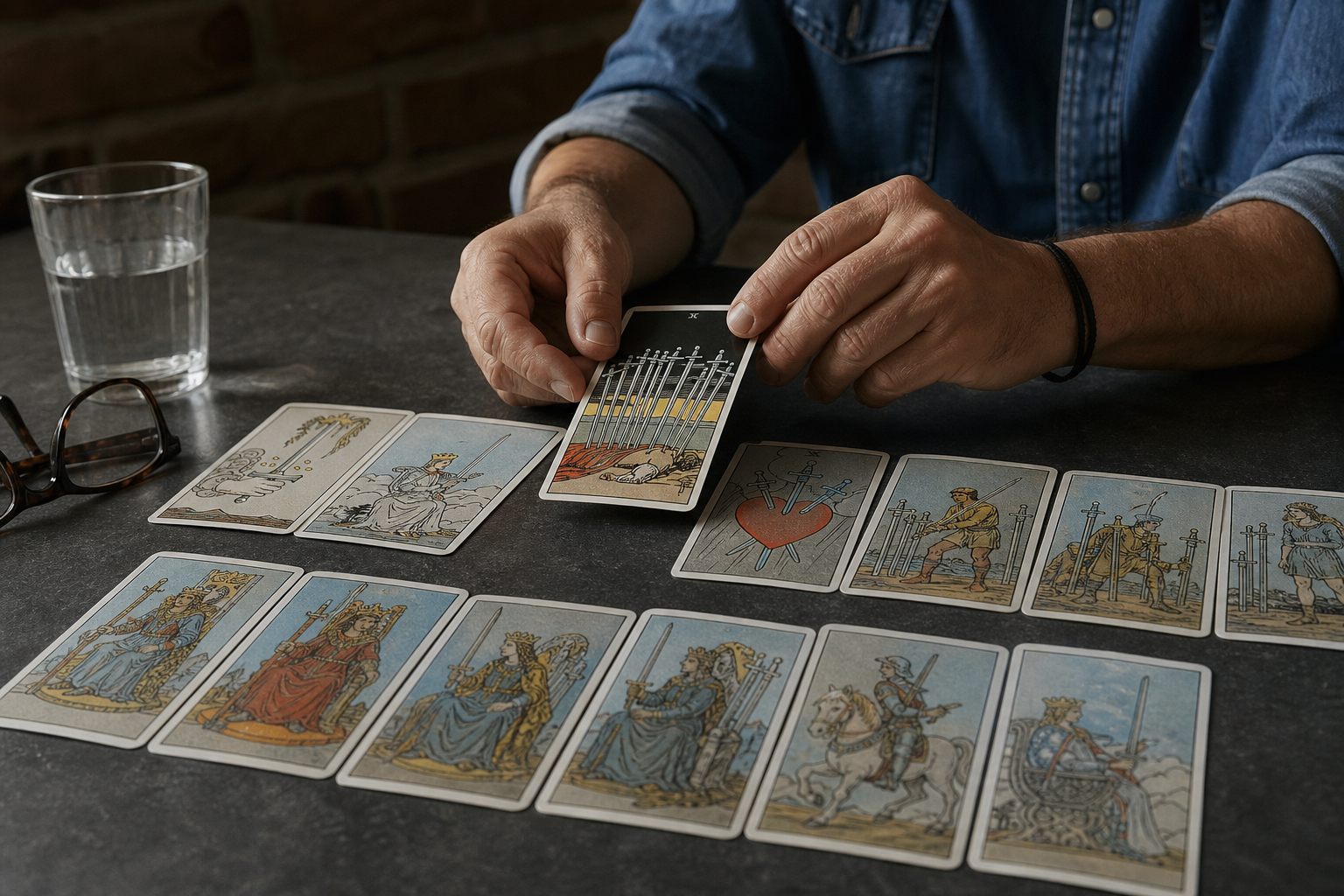
The Suit of Swords is one of the four suits of the Minor Arcana, running from the Ace to the King, fourteen cards in all. In the Rider-Waite-Smith tradition the Swords stand for the life of the mind: thoughts, words, decisions, arguments and the search for what is true. That is why the suit holds some of the sharpest images in the deck, such as the heart pierced by three blades and the figure lying under ten of them. None of those pictures is a forecast. A Swords card describes a way of thinking about a situation, and the difficult ones point to grief, worry or endings that you can look at calmly and work through. Tarot cannot tell you whether someone is lying, predict a quarrel or set a date for a decision. This page gives you every Swords card with upright and reversed keywords, shows how the suit differs from Wands, Cups and Pentacles, and walks through the hard cards one at a time.
If you pick up a tarot deck and sort it by suit, the Swords pile is the one most people hesitate over. The images drawn by Pamela Colman Smith for the 1909 Rider-Waite-Smith deck give this suit storm clouds, grey skies and a lot of blades. There is a reason. The four suits were part of a card game long before anyone read them, as Britannica’s history of tarot explains, and swords, cups, coins and batons were simply the suit signs used in Italy in the 1430s. When later readers attached meanings, the Golden Dawn tradition assigned each suit an element. Swords became air, the element of thought and speech, and the pictures were drawn to show what thinking feels like from the inside: sometimes clear and bright, sometimes anxious, sometimes cutting.
What the Swords are about
Four words cover most of the suit. The first is thought: ideas, plans, analysis and the stories we tell ourselves about what is happening. The second is conflict, because thinking often means disagreement, with other people or with ourselves. The third is clarity, the moment when the fog lifts and a decision becomes obvious. The fourth is truth, which the Swords treat as something worth the discomfort of finding out. When a Swords card appears, a good first question is not what will happen but what am I telling myself about this, and is it accurate.
The suit corresponds to Spades in an ordinary deck of playing cards, which is why readers who use cartomancy translate between the two so easily. In the Golden Dawn correspondences the Swords are also linked to the air signs Gemini, Libra and Aquarius. That pairing is a tradition used by some readers, not a statement about people born under those signs.
Reading a Swords card in four steps
- Name the thoughtSay out loud the belief or story the card seems to describe. The Eight of Swords, for example, usually names a belief that there is no way out.
- Find the conflictAsk who or what the thought is in tension with: another person, a fact, an older version of yourself.
- Check the clarityDecide whether the thought is sharp and useful, like the Ace, or clouded and repetitive, like the Nine.
- Choose the truthful stepPick one honest, practical action that follows from what the card helped you see.
Swords cards reward this kind of plain questioning more than any other suit.
The Suit of Swords, Ace to King
The table lists what each card shows in the Rider-Waite-Smith image and the keywords most guidebooks attach to it. Treat them as conventions, not rules, and let the picture speak first.
| Card | What the image shows | Upright keywords | Reversed keywords |
|---|---|---|---|
| Ace of Swords | A hand from a cloud holds an upright sword topped with a crown | Clarity, breakthrough, a new idea, truth | Confusion, a muddled plan, misused words |
| Two of Swords | A blindfolded woman holds two crossed swords before a calm sea | Stalemate, a decision avoided, an uneasy truce | Pressure to choose, new information, indecision ending |
| Three of Swords | A red heart pierced by three swords under rain clouds | Heartbreak, grief, a painful truth | Healing, releasing pain, forgiveness |
| Four of Swords | A knight lies still on a tomb with three swords on the wall above | Rest, recovery, a deliberate retreat | Restlessness, burnout, returning to action |
| Five of Swords | A man gathers swords while two others walk away under a ragged sky | Conflict, a hollow win, victory at a cost | Reconciliation, letting a grudge go, regret |
| Six of Swords | A ferryman rows a woman and child across water with six swords in the boat | Transition, moving on, calmer water ahead | Unfinished business, resisting a move, old baggage |
| Seven of Swords | A man tiptoes away from a camp carrying five swords and leaving two | Strategy, stealth, acting alone | Coming clean, getting caught, a conscience at work |
| Eight of Swords | A bound, blindfolded woman stands among eight swords near a castle | Feeling trapped, restriction, self-limiting beliefs | Release, a new perspective, the blindfold coming off |
| Nine of Swords | A person sits up in bed with head in hands, nine swords on the wall | Anxiety, worry, sleepless nights | Worry easing, facing a fear, asking for help |
| Ten of Swords | A figure lies face down with ten swords in the back as dawn breaks | An ending, rock bottom, a painful finish | Recovery, the worst behind you, refusing to let go |
| Page of Swords | A young person holds a sword aloft on a windy hill | Curiosity, new ideas, watchfulness | Gossip, hasty words, scattered thinking |
| Knight of Swords | A knight charges forward with sword raised through a windswept sky | Speed, directness, driving ahead | Recklessness, impulsiveness, rushing in |
| Queen of Swords | A queen in profile holds her sword upright and extends her other hand | Clear judgement, honesty, independence | Coldness, harshness, bitterness |
| King of Swords | A king faces forward on a throne carved with butterflies, sword slightly tilted | Authority, truth, intellectual power | Misuse of power, manipulation, rigidity |
How the four suits differ
Swords make more sense when you see them next to the other three suits. Each suit describes the same situation from a different angle, and the fastest way to read a Minor Arcana card is to ask which angle it is taking.
| Suit | Element (tradition) | Playing-card suit | What it describes | The question it raises |
|---|---|---|---|---|
| Wands | Fire | Clubs | Energy, ambition, work, creativity | What do I want to do? |
| Cups | Water | Hearts | Feelings, relationships, intuition | How do I feel about it? |
| Swords | Air | Spades | Thoughts, words, decisions, conflict | What do I think, and is it true? |
| Pentacles | Earth | Diamonds | Money, the body, practical matters | What will it cost and what will it build? |
A worked example shows the difference. Suppose someone asks about a job offer. The Three of Wands would describe the ambition and the long view. The Two of Cups would describe how they feel about the people involved. The Four of Pentacles would describe the money and the fear of letting go of what they have. The Two of Swords would describe the stalemate in their head: two good arguments, a blindfold, and no decision yet. Same job, four angles. The Swords angle is the one that asks you to think it through honestly.
The difficult Swords cards, handled calmly
Five cards in this suit frighten beginners, and all five are easier than they look once you know what the picture is doing.
Three of Swords
The heart with three blades through it is the most literal image in the deck, and that is why it lands so hard. In the tradition it stands for heartbreak, grief and the pain of a truth said out loud. It does not announce a betrayal or predict a break-up. In practice it most often describes a hurt that has already happened and is still being felt, and the rain in the background is read as the start of the clearing. The useful question is what truth hurt, and whether it has been fully heard.
Five of Swords
One man holds three swords and looks over his shoulder at two others walking away. Readers argue about whether the figure in front is the winner or the one left behind. Either way, the card is about a conflict where winning cost more than it was worth. It is a prompt to ask whether a point you are determined to make is worth the relationship it strains.
Eight of Swords
The woman in the Eight is tied and blindfolded, but the swords around her do not touch her and her feet are free. The tradition reads this as a trap made of thoughts: the belief that there is no way out, when the way out is simply to take a step. It is not a card about being imprisoned by other people. It is a card about a story that needs checking.
Nine of Swords
Someone sits up in bed in the dark with their face in their hands. This is the worry card: the 3 a.m. spiral, the replayed conversation, the dread that has no particular object. Note that the nine swords hang on the wall; none of them is hurting the person. In a reading it describes anxiety rather than a cause for it. If worry like this is a regular visitor rather than an occasional one, the right next step is not another spread but a conversation with a doctor or counsellor. The National Institute of Mental Health has a plain-language page on anxiety disorders that explains when worry crosses into something that deserves help.
Ten of Swords
The figure lies face down with ten swords along the spine, which looks like the worst card in the deck until you notice the dawn on the horizon and the calm water. The convention reads it as the end of something, fully and finally, with nothing left to fear from it. It is the Swords version of the Death card: a clean finish that makes room. It does not predict harm to anyone. When it appears, ask what has actually ended and what you are still holding on to out of habit.
How to read a spread full of Swords
- Notice the weather. Smith drew the Swords with changing skies: clear for the Ace and the Queen, stormy for the Three and the Five, grey for the Eight, dawn for the Ten. The sky is a quick read on the mood of each card before you touch the keywords.
- Count the suit. Three or more Swords in a five-card spread suggests the question is being thought about more than it is being felt or acted on. That is useful information, not a warning of arguments to come.
- Look for the turning cards. The Four (rest), the Six (transition) and the Ace (clarity) are the cards in the suit that move things forward. If one of them appears next to a difficult card, read it as the way through.
- Check who is holding the sword. In the court cards, the Page lifts it, the Knight charges with it, the Queen holds it still and the King rests it. Each describes a different relationship with the truth: curious, forceful, judicious or authoritative.
- Translate each card into a sentence you believe. The Two of Swords becomes: I have two good arguments and I am avoiding the choice. The Seven becomes: I am handling this alone and not telling anyone. Plain sentences keep the reading honest.
- End with one decision. The Swords are the suit of choices. Close every Swords-heavy reading by naming one small, truthful decision you can make this week.
Habits that keep the Swords useful
- Learn the suit as a story. Lay the ten numbered cards in a row: a bright idea (Ace), a stalled choice (Two), a painful truth (Three), a rest (Four), a fight (Five), a crossing (Six), a secret (Seven), a trap of thought (Eight), a sleepless night (Nine) and an ending (Ten). Told that way it is easy to remember.
- Pair a Swords card with its Cups neighbour. Drawing the Three of Cups beside the Three of Swords, for example, shows the same number from the feeling side, which often softens the reading in a useful way.
- Keep the court cards flexible. The Queen of Swords can be a person, a role you are playing or a mood of clear-eyed honesty. Decide which fits before you read her.
- Write down the sentence, not the keyword. A journal entry that says I am avoiding a decision about the lease is worth more than one that says Two of Swords, stalemate.
- Do not read the Swords as predictions of conflict. Nothing in the deck forecasts an argument, a lawsuit or a loss. The suit describes thinking, and thinking can change.
- Do not use the Swords to judge whether someone is lying. The Seven of Swords is about your own strategy, not evidence about another person. Tarot cannot read anyone’s mind.
- Do not let the Nine or the Ten stand in for help. Persistent anxiety and low mood are health matters. If you are having thoughts of harming yourself, call or text 988 (US).
- Do not read a Swords card about a legal or medical question as advice. Use it to clear your head, then take the question to a lawyer or a doctor.
Key takeaways
- The Suit of Swords is fourteen cards, Ace to King, read in the Rider-Waite-Smith tradition as the suit of thought, words, decisions and conflict.
- Swords are linked to the element of air and the playing-card suit of Spades; Wands, Cups and Pentacles describe the same situation from the angles of energy, feeling and practical life.
- The difficult cards (Three, Five, Eight, Nine, Ten) describe grief, hollow wins, mental traps, worry and endings. Each is a prompt to check a thought, never a forecast.
- In a Swords-heavy spread, look for the turning cards (Ace, Four, Six), translate each card into a plain sentence and close with one decision.
- Tarot cannot detect lies, predict arguments or replace professional help for anxiety, legal trouble or illness.
Related reading
- What Does the Queen of Swords Tarot Card Mean?
- Reading the Tarot Court Cards
- Interpreting Bad Tarot Cards
- Reading Reversed Tarot Cards
- The Fool’s Journey: All 22 Major Arcana Cards Explained
- Tarot Cards for Beginners
- Tarot and Mental Wellness
Frequently asked questions
1. What does the Suit of Swords mean in tarot?
In the Rider-Waite-Smith tradition the Swords describe the life of the mind: thoughts, words, decisions, conflict and the search for truth. A Swords card points to how a situation is being thought about rather than what will happen in it.
2. How many Swords cards are in a tarot deck?
Fourteen: the Ace through Ten, plus the Page, Knight, Queen and King. Together with the other three suits they make up the 56-card Minor Arcana.
3. Which element is linked to the Swords?
Air, in the Golden Dawn tradition that most modern guidebooks follow. A few older systems assign fire to the Swords instead, so it is a convention rather than a fixed rule.
4. Which playing-card suit matches the Swords?
Spades. Readers who use ordinary playing cards for cartomancy translate Swords to Spades, Cups to Hearts, Wands to Clubs and Pentacles to Diamonds.
5. Are Swords cards always negative?
No. The Ace, the Four, the Six, the Queen and the King are read as clarity, rest, transition, honesty and authority. Even the hard cards describe thoughts and feelings that can be worked through, not fixed outcomes.
6. What does it mean when a reading is mostly Swords?
Readers take it as a sign that the question is being analysed and argued over more than it is being felt or acted upon. It is a cue to think clearly and decide, not a prediction of quarrels or trouble.
7. Does the Three of Swords mean someone will break my heart?
No. The card describes grief or a painful truth, usually one that has already been felt. Tarot has not been shown to predict events in anyone’s relationship.
8. Does the Ten of Swords mean death or disaster?
No. The convention reads it as the complete end of a situation, with the dawn on the horizon showing that the worst is over. It does not predict harm to you or anyone else.
9. What does it mean if I keep drawing the Nine of Swords?
The card describes worry and sleepless nights. Drawing it often usually means worry is on your mind, which the cards reflect back. If the worry is persistent, talking to a doctor or counsellor is a better next step than another spread.
10. What is the difference between the Queen of Swords and the King of Swords?
Both stand for clear thinking and honesty. The Queen is read as judgement shaped by experience, often independent and direct; the King is read as authority and intellectual power applied to decisions and rules.
11. How do reversed Swords cards work?
Most readers treat a reversal as the blocked, easing or inward version of the upright meaning. For the difficult cards that often means relief: the Three reversed as healing, the Eight reversed as release, the Nine reversed as worry easing.
12. Which zodiac signs are linked to the Swords?
Gemini, Libra and Aquarius, the air signs, in the Golden Dawn correspondences. That is a tradition some readers use for flavour, not a statement about people born under those signs.
13. Can the Swords tell me if someone is lying to me?
No. The Seven of Swords describes strategy or secrecy as a theme, usually your own, and no card can read another person’s mind or detect deception.
14. Is the Ace of Swords a good card?
By convention, yes. It stands for clarity, a breakthrough idea and the truth coming into focus. Reversed, it points to a plan that is still muddled or words that have been used carelessly.
15. What does the Two of Swords say about a decision?
It describes a stalemate: two good arguments, a blindfold and no choice made yet. The card invites you to take the blindfold off by gathering one more piece of information or admitting what you already prefer.
16. What is the Seven of Swords warning me about?
In the tradition it is about acting alone, keeping something quiet or taking a shortcut. The useful question is whether handling it privately is wise or whether it is time to tell someone.
17. Does the Six of Swords mean I should move or leave a relationship?
Not literally. The card describes a transition toward calmer water that is already under way. It can prompt you to think about what you are leaving behind, but the decision is yours to make with the facts in front of you.
18. What do the Swords court cards represent?
The Page, Knight, Queen and King of Swords can be read as a person, a role you are playing or a mood. All four share the suit’s themes of thought and truth: the Page is curious, the Knight is forceful, the Queen is judicious and the King is authoritative.
Evidence note: The card meanings on this page are interpretive conventions attached to the Rider-Waite-Smith deck (1909) and the guidebooks that follow it; the element and zodiac correspondences come from the Golden Dawn tradition. Tarot has not been shown to predict events, read minds or detect lies. Historical details are drawn from Britannica’s entry on tarot, and the guidance on worry is from the National Institute of Mental Health. If you are feeling persistently anxious or low, or having thoughts of harming yourself, call or text 988 (US) to reach the Suicide and Crisis Lifeline.