
The Fool’s Journey is a way to learn the 22 Major Arcana as a connected story. You follow the Fool through images of skill, care, choice, change and completion, rather than memorising an isolated list.
You may approach the cards spiritually, reflectively or both. The story offers a language for exploring experience; it does not establish what will happen or which stage of life you must be in. This guide uses the Rider–Waite–Smith order, with the Fool at 0 and the World at 21.
A little history, before the story
A standard modern tarot deck has 78 cards: 22 Majors and 56 suit cards. Early tarot belonged to fifteenth-century northern Italian card games, with the Fool alongside 21 trumps. The Met’s history of tarot cards explains that structure. Later reading traditions gave the pictures other uses and meanings.
The familiar Rider–Waite–Smith pictures were illustrated by Pamela Colman Smith. The V&A’s tarot collection overview shows that style alongside other traditions. This page’s keywords are contemporary interpretive starting points, not a claim that every deck or historical writer gives the same meaning.
A four-part memory map
Keep the Fool as the traveller, then group cards 1–21 into three chapters. This is one study arrangement, not a universal division of the deck. A memory map—not a timetable.
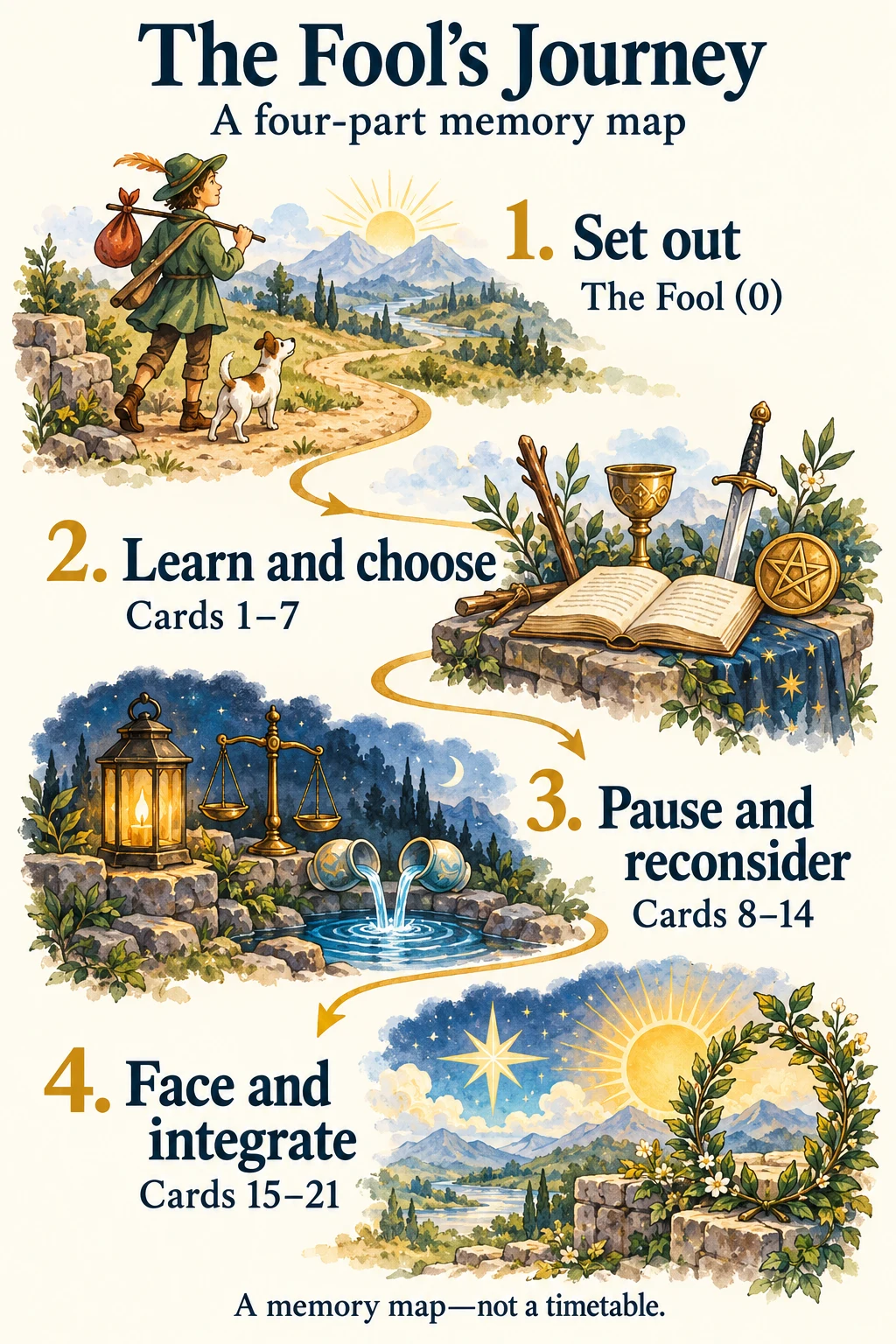
- Set out — The Fool (0). Meet the traveller before the numbered lessons begin. Curiosity can coexist with preparation.
- Learn and choose — Cards 1–7. Follow the Magician through the Chariot: tools, intuition, care, structure, teaching, values and direction.
- Pause and reconsider — Cards 8–14. Read Strength through Temperance as a sequence about patience, perspective, changing conditions, responsibility, endings and balance.
- Face and integrate — Cards 15–21. Follow the Devil through the World: attachment, disruption, hope, uncertainty, clarity, review and integration.
All 22 Major Arcana cards, in order
Read a card’s picture, then try its keywords in the context of a question. The reversal column offers possibilities if you use reversals; it does not describe a verified blockage, a diagnosis or a future delay. You may use your deck’s booklet or read all cards upright.
Numbering note: this RWS order places Strength at 8 and Justice at 11. Other deck traditions may swap them. Waite explicitly notes the interchange in his discussion of Strength; the numbering is not a ranking of spiritual worth.
0. The Fool
Look for: A traveller, small dog, rose and cliff edge.
- Upright lens
- New beginnings, openness, a leap of faith
- Reversal lens
- Recklessness, hesitation, poor timing
Ask: What could I begin, and what preparation would help?
1. The Magician
Look for: A raised wand and four suit tools on a table.
- Upright lens
- Skill, focus, having the tools you need
- Reversal lens
- Scattered effort, manipulation, unused talent
Ask: Which skill or resource can I use deliberately?
2. The High Priestess
Look for: A seated figure between dark and light pillars, with a scroll.
- Upright lens
- Intuition, stillness, inner knowing
- Reversal lens
- Ignored instincts, secrets, surface thinking
Ask: What needs quiet attention before I respond?
3. The Empress
Look for: A crowned figure, wheat and a richly growing landscape.
- Upright lens
- Nurturing, abundance, creativity
- Reversal lens
- Smothering, creative block, self-neglect
Ask: What would nourish this project or relationship?
4. The Emperor
Look for: A stone throne decorated with rams’ heads.
- Upright lens
- Structure, authority, stability
- Reversal lens
- Rigidity, control, lack of discipline
Ask: Which boundary or structure would be useful?
5. The Hierophant
Look for: A teaching figure, two followers and crossed keys.
- Upright lens
- Tradition, learning, shared values
- Reversal lens
- Questioning rules, personal beliefs, dogma
Ask: Which teaching supports me, and which deserves questioning?
6. The Lovers
Look for: Two figures beneath an angel, with contrasting trees.
- Upright lens
- Choice, partnership, alignment of values
- Reversal lens
- Disharmony, mismatched values, avoiding a choice
Ask: What choice would fit my values?
7. The Chariot
Look for: A driver above two differently coloured sphinxes.
- Upright lens
- Determination, control, momentum
- Reversal lens
- Lack of direction, forcefulness, stalled progress
Ask: Where do I need direction rather than more force?
8. Strength
Look for: A woman and a lion beneath an infinity symbol.
- Upright lens
- Patience, courage, gentle influence
- Reversal lens
- Self-doubt, raw emotion, loss of nerve
Ask: How could I respond with steadiness rather than pressure?
9. The Hermit
Look for: A cloaked figure carrying a lantern and staff.
- Upright lens
- Reflection, solitude, searching
- Reversal lens
- Isolation, withdrawal, loneliness
Ask: What might some quiet reflection help me notice?
10. Wheel of Fortune
Look for: A turning wheel surrounded by symbolic figures.
- Upright lens
- Change, cycles, a turning point
- Reversal lens
- Resistance to change, revisiting a pattern
Ask: What can I influence as circumstances change?
11. Justice
Look for: A seated figure holding scales and an upright sword.
- Upright lens
- Fairness, cause and effect, accountability
- Reversal lens
- Unfairness, avoiding responsibility, bias
Ask: Which facts and responsibilities deserve a fair hearing?
12. The Hanged Man
Look for: A calm suspended figure with a halo.
- Upright lens
- Pause, surrender, a new viewpoint
- Reversal lens
- Stalling, resistance, needless sacrifice
Ask: Would a pause reveal another point of view?
13. Death
Look for: An armoured skeleton on a white horse with a rose banner.
- Upright lens
- Endings, transformation, release
- Reversal lens
- Clinging to the past, stagnation, fear of change
Ask: What ending or transition am I trying to understand?
14. Temperance
Look for: An angel pouring between cups, one foot in water.
- Upright lens
- Balance, moderation, patience
- Reversal lens
- Excess, imbalance, impatience
Ask: What would a more workable balance look like?
15. The Devil
Look for: Two chained figures beneath a horned figure.
- Upright lens
- Attachment, habit, materialism
- Reversal lens
- Release, regaining control, facing a habit
Ask: Where might I need support with pressure or an attachment?
16. The Tower
Look for: Lightning, a displaced crown and falling figures.
- Upright lens
- Sudden change, upheaval, revelation
- Reversal lens
- Resisting disruption, considering repair
Ask: Which assumption would be worth checking?
17. The Star
Look for: A figure pouring water beneath a large star and smaller stars.
- Upright lens
- Hope, renewal, calm
- Reversal lens
- Discouragement, loss of faith, disconnection
Ask: What could help me recover hope in an ordinary way?
18. The Moon
Look for: A moon above two towers, a dog, a wolf and a crayfish.
- Upright lens
- Uncertainty, illusion, intuition
- Reversal lens
- Examining confusion, questioning an impression
Ask: What is unclear, and what information would help?
19. The Sun
Look for: A child on a white horse, sunflowers and a bright sun.
- Upright lens
- Joy, success, clarity
- Reversal lens
- Muted enjoyment, overconfidence, a need for perspective
Ask: What can I appreciate without overlooking the details?
20. Judgement
Look for: A trumpet-bearing angel above rising figures.
- Upright lens
- Reckoning, awakening, a call to act
- Reversal lens
- Self-doubt, refusing the lesson, harsh self-judgement
Ask: What deserves an honest review before I respond?
21. The World
Look for: A dancer within a wreath, with four figures in the corners.
- Upright lens
- Completion, integration, achievement
- Reversal lens
- Loose ends, incompletion, delay
Ask: What is complete enough to acknowledge, and what have I learned?
The story in three acts
Lay out your own cards if you have them. Read the following as a possible story linking their images, rather than instructions to make your life match the sequence.
Act 1: learning to meet the world (0–7)
Imagine the Fool as a traveller holding a question rather than a fixed destiny. The Magician brings attention to tools and practice; the High Priestess introduces the value of listening. Care takes shape with the Empress, while the Emperor asks what structure can protect it. The Hierophant brings teachers and shared traditions into the story. The Lovers raises the question of values, and the Chariot gathers attention into a direction.
This chapter can help you remember a new undertaking: What do I have? What do I need to learn? What will guide my choice? The cliff in the Fool’s picture is part of the image too; enthusiasm is not a reason to ignore practical risk.
Act 2: revising the first plan (8–14)
Strength offers a different kind of power from simply pushing ahead. The Hermit makes space for reflection, and the Wheel introduces changing conditions. Justice brings responsibility and a fair look at the facts. The Hanged Man interrupts momentum with a different viewpoint. Death gives an ending a place in the story, and Temperance explores how parts might work together.
These are possible chapters, not compulsory trials. Solitude need not mean refusing support, a pause need not become endless waiting, and an ending does not require an immediate happy replacement. You can revisit any of these images without claiming to have reached a particular spiritual rank.
Act 3: making room for a wider view (15–21)
The Devil and the Tower bring attachments and disruption into view; the Star offers an image of renewed hope. The Moon makes room for uncertainty, the Sun for openness and enjoyment, and Judgement for taking stock and responding. The World gathers the sequence into an image of completion and connection.
Do not turn this chapter into blame or a test you must endure. The Devil’s pictured chains do not mean that leaving a harmful situation is easy. The Tower does not prove someone built their life badly, and the Moon does not tell you to press forward without information. A hopeful ending is useful as a story shape, not a promised outcome.
When a reading contains many Major cards
A theme-focused reading can feel compelling. Keep your original question, the positions you chose and what you actually know in view. More Majors does not make a prediction more certain.
- Notice the mix. Count the Major cards without treating the total as a warning. A Major-heavy spread can be read thematically, but the count does not measure how serious your situation is.
- Keep the positions. Read each card in its assigned role: a past position, an option or something to consider. Number order does not turn a spread into a timeline.
- Let Majors and Minors work together. A Major can suggest a broad theme; a suit card can offer a more everyday angle. Neither establishes an event or someone else’s hidden intention.
- Compare, rather than combine into a prediction. Ask how the images differ. Death with the Tower might invite two questions about endings and disruption, not prove that an unwanted change is coming.
- Write a question beside the theme. “What needs checking?” is more useful than treating a dramatic card as a verdict. Include an observation or a practical detail you can verify.
- Choose a proportionate response. You can ask for information, seek support, take a small action or leave the reading unresolved. Moving quickly is not a requirement of the story.
Three ways to turn a pair into a useful question
The Tower with Three of Pentacles
Possible theme: assumptions about a shared project.
Question: Have we agreed who is doing what?
Check: review the actual plan with the people involved, rather than infer that the team is about to fail.
The Hermit with the Hanged Man
Possible theme: reflection and a pause.
Question: Would time to think help, or am I avoiding a conversation?
Check: decide whether there is a real deadline or support need before postponing something.
The Star with the Sun
Possible theme: hope and enjoyment.
Question: What is encouraging me, and what still needs attention?
Check: acknowledge something good without treating the pair as a guarantee of success.
For more help with unsettling images, see interpreting difficult tarot cards. You do not have to force a reassuring interpretation, and you do not have to treat a frightening one as a forecast.
A manageable way to study the journey
- Learn in small groups. Start with the Fool and cards 1–7, then add the next group. Say a keyword and point to one feature in each picture.
- Separate noticing from interpreting. Write “a lantern” before “I need solitude”. Keeping those two notes apart lets you revisit an interpretation.
- Use a short journal entry. Record the question, card, position, possible meaning and what you later observed. Include readings that did not fit.
- Allow a different response. A card you dislike need not reveal a hidden lesson. You can explore the reaction, put the deck away or return when you feel steadier.
Try one card for “a theme to consider today”, or three positions: “what I am noticing”, “another viewpoint” and “a practical response”. Record an interpretation and revisit it alongside what happened, including any mismatch. The practice is complete even if you decide not to act.
Frequently asked questions
1. What is the Fool’s Journey in tarot?
It is a teaching story that links the Major Arcana in sequence, using the Fool as a traveller. It can help you remember images and explore a question. It is not a timetable or a required path through life.
2. How many Major Arcana cards are there?
A standard modern tarot deck has 22 Major Arcana cards, usually numbered 0–21. The Fool is 0 and the World is 21 in the Rider–Waite–Smith order used here.
3. Why is the Fool numbered zero?
Zero gives the Fool a position apart from the sequence 1–21 in many modern reading decks. Historically, the Fool had a special role alongside the 21 trumps in the game. Some decks leave the Fool unnumbered.
4. Is the Fool’s Journey ancient tarot history?
The early cards were used for play; the traveller’s connected learning story is a modern interpretive approach. It is useful to distinguish the history of the objects from a story you use to study them.
5. Why do Strength and Justice change places in some decks?
Rider–Waite–Smith uses Strength at 8 and Justice at 11. Many Marseille-style decks use Justice at 8 and Strength at 11. Follow the printed order and guidebook of your deck rather than treating one numbering as an error.
6. Does a Major Arcana card mean a major event will happen?
No draw establishes that an event is coming. Reading Majors as broad themes is a convention you can use to shape reflection, not evidence about the size or timing of a future event.
7. What if most of my spread is Major Arcana?
Keep the positions and your original question. Read the themes together, then ask what information or support would be useful. The number of Majors is not a score for fate, danger or spiritual importance.
8. Which Major Arcana cards can feel difficult?
Death, the Tower, the Devil and the Moon can look unsettling. You can explore endings, disruption, attachment or uncertainty without treating the picture as a sentence. Context matters more than a frightening keyword.
9. Does Death predict someone’s death?
A tarot draw is not a reliable basis for predicting a death. Contemporary reflective readings often explore endings and transition. Historical divinatory lists vary, so it is also inaccurate to claim that every writer has always used only a symbolic meaning.
10. Must I memorise all 22 cards at once?
No. Learn a small group, notice the pictures and practise turning one theme into a question. Use a reference when you need it. There is no required speed or test of spiritual ability.
11. How do the Major and Minor Arcana differ?
The Majors are the 22 named cards. The 56 Minors belong to Wands, Cups, Swords and Pentacles in this deck style, with Ace through Ten and Page, Knight, Queen and King in each suit.
12. Can I read with only the Major Arcana?
Yes. Set the Minors aside if you want a theme-focused exercise, and choose positions before drawing. You do not need to interpret a Major-only deck as evidence that everything in the reading is a major life event.
13. How should I read reversed Major cards?
Choose a method before the reading. You might consider an inward, resisted, excessive or underexpressed theme, or use your deck’s guidebook. Reversal is not universally a delay, an opposite or a worse outcome. You can also read without reversals.
14. Which Major card is the best?
No card is best for every question or position. A cheerful image can still invite a practical check, while a challenging one can raise a useful question. Avoid choosing extra cards until you get a preferred answer.
15. Does every deck tell the same journey?
No. Names, numbering, artwork and interpretation vary. Marseille and Thoth traditions differ from Rider–Waite–Smith in important ways. This four-part map is one learning arrangement, not a universal doctrine that every deck must follow.
16. Can the journey identify my life stage?
You can choose an image that helps describe how something feels now. That comparison comes from your interpretation; the card does not establish your age, spiritual level or place on a fixed life path.
17. Where did tarot cards come from?
Surviving early tarot decks and records belong to fifteenth-century northern Italy. They were playing cards before later divination traditions developed. The Met’s collection history explains the Fool, the 21 trumps and the suit cards.
18. Why can an image feel personally meaningful?
Your memories, current concerns, beliefs and associations can give a picture personal significance. You can value that experience while checking whether the interpretation fits specific facts, rather than taking resonance alone as proof that a claim is true.
19. Can I use a reading for health, legal or financial questions?
You can name feelings or questions to discuss, but use appropriate qualified advice and real-world information for the decision itself. A card cannot diagnose an illness, determine legal rights or verify whether an investment is suitable.
If a reading leaves you distressed, pause and reach out to someone you trust. If you are in emotional crisis or having thoughts of harming yourself in the United States, call or text 988 for the Suicide & Crisis Lifeline. A tarot interpretation is not a reason to face a crisis alone.
Continue with the cards that interest you
Learn the pictures; leave room for your own response
Use the order to remember the cards, the images to ask better questions and your own observations to assess what fits. You can return to any chapter without treating it as a step you have passed or failed.
For a fuller starting routine, continue with Tarot Cards for Beginners.
[…] Tarot and the Fool’s Journey: the 22 Major Arcana in order […]