

Quick guide
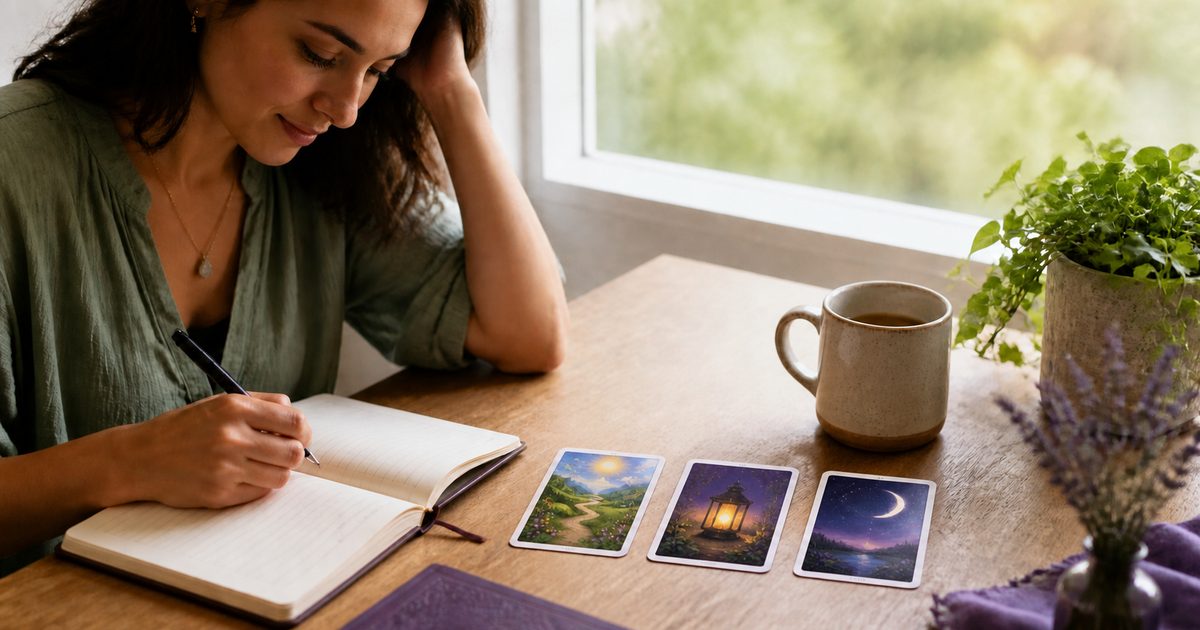
Tarot can be a useful prompt for reflection. A card is a picture with a long tradition of meanings attached to it, and looking at that picture for a few quiet minutes can help a person notice a feeling, name a worry, or ask a question they had been avoiding. That is what tarot offers a wellness routine. What tarot is not: it is not therapy, it is not a diagnosis, and it is not a treatment for anxiety, depression, or any other condition. A reading cannot see the future, read another person’s mind, confirm a pregnancy, diagnose an illness, pick lottery numbers, or guarantee an outcome. People who get the most from tarot treat it as a journaling tool: one card, a few lines about what they see, a comparison with what is actually going on, and one small step. If they work with a therapist or doctor, that care stays in charge and the journal comes along as material to discuss. If symptoms are heavy, persistent, or frightening, the right move is a doctor, a therapist, or the 988 Suicide and Crisis Lifeline, not another card. This guide explains how to keep the practice in its proper place.
Why a picture on a card can help you think
Most of us find it hard to describe what we feel while we are feeling it. A tarot card gives you something outside yourself to look at and react to. The Five of Pentacles shows two figures walking past a lit window in the snow; the Star shows a woman pouring water under a night sky. Nobody needs to believe the cards carry hidden power to notice that one image makes them think of being shut out and the other of relief after a hard stretch. That reaction is the useful part.
Used this way, tarot works like a set of writing prompts with pictures attached. The traditional meanings, most of which trace to the Rider-Waite-Smith deck of 1909, give you a vocabulary: beginnings, loss, patience, conflict, rest. You borrow it to describe your own week. The card does not tell you anything; you tell yourself something, with the card as a starting point, and the journal entry is where the value lands.
What tarot is not
This has to be said plainly once, because vague wellness language can blur it. Tarot is not psychotherapy. Therapy is delivered by a licensed professional who assesses, plans, and is accountable for the care they give. Tarot is not a diagnostic tool; no card, spread, or reader can tell you whether you have anxiety, depression, ADHD, or anything else. Tarot is not a treatment for any condition, and there is no evidence that it changes the course of a mental illness.
Ideas like energy, intuition, the universe sending signs, or a card carrying a message are interpretive frameworks. Many people find them meaningful, and this site treats them with respect, but they are not established facts and they should never be the reason someone delays or stops professional care. If a reader ever tells you that a card shows you are ill, that you should stop a medication, or that a ritual will lift a low mood, that is a reason to leave. Your feelings are real. The card is a picture.
Reflective uses and harmful uses side by side
The same deck can be used well or badly, and the difference is usually in the question and the follow-up. The table below pairs common reflective uses with the harmful version of the same habit, so you can check your own practice against it. If you recognize yourself in the right-hand column more than once, that is worth noticing, and worth mentioning to a professional if you already see one.
| Reflective use | Harmful use | What keeps it on the healthy side |
|---|---|---|
| Drawing one card as a journaling prompt | Drawing cards again and again until one feels reassuring | One draw, one entry, then close the deck |
| Asking what you might be avoiding | Asking the cards whether you are sick or depressed | Health questions go to a doctor or therapist |
| Using a card to name a feeling | Treating a card as proof the feeling is justified or fated | Compare the card with facts from your actual week |
| Preparing questions for a therapy session | Using cards instead of a session you need | Tarot sits beside care, never in front of it |
| Choosing one small action after a draw | Making major decisions on a card alone | Cards prompt thinking; facts and advice decide |
| Spending on a deck you enjoy | Paying a reader to remove a curse or block | Curse removal is a scam; report it to the FTC |
How people use tarot alongside professional care
Some people who see a therapist or counselor also keep a tarot journal, and the two can sit together comfortably as long as the roles are clear. The therapist is responsible for care. The deck is a private tool for noticing. A person might draw a card on Sunday evening, write two paragraphs about why the Eight of Swords made them think of the argument they keep replaying, and then bring that page to their Tuesday appointment as something concrete to discuss. The card did not diagnose anything; it produced a page of honest writing that a professional can work with.
A few guardrails matter. Never ask the cards about medication, dosage, or whether to keep an appointment; those questions belong to the prescriber. Do not let a reading talk you out of a plan made with a professional. Tell your therapist you use tarot if it comes up; many clinicians welcome any reflective habit a client keeps. If one advises stepping back from it for a while, take that seriously.
- 1. ObserveDraw one card. Describe what is in the picture before you look up any meaning.
- 2. NameWrite the feeling or situation the image brings to mind, in one plain sentence.
- 3. Reality-checkAsk what in your actual week supports or contradicts that reaction.
- 4. One stepChoose a single small action: a text, a walk, a call, a rest, a question for your doctor.
A simple five-minute check-in
This practice is deliberately small: one card, a pen, about five minutes, and it works whether you know all 78 cards or none. The aim is to leave with a sentence about yourself you did not have before, not a prediction. If you feel worse afterward rather than clearer, stop for the day and talk to someone. For more on wording, see the guide to tarot questions to never ask.
- Settle: sit somewhere quiet, take three slow breaths, and write the date at the top of a page.
- Ask a reflective question: for example “What needs my attention this week?” Avoid yes-or-no questions and anything about health, medication, or another person’s mind.
- Draw one card and describe it in two or three lines: figures, posture, colors, weather, objects.
- Write your first association without a guidebook. What memory, worry, or hope does the image touch?
- Check it against reality: list one fact that supports the association and one that cuts against it.
- Choose one step you can take within 24 hours, and write it down so you can look back later.
- Close the deck. One draw is the whole exercise. Do not pull a second card to get a better answer.
When to seek help
Tarot is for ordinary reflection on an ordinary week. It is the wrong tool when a mood has settled in and will not lift, when worry disrupts sleep, work, or relationships, or when you have any thought of harming yourself. Then the next step is a person, not a card. In the United States you can call or text the 988 Suicide and Crisis Lifeline at any hour; if someone is in immediate danger, call 911. A family doctor can refer you, and the National Institute of Mental Health pages on anxiety disorders and depression explain what treatment involves and how to find it.
The table below is not a diagnostic checklist. It is a way to pause and ask whether you are using a reflective tool for a problem that needs more than reflection.
| What you notice | Where it belongs | What to do |
|---|---|---|
| A restless or flat day, nothing alarming | Reflection, journaling, a walk, a call to a friend | A one-card check-in is fine |
| Low mood or worry most days for two weeks or more | A doctor or therapist | Book an appointment; keep journaling if it helps |
| Panic, sleep loss, or trouble functioning at work or home | A doctor or therapist, soon | Skip the cards; make the call |
| Thoughts of self-harm or suicide | Crisis support now | Call or text 988, or 911 if in immediate danger |
| Fear, control, or threats in a relationship | Safety planning | National Domestic Violence Hotline 1-800-799-7233 or text START to 88788 |
| A reader says you are ill, cursed, or must stop treatment | Nowhere; leave | End the session; report fraud to the FTC |
Key takeaways
- Tarot can serve as a journaling prompt: a picture you react to, write about, and check against your real week.
- It is not therapy, not a diagnosis, and not a treatment for anxiety, depression, or anything else.
- Keep professional care in charge. Never ask cards about medication or use them in place of an appointment.
- One card, one question, one entry. Re-drawing for reassurance is the habit most likely to make things worse.
- Reading while upset or panicked is a signal to put the deck down and talk to someone.
- Persistent low mood, worry that disrupts life, or any thought of self-harm means 988, a doctor, or a therapist, not a reading.
Related reading
- Using tarot to battle anxiety: what it can and cannot do
- Using tarot cards in your darkest hour: reflection, not rescue
- How to use tarot when times are hard
- Using tarot cards to support your wellbeing routine
- Tarot meditation: a calm way to sit with a card
- How affirmations can help keep you steady
- How accurate are tarot card readings?
- Tarot questions you should never ask
Frequently asked questions
1. Can tarot improve mental health?
Tarot can support a reflective habit such as journaling, and reflection is good for many people. That is different from improving mental health in a clinical sense. There is no evidence that tarot treats or prevents any condition. If mood or worry has been heavy for weeks, see a doctor or therapist and keep the deck as an optional extra.
2. Is tarot a form of therapy?
No. Therapy is delivered by a licensed professional who assesses your situation, plans care with you, and is accountable for it. Tarot is a set of illustrated cards with traditional meanings that some people use as prompts for thinking and writing. The two can coexist, with the therapist in charge, but a reading is never a session.
3. Can a tarot reading diagnose anxiety or depression?
No card, spread, or reader can diagnose anything. Anxiety and depression are diagnosed by clinicians using criteria, conversation, and sometimes screening tools. If a reader says a card shows you have a condition, end the session. The National Institute of Mental Health explains how these conditions are actually assessed and treated.
4. Does tarot treat anxiety?
No. Some people feel calmer after ten quiet minutes with a card and a journal, and that calm is real, but it comes from slowing down and writing, not from the deck. Anxiety that disrupts sleep, work, or relationships is treated with therapy, sometimes medication, and changes guided by a professional. Tarot is not on that list.
5. How do people use tarot as a journaling prompt?
They draw a single card, describe what is in the picture, write the first feeling or memory it brings up, and then compare that reaction with the facts of their week. The entry ends with one small action. The card supplies an image; the person supplies the meaning. Reviewing entries a month later is often where the insight shows up.
6. What is a good reflective question to ask the cards?
Open questions about your own attention, values, or next step work best: what needs my attention, what am I avoiding, what would rest look like today, what is one thing I can control here. Avoid yes-or-no questions, questions about health or medication, and any question about what another person thinks or feels.
7. Can I use tarot while I am in therapy?
Many people do, and it can work well when the roles are clear. Your therapist is responsible for your care; the deck is a private tool for noticing. Bringing a journal entry sparked by a card to a session gives you concrete material to discuss. Mention the practice to your therapist, and if they suggest a break from it, take that seriously.
8. Should I ask the cards whether to stop my medication?
Never. Medication decisions belong to the prescriber, and stopping some medicines suddenly can be dangerous. A card cannot know what you take or why. If a reader suggests a card means you should change a treatment, leave. The right question for the cards is how you feel about a conversation with your doctor, not what the doctor should decide.
9. Is a daily card pull healthy?
It can be a calm daily ritual if it stays optional and low-pressure, like a morning page in a journal. It becomes a problem when you cannot start the day without it, when a card sets your mood for hours, or when you pull again and again to get a better one. If you notice any of those, take a week off and see how you feel.
10. What are the signs that tarot is making things worse?
Re-drawing for reassurance, reading late at night when panicked, spending money you cannot afford on readings, delaying medical or legal help because of a card, feeling watched or commanded by the deck, or being unable to make ordinary decisions without a reading. Any of these is a signal to put the deck away and talk to someone you trust or a professional.
11. Can a reading tell me what someone else is thinking or feeling?
No. A reading cannot read another person’s mind, and questions like whether a partner is cheating or whether a friend is angry set you up to invent an answer and act on it. Reframe toward your own choices: what do I want to say to this person, and what would I do either way. Then ask them directly.
12. What should I do if a card brings up something painful?
Close the deck. Put your feet on the floor, name five things you can see, and drink some water. Write a few lines if it helps, then contact a trusted person. If the material is heavy, bring the entry to a therapist rather than working it out through more cards. The deck should always be something you can put down.
13. Are ideas like energy, signs, and intuition real?
Feelings and experiences are real. Energy, signs from the universe, and messages in a card are interpretive frameworks that give those experiences a shape; many people find them meaningful, and this site treats them respectfully. They are not established facts and should never be the reason anyone delays care. You can enjoy the framework and still keep a doctor in charge of your health.
14. How is reflection with tarot different from reassurance-seeking?
Reflection asks what you might be missing and leaves you with a next step. Reassurance-seeking asks the cards to promise that things will be fine, and it never satisfies, so people pull again. The tell is the second draw. If you are shuffling after an answer you did not like, you have moved from reflection to reassurance, and the practice has stopped helping.
15. What are red flags in a wellness-themed reading?
A reader who diagnoses, promises a cure, tells you to stop treatment, says you carry a curse, block, or attachment that costs money to remove, asks for gift cards or wire transfers, or uses fear to sell a follow-up session. Curse removal is a scam. Leave, keep your money, and report fraud to the Federal Trade Commission.
16. When should I seek professional help instead of reading cards?
When low mood or worry has lasted two weeks or more, when it disrupts sleep, work, or relationships, when you cannot function the way you normally do, or when you have any thought of harming yourself. In the United States, call or text 988 for the Suicide and Crisis Lifeline, or 911 in an emergency. A family doctor can refer you to a therapist.
17. Does tarot have any scientific support as a mental health tool?
Not as a treatment. Some professional writing has explored card imagery as a prompt for reflection, but those are conceptual frameworks, not clinical trials, and their authors say so. The parts that do have support are borrowed from elsewhere: writing about feelings, pausing before reacting, choosing a concrete step. Tarot is one way to organize those habits.
18. Can I do a tarot check-in with someone else?
Yes, and it can be a good way to talk. Two people can each draw a card and describe what they see, then share what it brought up. Keep the same rules: no health questions, no questions about a third person, no re-drawing. Never use a shared reading to pressure someone to disclose more than they want. A short reflective conversation is the goal.
Evidence note: This article treats tarot as a reflective and journaling prompt only. It is not medical advice. Tarot does not diagnose, treat, or prevent any mental health condition, and no reading can predict events or read another person’s mind. If you are struggling, contact a doctor, a therapist, or the 988 Suicide and Crisis Lifeline (call or text 988). If someone is in immediate danger, call 911.