

Quick guide
A love tarot reading is a structured conversation about a relationship, held with a deck of 78 illustrated cards. The cards carry traditional meanings that go back to the Rider-Waite-Smith deck of 1909, and a reader, or you on your own, uses those meanings as prompts: what am I feeling, what am I avoiding, what do I want next. A reading cannot look into a partner’s mind, confirm whether someone loves you, rule on whether an ex is coming back, or promise a wedding by a certain date. Readings that claim those results sell certainty they do not have. What a love reading does well is slower: it helps you say out loud what you already suspect, notice a pattern you keep repeating, and choose one next step that is yours to take. This guide covers the questions that work, a five-card relationship spread, the cards that come up most often with their traditional meanings, how a reading changes when you are single, partnered or newly separated, and the two situations where you should stop and call someone: a relationship that frightens you, and a paid reader who starts selling reunions, spells or block removal.
What a love reading can do, and what it cannot
Tarot began as a card game in fifteenth-century Italy, and the meanings people now read into it grew up in eighteenth-century France before being fixed in the imagery most decks copy today. Nothing in that history gives a card the power to see into another person. A love reading is a set of pictures with agreed meanings, laid out in positions that stand for parts of a question. The Two of Cups in a position marked the connection does not report that a partner feels close to you; it asks whether you experience the relationship as balanced, and why. That shift, from cards as verdicts to cards as questions, is the difference between a reading that helps and one that leaves you more anxious. A reading can help you name a feeling, spot a pattern across several relationships, rehearse a hard conversation, and decide what you will do this week. It cannot detect cheating, verify a soulmate, tell you a stranger’s intentions, or time a proposal. Anyone who offers those results is guessing, and the confident tone is part of the product.
Questions that make a love reading useful
The quality of a reading is set before the first card is turned, by the question. Questions about another person’s hidden feelings pull the reading toward guesswork, because nothing in a deck can check them. Questions about your own experience, choices and next steps give the cards something to work with. A simple test: if the answer would depend on information only the other person has, rewrite the question so that it depends on information you have. The rewritten question is harder to sit with, which is why it is worth asking.
- What pattern do I keep repeating when a relationship gets serious?
- What do I need from a partner that I have not said out loud?
- Which boundary would make this relationship feel safer for me?
- What would I do next if I trusted my own read of this situation?
- Does he love me: replace with what his behavior has shown me over the last month
- Will she come back: replace with what I am building whether or not she does
- Is my partner cheating: replace with what has changed, and what I am avoiding asking
- Is this person my soulmate: replace with whether our values, habits and plans fit
- When will I meet someone: replace with what I am doing this month to meet people
A five-card relationship spread
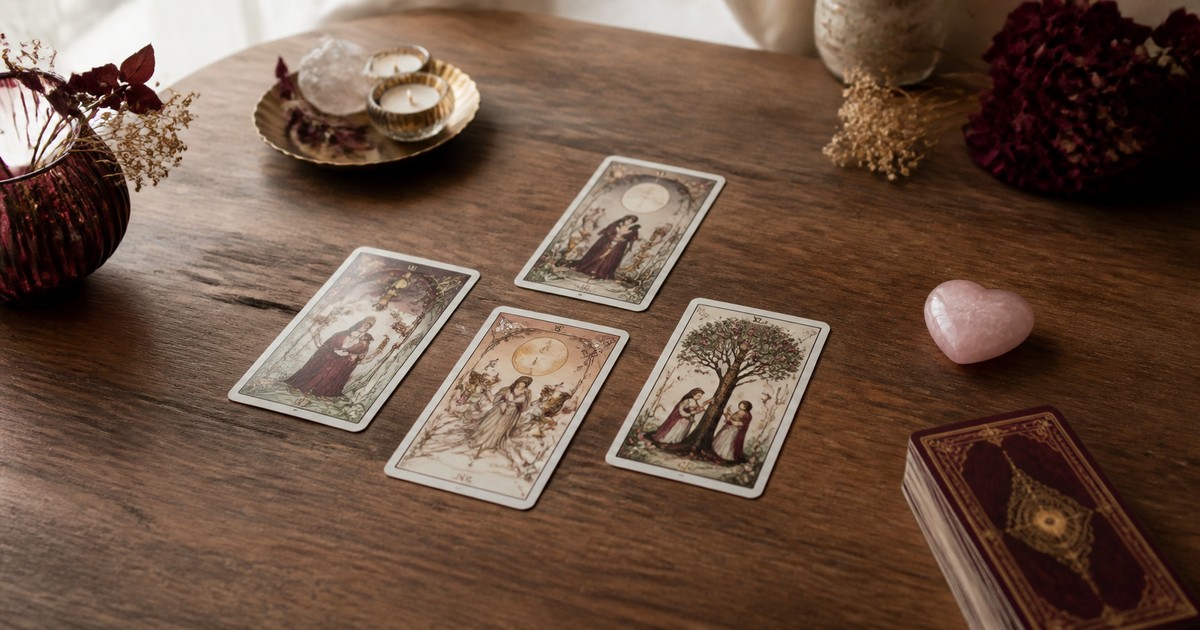
Most relationship spreads share the same weakness: a position labeled their feelings, which invites the reader to speak for someone who is not in the room. The spread below replaces that position with what you can observe. Shuffle, lay five cards left to right, and write one or two lines for each before you look anything up. Then read the traditional meanings and notice where they match your notes and where they do not; the mismatches are often the most useful part.
| Position | What it asks | A prompt to write about |
|---|---|---|
| 1. Where I stand | Your feelings, needs and what you bring right now | What have I wanted to say this week and not said? |
| 2. What I observe | The other person’s behavior as you have actually seen it | What did they do, not what did I hope they meant? |
| 3. The connection | How the two of you work together day to day | When are we at our best, and what is different then? |
| 4. What helps | A strength, habit or resource to lean on | What has repaired things before, and can I do it again? |
| 5. What needs attention | A pattern, boundary or conversation that is overdue | What would I tell a friend in my position to do? |
Cards that come up in love readings
No card has one fixed meaning, and the same card reads differently in the position marked what helps than in the one marked what needs attention. The table lists cards people ask about most in relationship readings, with the meanings most guidebooks attach to them. Treat every line as the start of a question, not a report on your partner. The Three of Swords does not mean a breakup is coming; the Tower does not end a relationship.
| Card | Traditional upright meaning | Traditional reversed meaning | A question it raises |
|---|---|---|---|
| The Lovers (VI) | A choice, union, values in alignment | Misalignment, a choice avoided | Do our values line up where it matters? |
| Two of Cups | Mutual attraction, partnership, balance | Imbalance, a connection cooling | Is the give and take even? |
| Ace of Cups | A new feeling, emotional openness | Feelings held back | What am I not letting myself say? |
| Ten of Cups | Contentment, family harmony | Strain at home, an ideal unmet | What does a good ordinary day look like for us? |
| Three of Swords | Heartbreak, grief, a painful truth | Healing, or pain still unspoken | What hurt have I not named? |
| The Tower (XVI) | Sudden upheaval, a structure that fails | Change resisted or under way | What have I been propping up? |
| The Devil (XV) | Attachment, patterns that bind | Loosening a hold | What do I return to even when it hurts? |
| The Hermit (IX) | Solitude, reflection | Isolation, withdrawing too far | Is time alone restoring me or hiding me? |
Single, partnered, or after a breakup
The same deck serves three different jobs. If you are single, the useful readings are about you: what you want, which patterns show up by the third date, and whether you like who you are when you are dating. When will I meet someone is not a question a card can answer, and asking it weekly makes waiting feel like a plan. If you are partnered, read for yourself, not about your partner’s inner life; if your partner is willing, read together and treat each card as a conversation starter that neither of you has to defend. Couples researchers describe four habits that predict trouble, criticism, contempt, defensiveness and stonewalling, and if conflict cards keep landing in your spreads, those four are worth checking against your own conversations; the Gottman Institute explains them in its guide to the four horsemen. After a breakup, the danger is the loop: pulling cards every night to ask whether they will come back, and pulling again when the answer disappoints. Set a limit, one reading a week at most, and change the question: what do I need this week, and what is one thing that is mine to do. A deck will not shorten grief, but it can give the grief somewhere to go.
- 1. FrameWrite the question so it depends on what you know, not on what someone else secretly thinks
- 2. PullLay the spread, and write a line for each card before you look up any meaning
- 3. CompareSet the traditional meanings beside what you have seen and heard; note the mismatches
- 4. ChoosePick one step that is yours to take this week, then put the deck away
Safety, and red flags in paid love readings
Two situations should end a reading. The first is when fear, control or threats are part of the relationship you are asking about. Monitoring your phone, deciding who you may see, threats, shouting that leaves you shaking: these are not questions for a deck. No responsible reader will tell you to stay with someone who frightens you, and no card should be read that way. The National Domestic Violence Hotline is available at 1-800-799-7233 or by texting START to 88788, and in immediate danger the number is 911. The second situation is a paid reader who starts selling: a promise to reunite you with an ex, a spell or candle service for a fee, a claim that a block or a curse is keeping love away and can be removed, then a second fee, a third, and a request for gift cards or a wire transfer. Each step relies on the fear the previous one created. Leave at the first, keep the messages, and report the loss to the Federal Trade Commission. A fair reading has a price stated up front, a fixed length, and no reason to contact you again.
- A promise to bring an ex back, reunite you, or make someone fall in love
- Spells, candles, cleansings or rituals sold as a separate service
- A curse, block or attachment that only the reader can see and only a fee can clear
- Rising fees, urgency about paying today, gift cards or wire transfers, or being told to keep the reading secret
Key takeaways
- A love reading is a structured conversation with yourself; it cannot read a partner’s mind or say whether an ex will return.
- Write questions that depend on what you know and can do, not on what someone else secretly feels.
- Use a spread that asks what you observe rather than what the other person thinks.
- Card meanings are traditions and prompts; the Tower and the Three of Swords are questions, not sentences.
- Fear or control means calling the hotline, not pulling cards; reunion promises and block removal mean leaving the reader.
Related reading
- Asking the right love questions for tarot
- Using tarot to improve your relationship
- Different types of relationships on tarot spreads
- Making long-distance work
- First date mistakes the tarot can help you notice
- Using tarot to find your soulmate
- Tarot questions to avoid asking
Frequently asked questions
1. Can a love tarot reading tell me if he loves me?
No. A deck has no access to another person’s feelings, and a reader who says otherwise is guessing from what you have told them. What a reading can do is help you look at what you have seen: how he treats you over a month, whether words and actions match, and whether that is enough for you.
2. Will a reading tell me whether my ex is coming back?
It cannot. The cards do not track another person’s decisions, and reunion readings tend to become a nightly loop in which you pull again until the answer improves. A better use of the deck after a breakup is one weekly question: what do I need, and what is mine to do.
3. What questions work best in a love reading?
Questions about your own patterns, needs, boundaries and next steps: what you keep repeating when a relationship gets serious, what you need that you have not said, which conversation you are avoiding, and what you would do if you trusted your own read. If a question depends on information only another person has, rewrite it.
4. Which tarot cards are usually read as positive for love?
By tradition, the Lovers, the Two of Cups, the Ace of Cups, the Ten of Cups, the Empress and the Knight of Cups are read as encouraging in relationship readings. None proves that a relationship will work, and each has a reversed reading that points at imbalance. Treat a hopeful card as a prompt to ask what is going well.
5. Does the Three of Swords mean a breakup is coming?
No. Its traditional meaning is heartbreak, grief or a painful truth, and in a reading it is usually taken as an invitation to name a hurt that has not been spoken. It does not forecast an event. If it lands in the position for what needs attention, ask what hurt you have been carrying.
6. Does the Tower mean my relationship will end?
The Tower’s traditional meaning is sudden upheaval or a structure that no longer holds. It is one of the most feared cards and one of the most over-read. In a relationship spread it asks what you have been propping up that has stopped working. Whether a relationship ends is a decision people make, not a card.
7. Is a reversed card in a love reading a bad sign?
Not by itself. Many readers do not use reversals at all. Those who do usually read a reversed card as the same theme turned inward, delayed, blocked or out of balance, rather than as the opposite of upright. A reversed Two of Cups might prompt a question about uneven effort; it does not announce that a relationship is failing.
8. What is a good spread for a relationship question?
A five-card row works well: where I stand, what I observe, the connection, what helps, and what needs attention. The second position deliberately asks about the other person’s behavior as you have seen it, not their hidden thoughts. Write a line for each card before looking up meanings, then compare. Three cards, past, present and next step, is a shorter option.
9. Can I do a love reading for myself?
Yes, and many people find self-readings more useful because there is no one to perform for. The risk is wishful reading: pulling until a hopeful card appears, or bending a meaning to fit what you want. Write the question first, write your notes before looking anything up, and keep the notebook.
10. Should I read tarot with my partner?
If both of you want to, it can be a low-pressure way to start conversations that are hard to open cold. Agree that no card is evidence about either of you and that either person can stop. Take turns drawing and saying what a card brings up. If the cards become accusations, put the deck away and talk without it.
11. How often should I get a love reading?
Less often than you want to when you are anxious. A reasonable limit is once a week for a self-reading and a few times a year for a paid one. Repeated readings on the same question do not add information; they add noise and cost. If you are reading daily about one person, talk to a friend or a counselor instead.
12. Can tarot tell me if my partner is cheating?
No. Nothing in a deck can detect another person’s behavior, and readers who claim to see infidelity in the cards are guessing from your tone. If you suspect cheating, the useful questions are about what has changed, what you have noticed, and what conversation you are avoiding. A reading can help you prepare for it, not replace it.
13. Can a reading tell me when I will meet someone?
It cannot give a date, and readings that offer one, by summer, within three months, are guesses dressed as predictions. The question also makes waiting feel like a strategy. Ask instead what you are doing this month that puts you around people you might like, and what pattern you would want to change.
14. What should a love reading cost?
Prices vary widely by reader and format. A fair price is stated in full before you start, for a fixed length, with no add-ons. What matters more than the number is the shape of the deal: one session, one fee, no reason to contact you afterward. A reading that leads to a second fee for a ritual or a cleansing is a sales process.
15. What are the red flags in a paid love reading?
Promises to reunite you with an ex or make someone love you; spells, candles or cleansings sold separately; a curse, block or attachment only the reader can see; fees that rise with each contact; urgency about paying today; requests for gift cards or wire transfers; and instructions to keep the reading secret. Any one is a reason to leave.
16. What if a reader says they can bring my ex back?
Stop the session and do not pay. No reader, ritual or spell can change another person’s decisions, and reunion services are among the most common ways people lose large sums to psychic fraud, because fees escalate while you are grieving. Keep the messages and receipts and report the loss to the Federal Trade Commission.
17. What if I feel afraid of my partner?
Put the cards down and call someone. Fear, control, monitoring, threats and isolation are safety issues, not reading questions, and no card should ever be read as advice to stay. In the United States, the National Domestic Violence Hotline is 1-800-799-7233, or text START to 88788; it is free and confidential. In immediate danger, call 911.
18. Can tarot replace couples counseling or therapy?
No. A reading can help you find words for a problem and decide to raise it, which is real value. A licensed counselor or therapist offers something different: training, an outside view of both partners, and tested methods for communication and conflict. Use the cards to prepare for those conversations, not to replace them.
Evidence note: Card meanings here follow the traditions attached to the Rider-Waite-Smith deck (1909) and the guidebooks that copy it; they are interpretive conventions, not findings. Tarot has not been shown, under controlled conditions, to predict events or to reveal another person’s thoughts, and no reading can confirm love, infidelity, a reunion or a timeline. The four conflict habits come from published research by John Gottman and colleagues. Fear, control or threats in a relationship are safety matters: call the National Domestic Violence Hotline at 1-800-799-7233, text START to 88788, or call 911 in an emergency. Reunion promises, spells and block removal sold for a fee are fraud; report losses to the Federal Trade Commission.