A tarot reading connects a question, a set of images and the meanings you give them. A standard deck contains 78 cards. You draw a few, place them in positions with agreed meanings and consider how the images relate to your situation.
Some readers approach this as spiritual guidance or divination; others use it for reflection, creativity or conversation. You can learn the structure without deciding in advance what every meaningful coincidence means. Start with the deck, then try a small reading you can actually follow.
The 78-card deck, without the confusion
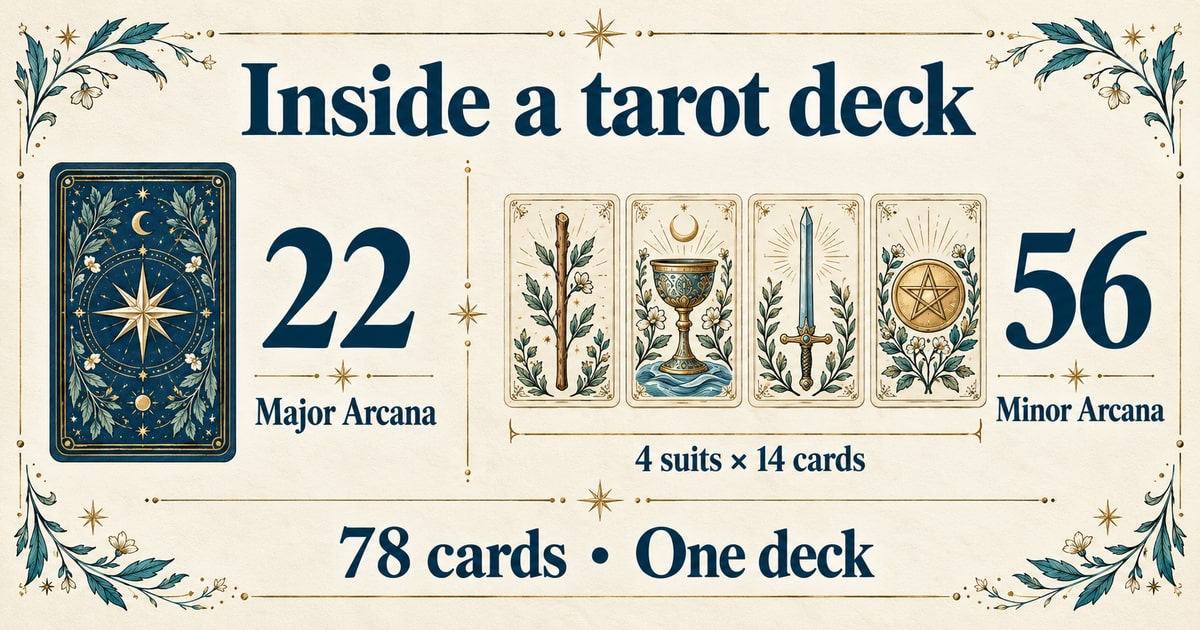
In the widely used Rider-Waite-Smith tradition, the deck has 22 Major Arcana and 56 Minor Arcana. The Major Arcana include The Fool, The Magician, The Lovers and The World. Readers often connect them with wider themes or turning points. A Major is not automatically a more important fact, and a dramatic image is not a forecast of disaster.
The Minor Arcana bring attention to everyday experiences. Each of four suits contains Ace through Ten, then Page, Knight, Queen and King: 14 cards per suit. The 16 court cards are already included in the 56 Minors, not an extra group to add on.
- Wands
- Common associations include initiative, creativity, effort and ambition. A question might be: “Where do I want to put my energy?”
- Cups
- Feelings, relationships and connection. Try: “What am I feeling, and what am I assuming someone else feels?”
- Swords
- Thought, communication, decisions and conflict. Try: “What needs to be said or understood more clearly?”
- Pentacles
- Resources, work, home and practical care. Try: “What can I support through steady, realistic action?”
These are starting associations, not rigid rules. Decks may use Coins instead of Pentacles, Batons instead of Wands or different court titles. The Fool is usually numbered 0 in Rider-Waite-Smith decks; numbering and imagery vary across traditions. Court cards can suggest a role or an approach, not only a particular person or gender. Your deck’s guidebook is a useful companion.
How a reading works: four practical moves
- Ask a question you can work with. “What should I consider before accepting this project?” leaves room for reflection. “What will my employer secretly decide?” asks the cards for information you cannot check from the images.
- Shuffle and draw. Mix the deck in a comfortable way; overhand shuffling or spreading cards on a clean surface are both options. Decide how many cards you will use before drawing. There is no need for an elaborate ritual unless it is meaningful to you.
- Give each position a job. Write down the position meanings first. A card in “what needs attention” is asking a different question from the same card in “a resource I can use.”
- Interpret, then choose. Notice the picture, consult its traditional meaning and connect it with the question and position. Record what fits, what does not and one action to consider. Check that action against real circumstances.
You may use intuition, prayer or a quiet moment as part of your practice. Those choices do not require treating an interpretation as an established fact. For more detail, continue with how tarot readings work or cards, meanings and readings.
A three-card reading you can try
Ask: “What could help me approach a new project?” Lay three cards in a line from left to right. Keep these position meanings fixed while you read.
1. Situation
What am I bringing to this? A Two of Pentacles, with its figure holding two coins, might prompt you to notice competing commitments.
2. Attention
What deserves a closer look? An Eight of Pentacles, showing a craftsperson at work, might invite attention to the practice or preparation the project needs.
3. Next step
What could I do? A Three of Pentacles, with its working scene and other figures, might suggest asking someone for feedback or agreeing who will do what.
Put the cards together: “I am juggling commitments, this will need practice, and a conversation about the work could help.” A practical next step could be to check your available time and discuss the brief before saying yes.
This is an illustrative reading, not a promise of success. Another reader may connect the same images differently. If a card does not fit, note the mismatch rather than inventing a problem or drawing repeatedly for a preferred answer.
Choose a spread for the question, not for its size
- One card
- One image and one question, such as “What could I notice today?” Useful when you are learning to describe a picture before consulting meanings.
- Three cards
- Try situation, attention and next step, as above. Past, present and future is another familiar option; treat “future” as a possible direction to consider, not a fixed event.
- Five-card cross
- A reader-defined layout can add context, such as situation, challenge, support, choice and next step. There is no single universal five-card cross: write down the version you use.
- Celtic Cross
- A ten-position layout with a central cross and a four-card line alongside it. Position names vary. It offers more layers to connect, not automatically more certainty, and you can leave it until a smaller spread feels comfortable.
Choose whether to use reversed cards before you begin. Some readers use an upside-down card to explore inward, blocked or delayed aspects; others read all cards upright. Neither approach makes a card automatically bad. The beginner tarot guide can help you build a manageable practice.
A short history: game, divination and modern decks
The documented history begins in 15th-century northern Italy, not ancient Egypt. Early tarot combined four suits with trump cards and a Fool for a card game. The Metropolitan Museum of Art describes references from the 1440s and 1450s and surviving Italian decks, including Visconti and Visconti-Sforza cards.
Fortune-telling and occult interpretations developed later, notably in late-18th-century France through writers such as Court de Gébelin and Etteilla. Egyptian-origin stories belong to that later interpretation, not demonstrated ancient provenance. Nineteenth-century occultists added systems involving Kabbalah and other correspondences.
The V&A’s history of tarot traces these developments and the Rider-Waite-Smith deck, first published in 1909. Arthur Edward Waite and artist Pamela Colman Smith helped shape a hugely influential visual tradition. Smith’s illustrated Minor Arcana scenes remain important to many readers; they are not the only way a tarot deck can look or work.
Why a reading can feel meaningful
A card can bring an overlooked concern into focus, give a feeling a name or open a conversation. Some people understand that resonance spiritually. Meaningful reflection, however, is different from demonstrating that the cards reliably predict events or reveal another person’s private thoughts.
Two psychological ideas are useful to keep in view. The Barnum effect concerns general descriptions feeling specifically personal. Confirmation bias involves favoring evidence that supports an existing expectation. These can influence how you receive a reading; they do not tell us exactly why every individual experience felt significant.
Rather than counting only the apparent “hits,” record the full interpretation, including misses and uncertainty. Ask what you already knew, what you inferred and what could be checked independently. A reader’s questions may help clarify your situation without being proof of psychic access. Explore tarot reading accuracy if you want to examine that distinction further.
Read for yourself or with someone else?
Reading for yourself
You control the pace and can keep the exercise private. A deck and its guidebook are enough to begin; you do not need an expensive collection. Your hopes can shape the interpretation, so write down the question and resist changing it to fit the draw.
Reading with a reader
A reader may offer familiarity with symbols and a different perspective. Ask how they work, what topics they decline, the full price and duration, and how privacy and cancellation are handled. An outside viewpoint is not a guarantee of accuracy.
Do not let a reading replace medical assessment, legal advice or other qualified help. Cards cannot establish a pregnancy, diagnosis, another person’s consent or a financial fact. If you need emotional crisis support in the United States, you can call or text 988; you do not need to wait for a reading.
Pressure to pay more to avert a curse, secrecy, threats or guaranteed outcomes are reasons to stop. Do not send gift-card numbers or PINs as payment: the FTC explains how to recognize and report that scam. A spiritual belief is not itself evidence of fraud; coercive conduct and payment demands deserve scrutiny.
For related questions, read about tarot readers and psychics or psychic medium claims. To decide whether you want to try the practice, explore whether tarot suits you and ways to use tarot for reflection.
Frequently asked questions
1. What are tarot cards, in one sentence?
Tarot cards are an illustrated deck commonly used for divination, spiritual exploration or reflection by interpreting drawn cards in relation to a question and their positions in a spread.
2. How many cards are in a tarot deck?
A standard deck has 78: 22 Major Arcana and 56 Minor Arcana. Each of four suits has ten numbered cards, counting the Ace, and four court cards. Historical and specialist decks can differ.
3. What is the difference between Major and Minor Arcana?
Readers often connect Major Arcana with broader themes and Minor Arcana with everyday circumstances. These are interpretive categories, not a ranking of how certain a message is. Both belong in the same deck.
4. How does a tarot reading work?
Choose a question, shuffle and draw, place the cards in defined positions, then connect the images and traditional meanings with the question. Finish by considering what fits your circumstances and what action, if any, you want to take.
5. Can tarot cards predict the future?
Some traditions read cards predictively, but an interpretation is not an established or guaranteed forecast. Do not treat a future-position card as proof of what must happen. Consider possible directions alongside independently checkable facts.
6. Where did tarot originate?
Its documented history begins with card games in 15th-century northern Italy. Fortune-telling and occult interpretations developed later, particularly in late-18th-century France. Today’s spiritual uses are part of that evolving history.
7. Did tarot come from ancient Egypt?
Ancient Egyptian origins were proposed by later occult writers, but they are not established by the documented history of tarot. Egyptian imagery in a modern deck can express a theme or spiritual system without proving an ancient origin.
8. What is the Rider-Waite-Smith deck?
It is the influential deck first published in 1909, associated with Arthur Edward Waite and artist Pamela Colman Smith. Its illustrated suit-card scenes make it a common reference for learning. Other traditions use different imagery and numbering.
9. What is a tarot spread?
A spread is an arrangement in which each card position has a defined role. For example, situation, attention and next step gives three images three different questions. Define the roles before drawing rather than changing them to obtain a preferred answer.
10. What does a reversed card mean?
It is a card oriented upside down. Depending on your chosen system, you might explore an inward, restricted or delayed expression of its themes. You can also read every card upright. Decide beforehand; reversal is not automatically a negative verdict.
11. Why can a reading feel accurate?
Rich images, personal associations, conversation and expectations can all influence the experience. General descriptions may feel specifically personal, and you may notice confirming details more readily than mismatches. Record both before deciding how much weight to give the reading.
12. What is the Barnum effect?
It is the tendency to experience a broad description as specifically applicable to yourself. To check a reading, ask which details are genuinely specific, which could fit many people and which do not fit at all.
13. Do I have to be psychic to read tarot?
You can learn to observe images, consult meanings and work with spreads without claiming psychic ability. Some readers understand their practice spiritually or intuitively. Learning has no fixed deadline, and confidence does not itself establish predictive accuracy.
14. Should I read my own cards or pay a reader?
Self-reading offers privacy and a flexible pace. A reader can offer conversation and another perspective, but quality varies. You do not need a paid session to begin. If you book, agree on the price, duration and boundaries first.
15. What questions are useful for beginners?
Try questions about your attention and choices: what should I consider, what am I overlooking, or what practical step could I take? Avoid using the cards to establish a medical fact, someone else’s private thoughts or a guaranteed outcome.
16. How should I budget for tarot?
For self-reading, compare the price of a complete deck and guidebook with what you can comfortably afford. For a session, check whether billing is per minute or per session, calculate the total and set a stopping point. Decline unexpected paid extras.
17. What warning signs should make me stop a reading?
Threats, pressure to keep paying, promises to guarantee a result, demands for gift-card numbers or claims that only an expensive service can prevent harm deserve immediate caution. Keep payment records and seek independent support if you suspect fraud.
18. How do I begin learning without feeling overwhelmed?
Choose one deck, look closely at a single card and write your observations before checking the guidebook. Gradually learn the suits and Major Arcana, then try three defined positions. Review your notes rather than repeatedly redrawing the same question.