

Quick guide
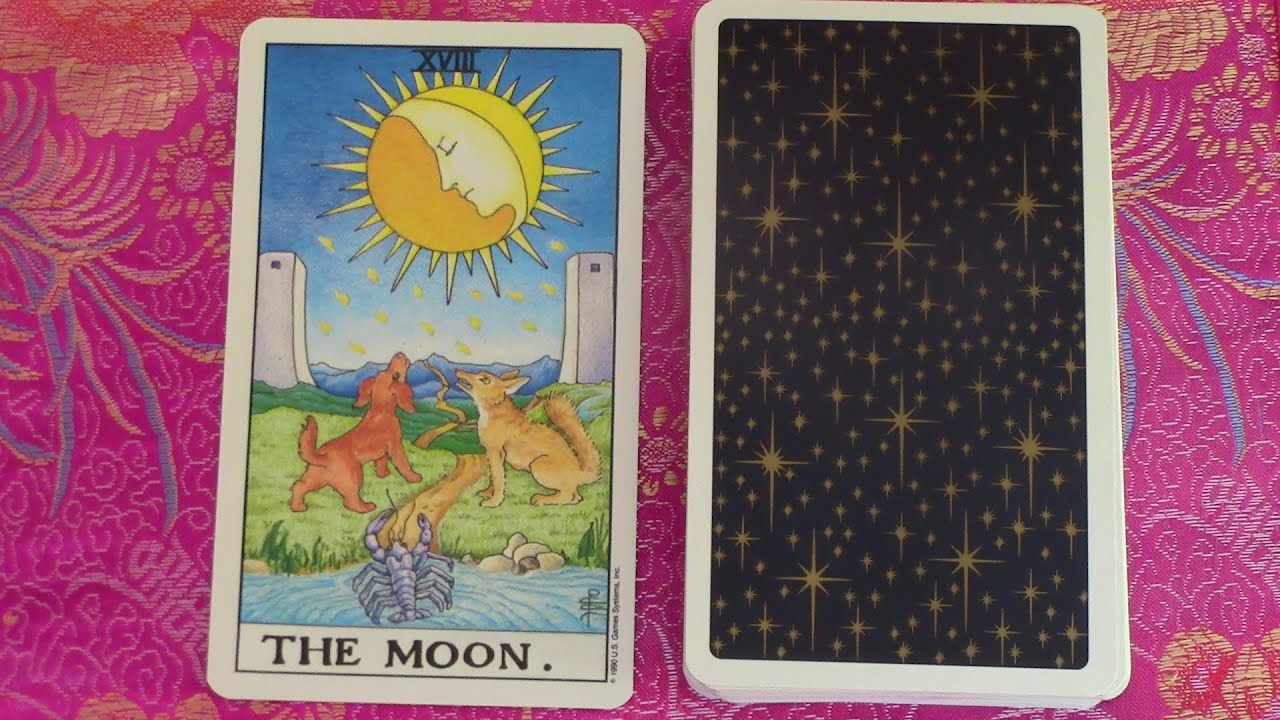
The Moon is card XVIII of the Major Arcana. In the Rider-Waite-Smith image a moon with a calm face hangs over a night landscape: a dog and a wolf howl up at it, a crayfish climbs out of a pool at the bottom of the card, two towers stand on either side of the horizon, and a winding path runs between them toward distant hills. Upright, the card is traditionally read as uncertainty, fear, imagination, dreams and things not yet clear. Reversed, it points to confusion lifting, a fear being named, or a misunderstanding coming to light. The one question the Moon usually raises is simple: what do I actually know here, and what am I filling in with worry?
| At a glance | |
|---|---|
| Arcana / number / suit | Major Arcana, card XVIII (18); no suit |
| Upright keywords | Uncertainty, fear, imagination, dreams, intuition, things hidden, a path walked in low light |
| Reversed keywords | Clarity returning, fear named, confusion fading, a secret or mistake surfacing, relief |
| Element / astrological association (tradition) | Water; Pisces (Golden Dawn correspondence) |
| Yes/no reading (convention) | Usually read as unclear or not yet; wait for more information |
The image and its symbols
Everything on the Moon card is lit from above by a light that does not quite show things as they are. The moon itself has a face in profile set inside a full disc, and from it fall small drops, which Arthur Waite called the dew of thought. The light is real, but it is reflected light; readers take that as the card’s first lesson. What you see by moonlight is partly the thing and partly your own mind.
At the bottom of the card a crayfish crawls out of a pool. It is usually read as something from deep down, an old fear or an instinct, rising to the surface where it can finally be seen. On the bank a dog and a wolf howl at the moon together. The dog is the tame part of the mind, the wolf the wild part, and both react to the same light. Readers use the pair to describe how a worry can be perfectly reasonable and completely out of proportion at the same time.
Two towers frame the horizon, one on each side, and a path runs between them from the pool toward the hills. The path is the quiet hope of the card: there is a way through, it winds, and it has to be walked without full visibility.
Upright meaning
Upright, the Moon is read as a time when the facts are incomplete and the imagination is working overtime. It appears when a person is waiting for news, reading too much into a message, lying awake at 3 a.m., or sensing that something is off without being able to say what. The traditional keywords are illusion, fear, anxiety, intuition and the subconscious. In practice the card most often describes the gap between what is known and what is feared.
The Moon is also the card of dreams and of the creative, image-making part of the mind. Readers often take it as a sign to pay attention to dreams, to write them down, and to notice recurring pictures, not because dreams predict anything but because they tend to show what a person is preoccupied with. In a past, present, future spread the Moon in the past often describes a period of confusion that has since cleared; in the present it describes the fog itself; in the future it is read as a stretch where patience and fact-checking will matter more than action.
One honest note belongs here. Older guidebooks sometimes read the Moon as deception or betrayal. That is a convention, not a verdict. The card cannot tell you that a person is lying or hiding something. It can prompt you to ask what you have assumed and to check it against what you can actually confirm.
Reversed meaning
Reversed, the Moon is usually read as the fog beginning to lift. A fear is named and turns out to be smaller than it felt, a misunderstanding is cleared up, a secret or mistake comes to light and can finally be dealt with. Many readers treat the reversed Moon as a relief card, especially if it sits next to the Sun, the Star or the Ace of Swords.
A second reading is also common: the reversed Moon as a person pushing a fear down rather than facing it, or dismissing a real intuition because it is inconvenient. Which reading fits depends on the question and the surrounding cards, and on the honest answer to whether the worry has actually gone or is just being ignored.
Fear deserves a plain sentence of its own. A card can name a mood; it cannot diagnose one. If worry is constant, sleep is broken, or anxiety is interfering with daily life, that is a health matter for a doctor or therapist, not for the cards. In the US you can also call or text 988 at any hour if the nights are getting hard to get through.
In a love reading
Upright, the Moon in a relationship reading usually describes uncertainty: not knowing where things stand, mixed signals, a partner who seems distant, or a person’s own doubts about what they want. For a single person it can describe a strong attraction that is partly projection, or a fear of being hurt that is shaping every decision. Readers treat it as a prompt to replace guessing with a direct conversation.
Reversed, the Moon in love often describes a conversation that finally happens, a misunderstanding cleared, or a fear of abandonment that turns out to have more to do with the past than with the present partner. What the card cannot do is confirm love, infidelity or whether someone will return; no card can. If a relationship involves fear, control or threats, that is not a question for cards. The National Domestic Violence Hotline is 1-800-799-7233 (text START to 88788), and in immediate danger call 911.
In a career or money reading
At work the upright Moon describes situations where the full picture is not available: a restructure announced without details, an interview with no feedback, a colleague whose motives are unclear, or a project whose scope keeps shifting. The usual advice attached to the card is to ask direct questions, put agreements in writing, and avoid big decisions until the facts are in.
Reversed in a career reading, the Moon often describes information arriving: the offer is clarified, the rumour is confirmed or dismissed, the reason for the delay is explained.
In money questions the Moon is read as a warning against deciding in the dark: unclear terms, an offer that sounds too good, figures that have not been checked. It is not a forecast and it is not a sign of fraud. If something financial feels foggy, the practical step is to read the paperwork and ask a qualified adviser, not to pull another card.
How to work with this card
- Separate the two columns. Write what you know for certain on one side and what you are assuming on the other. Most Moon-card worries live entirely in the second column.
- Name the crayfish. Ask what old fear this situation is stirring up, and whether it belongs to the present or to something that happened years ago.
- Watch for confirmation bias. By moonlight every shadow looks like the thing you expect. Notice whether you are collecting evidence for a conclusion you reached before you looked; Britannica has a clear summary of how confirmation bias works.
- Keep a dream line. For a week, write one line about any dream you remember. The point is not prediction but noticing what your mind keeps returning to.
- Set a fact-finding date. Decide what information would settle the question and when you will ask for it, then stop re-reading the message in the meantime.
Cards that often appear with it
The Moon with the Sun (XIX): the next card in the Major Arcana, and the natural answer to the Moon. The pairing is usually read as confusion followed by clarity, or as the advice to wait for daylight before deciding.
The Moon with the Seven of Cups: both cards are about imagination outrunning facts. Together they are read as too many options, wishful thinking, or a choice that needs to be made on evidence rather than on which picture looks best.
The Moon with the Nine of Swords: worry at night. Readers take this pairing as anxiety that grows after dark and shrinks by morning, and they commonly suggest better sleep, less late-night scrolling, and a conversation with someone trusted or a professional if the pattern is persistent.
Key takeaways
- The Moon is card XVIII of the Major Arcana and is read as uncertainty, fear, imagination and things not yet clear.
- The dog and wolf, the crayfish and the winding path all describe a mind reacting to partial information.
- Reversed, it usually describes confusion lifting, a fear being named, or a misunderstanding coming to light.
- The card cannot confirm lying, cheating or betrayal; it prompts you to check assumptions against facts.
- Persistent anxiety or sleepless nights are a health matter for a professional, not a tarot matter.
Related reading
- Tarot and the Fool’s Journey: the 22 Major Arcana in order
- Interpreting difficult tarot cards
- Temperance tarot card meaning
- The High Priestess tarot card meaning
- Interpreting dreams with tarot cards
- Tarot cards for beginners
Frequently asked questions
1. What does the Moon card mean in tarot?
The Moon is traditionally read as uncertainty, fear and imagination: a situation where the facts are incomplete and the mind is filling the gaps. It describes a state of not knowing, not a prediction of what is hidden.
2. What number is the Moon card?
The Moon is card XVIII, the eighteenth card of the Major Arcana in the Rider-Waite-Smith deck. It follows the Star (XVII) and comes before the Sun (XIX).
3. What do the dog and the wolf on the Moon card mean?
The dog and the wolf are usually read as the tame and wild sides of the mind, both reacting to the same light. Readers use them to describe how a worry can be reasonable and out of proportion at the same time.
4. What is the crayfish on the Moon card?
The crayfish climbing out of the pool is read as something from deep in the mind, often an old fear or instinct, rising to the surface where it can be seen and dealt with.
5. What does the Moon mean reversed?
Reversed, the Moon is usually read as confusion lifting: a fear named, a misunderstanding cleared, or a hidden mistake coming to light. Some readers also take it as a fear being pushed down instead of faced.
6. Is the Moon a yes or no card?
By common convention the Moon is read as unclear or not yet, a prompt to wait for more information before deciding. A yes or no reading is a tool for reflection rather than a prediction.
7. What does the Moon mean in a love reading?
Upright, it describes uncertainty about where things stand, mixed signals, or doubts shaped by old fears. Reversed, it often describes a conversation that clears the air. The card cannot confirm how another person feels.
8. Does the Moon card mean someone is lying or cheating?
No. Older guidebooks list deception as a theme, but a card cannot show what another person is doing. The Moon is best read as a prompt to separate what you know from what you are assuming and to ask directly.
9. Which zodiac sign is linked to the Moon card?
In the Golden Dawn system of correspondences the Moon is assigned to Pisces and the element of Water. This is a reading tradition, not a fact about people born under the sign.
10. What does the Moon mean in a career reading?
At work the Moon describes situations with missing information, such as an unexplained restructure or an interview with no feedback. The usual advice is to ask direct questions and put agreements in writing before deciding.
11. Is the Moon a bad card to pull?
The Moon is often grouped with the difficult cards, but it describes a state of uncertainty rather than a bad outcome. Its useful message is to check assumptions, wait for facts and look after sleep and nerves in the meantime.
12. What does the Moon mean as a daily card?
As a card of the day it is usually taken as a reminder not to make big decisions on partial information, to notice where worry is filling in the blanks, and to write down any dream you remember.
Evidence note: The meanings on this page are interpretive conventions attached to the Rider-Waite-Smith deck, first published in 1909, and to the guidebooks that follow it; they are not findings about what will happen. Tarot began as a card game in northern Italy in the 1430s, as Britannica’s entry on tarot records, and its divinatory use came centuries later. No reading has been shown to predict events, read another person’s mind or set a timeline, and the tendency to see what we expect is described in Britannica’s entry on confirmation bias. Persistent worry, broken sleep or fear that interferes with daily life are health matters; the National Institute of Mental Health explains anxiety disorders and when to seek help, and in the US you can call or text 988 at any hour. Legal and financial questions belong with a qualified professional.