

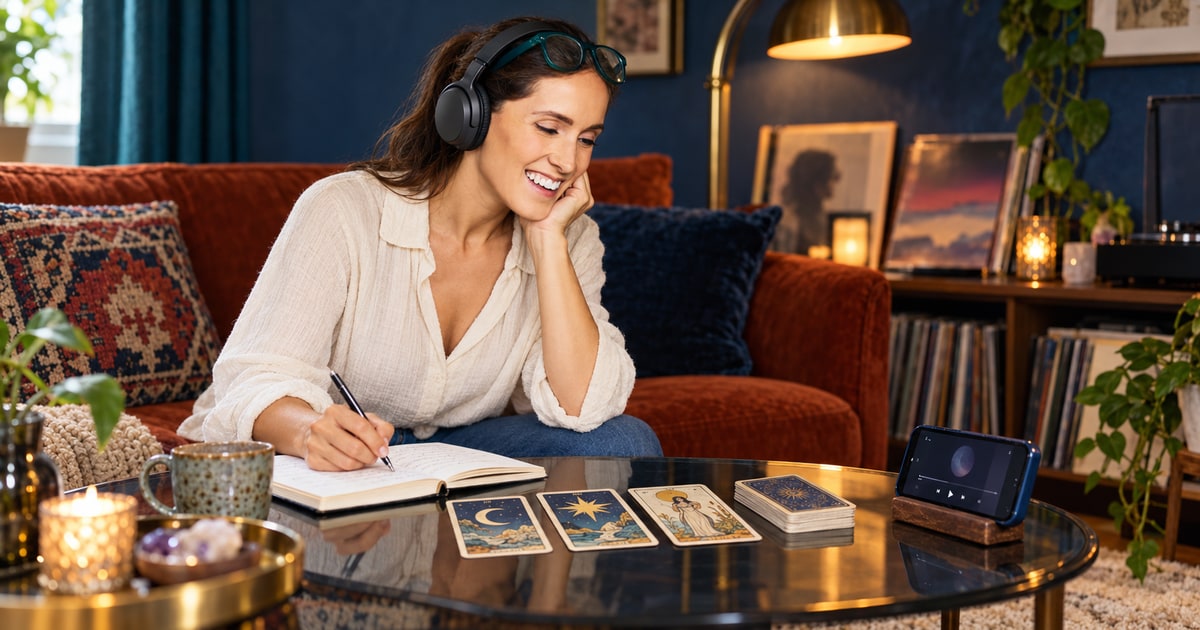
A desert silhouette, a waking saint, a glittering cross: some Madonna images stay with you long after the music stops. For a tarot reader, those scenes offer a fascinating way into the cards. They invite you to notice what a symbol makes you feel, which archetype comes to mind, and where your own intuition takes the story.
The pairings below are creative interpretations, not documented tarot instructions from Madonna. You can find spiritual meaning in a performance without assuming you know the performer’s private beliefs—or treating a striking image as a prediction about your life.
Why music and tarot can speak the same symbolic language
A tarot card gives you a scene to enter: a figure, an object, a gesture and a setting. A music video can do something similar. A door might suggest a threshold; a veil might suggest privacy, mystery or protection. The details matter, but so does the context. A cross in a church, on a necklace and on a concert stage need not communicate the same thing.
This guide uses the Rider–Waite–Smith deck, illustrated by Pamela Colman Smith and first published in 1909, as a familiar reference. It is not the source of every mystical-looking image in popular culture. Religious art, theatre, surrealism and other traditions have their own histories, often much older than this deck.
Tarot itself also has a history beyond spiritual practice. The Met’s account of early tarot describes fifteenth-century Italian playing cards and their later connection with divination. That history does not prevent you from using a modern deck spiritually; it helps you distinguish a card’s historical roots from the meaning you bring to it today. If the imagery is new to you, begin with our introduction to tarot cards.
Madonna’s mystical eras: scenes, cards and questions
Think of these as possible companions, not a fixed code. A different card can work if you can explain the visual or emotional connection.
1983–1986: costume, contrast and the Magician
Lace, crucifixes, rosaries and layered jewellery helped make Madonna’s early image immediately recognisable. Her 1984 MTV Video Music Awards performance combined a bridal dress with the “Boy Toy” belt. The “Material Girl” video drew on Marilyn Monroe’s pink-dress performance in Gentlemen Prefer Blondes. Sacred, romantic and glamorous images could sit together while pulling in different directions.
A possible card: the Magician. His tools suggest the resources available to shape an expression or action. Ask: “What am I choosing to communicate, and which parts of me am I leaving out?” This is an analogy about presentation, not evidence that the performance was designed around this card.
1989–1990: “Like a Prayer,” awakening and Judgement
The official “Like a Prayer” video combines a chapel, a gospel choir, burning crosses and a saintly figure who comes to life. Its story also involves witnessing violence and the treatment of a Black man; reducing it to a collection of mystical props would miss that human context. The church and childhood imagery of “Oh Father,” and the religious staging of “Like a Prayer” on Blond Ambition, extend the era’s interest in faith and authority.
A possible card: Judgement. The figures answering a trumpet call can suggest awakening, conscience or responding to something you can no longer ignore. Ask: “What am I being called to acknowledge or act on?” Another viewer might choose Justice because of the video’s story.
1993–1995: the Pierrot, the dream and the Moon
The Girlie Show’s Pierrot costume offers a theatrical companion to the Fool: a playful or vulnerable figure stepping into a role. Pierrot and the tarot Fool are not interchangeable characters, however, and a clown costume alone does not establish a tarot reference.
For a more dreamlike exercise, try “Bedtime Story.” Its shifting bodies, birds and impossible scenes invite associations rather than a single literal reading. Madonna’s official single page credits director Mark Romanek and describes the video’s surreal transformations.
A possible card: the Moon. Here, intuition and uncertainty can exist together. Ask: “What feeling am I noticing before I try to explain it?” Keep the feeling distinct from a factual conclusion about another person.
1998: “Frozen,” “Ray of Light” and inner renewal
On Ray of Light, electronic textures sit beside songs such as “Shanti/Ashtangi,” “Frozen” and “Nothing Really Matters.” William Orbit’s production is central to the album’s sound. The Sanskrit verses of “Shanti/Ashtangi,” the red kimono in “Nothing Really Matters,” and the album’s changing pace give you several different starting points—not one universal spiritual message.
The official “Frozen” video, directed by Chris Cunningham, places a dark-clothed figure in a wide desert landscape, with transformations into birds and a dog. Notice how space, movement and concealment create a mood. There is no need to imagine water in the desert scene just because the card you chose contains water.
Two possible cards: the High Priestess or the Star. “Frozen” can evoke the High Priestess’s reserve and hidden knowledge; the album’s sense of release may lead you toward the Star. Ask: “What needs quiet attention?” or “What would renewal look like in an ordinary action?” For another angle, explore the High Priestess’s symbolism.
2002–2006: Hebrew letters, the Wheel and a changed perspective
The Hebrew-letter imagery in “Die Another Day,” the red-string bracelet associated with this period, and “Isaac” on Confessions on a Dance Floor bring Jewish mystical references into the conversation. These belong to specific traditions; they are not simply interchangeable decorations for anything spiritual. The song features Yitzhak Sinwani, and the Confessions Tour later set “Live to Tell” on a mirrored cross.
Possible cards: Wheel of Fortune and the Hanged Man. The Rider–Waite–Smith Wheel includes Hebrew letters as part of its occult symbolism; that offers a visual connection, not proof of shared intention. The Hanged Man offers a separate association with suspension and perspective, rather than an exact match for crucifixion. Ask: “What is changing around me?” or “What becomes visible when I stop forcing the next step?”
Our guide to Kabbalah and Hermeticism in tarot explores the card tradition further. Hermetic tarot correspondences and Jewish religious practice should not be treated as the same system.
2012–2015: church staging and the Hierophant
The MDNA Tour’s confessional and cathedral imagery, followed by the nun costumes and Last Supper tableau of the Rebel Heart Tour, return to the tension between religious tradition and personal expression. A symbol can feel reverent to one viewer and confrontational to another. Both responses deserve more care than a claim that every sacred image means the same thing.
A possible card: the Hierophant. Consider teachers, institutions and inherited values. Ask: “Which tradition supports me, and which rule am I ready to examine?” The card can represent learning and belonging as well as conformity.
2019: Madame X and the roles of the court cards
Madame X’s eye patch and changing identities make this era a useful prompt for thinking about roles. In “Dark Ballet,” Mykki Blanco portrays Joan of Arc; Madonna’s official announcement identifies that story as an inspiration. “God Control” uses a nightclub-shooting narrative, while the accompanying tour moved into theatres.
A possible companion: the court cards. Pages, Knights, Queens and Kings can describe attitudes or ways of engaging with a situation, alongside other reading traditions that use them for people. Ask: “Am I learning, taking action, supporting someone or directing the situation?” A court card need not be assigned by gender.
A four-step music-and-tarot exercise
Choose one song or a short video scene you enjoy. You can use the cards as spiritual companions, creative prompts, or both. For this exercise, deliberately select a card after looking at the scene; you do not need a random draw.
- Describe what is actually there.
Write down three visible details: a veil, an open landscape, a person standing alone. With audio only, describe the pace, sound and emotional atmosphere instead.
- Name your response.
Choose a feeling such as longing, courage, uncertainty or relief. Write “I feel…” rather than assuming everyone must experience the scene in the same way.
- Choose a card and explain the link.
Find one shared detail or theme. Then notice one difference. The High Priestess’s seated stillness might fit a scene’s mood even when its setting is completely different.
- Ask a question you can use.
Move from “What secret is this predicting?” to “What deserves my attention?” Finish with one small action, such as making time to rest, writing a difficult question, or starting a creative project.
Worked example: “Frozen” and the High Priestess
Observation: a solitary figure, dark clothing and a wide, spare landscape.
My response: the scene feels private and guarded.
Card connection: the High Priestess suggests listening before speaking. The video and card do not share every object or setting.
Journal question: “What feeling have I rushed past?” A useful next step might be ten quiet minutes of writing—not deciding that someone else is hiding something.
If you choose the Moon instead, explain why. A thoughtful alternative is more useful than matching our answer. You can extend the exercise with colour symbolism in tarot or follow the larger story of the Fool’s Journey.
Keep the meaning personal without flattening the traditions
Your emotional or spiritual response to a song can be meaningful without becoming evidence of a performer’s psychic abilities. Likewise, the appearance of a sacred symbol does not tell you everything about the faith it comes from. Look at its role in the scene, learn its cultural context, and leave room for another viewer to respond differently.
You also do not need to make a song into a healing claim to value it. Music may help you feel connected or create a reflective atmosphere; a powerful listening experience does not establish a particular healing frequency, chakra effect or supernatural message.
Frequently asked questions
1. Does this article show that Madonna uses tarot cards?
No. It pairs scenes from her public work with tarot themes as a creative exercise. A visual resemblance is not evidence that an artist used a particular deck or planned a performance around a card.
2. Is Madonna being described as psychic?
No claim about her psychic abilities is made here. You can explore spiritual themes in the work without making assumptions about the performer’s abilities, private practices or beliefs.
3. Why use the Rider–Waite–Smith deck?
Its illustrated scenes provide a useful shared reference for this exercise. It is one influential deck, not the origin of every religious, theatrical or mystical image in a music video. You can use another deck and describe its different imagery.
4. Which card could fit Like a Prayer?
Judgement can fit the theme of awakening or answering a call. Justice is another possible choice when you focus on the video’s story. These are interpretations, not an official tarot explanation of the song.
5. Why pair Frozen with the High Priestess?
Its solitary figure, dark clothing and reserved atmosphere can suggest privacy and inner attention. The comparison concerns mood: the desert video and the High Priestess card do not share every visual detail.
6. Could I choose the Star for Ray of Light?
Yes, if the album gives you a sense of renewal, openness or release. Explain what in the music supports your choice. That is more useful than treating any album as having one mandatory tarot meaning.
7. How does Bedtime Story connect with the Moon?
Its surreal transformations can evoke dreams, imagination and uncertainty. The Moon offers one way to explore that response without forcing every scene into a literal message or prediction.
8. Is Pierrot the same character as the tarot Fool?
No. Pierrot is a theatrical clown character; the Fool belongs to the tarot tradition. Playfulness, vulnerability or performance may connect them for you, but the costume alone does not establish a direct tarot reference.
9. What connects the Wheel of Fortune with Hebrew-letter imagery?
Hebrew letters appear on the Rider–Waite–Smith Wheel. That creates a possible visual association with works using Hebrew lettering. It does not establish that their meanings or intentions are identical, or make Jewish tradition interchangeable with Hermetic tarot.
10. Was the mirrored cross on the Confessions Tour a Hanged Man reference?
The analogy here concerns suspension and a changed perspective, not a verified statement of artistic intent. The Hanged Man and the crucifixion image also have important differences; they should not be treated as identical symbols.
11. How can Madame X help me understand court cards?
Its changing roles offer a prompt for considering different ways of acting. A Page might explore, a Knight pursue, a Queen nurture and a King direct. Those are possible reading approaches, not fixed gender rules or a claim that Madame X was based on tarot.
12. Can I use music in a spiritual tarot practice?
Yes. Choose music that helps you settle or connect with the question. Notice your own response without assuming a song guarantees a message, a healing effect or access to somebody else’s private thoughts.
13. Does the exercise work without watching a video?
Yes. Describe the tempo, texture or emotional movement you hear, then choose a card that resonates. Keep those sound-based observations separate from visual details you have not actually seen.
14. What if my card choice is different from this guide’s?
That is welcome. Identify one shared detail or theme and one difference. Your explanation matters more than agreeing with a suggested pairing; you can also decide that no card fits particularly well.
15. Where did tarot begin, and does that change its spiritual meaning?
Surviving early tarot cards and historical records place its development as a game in fifteenth-century northern Italy. Spiritual and divinatory traditions developed later. Learning that history can enrich a modern practice without dictating what the cards must mean personally to you.
‘Ray of Light’ is truly magical! The way she blends music with metaphysical themes makes it feel like a spiritual experience rather than just a song. 🎶 It’s fascinating how much thought goes into her work.
‘Madonna as a cultural oracle?’ Come on! She’s just another celebrity riding the trends for fame and money. What does she know about spirituality? It’s all marketing gimmicks.
>Marketing gimmicks? Have you even listened to her lyrics? There’s depth there that reflects real experiences and emotions—something few artists can achieve today.
‘Madonna’s influence on spiritual activism is undeniable.’ Now that’s an insightful observation! It’s fascinating how she has managed to blend art and advocacy in such compelling ways over her career.
While I appreciate the artistic perspective, I find it hard to accept that Madonna is some kind of spiritual oracle. She’s just a celebrity who knows how to market herself. This whole ‘psychic evolution’ narrative seems exaggerated.
Isn’t it ironic that we call someone a ‘spiritual warrior’ when they also flaunt materialism? If her music really is sacred, why does she still rely on flashy imagery? Seems contradictory to me! 🤔
I absolutely loved this article! It’s so refreshing to see Madonna acknowledged not just as a pop star but as a spiritual leader. Her ability to evolve and connect with the collective consciousness is truly inspiring. 🌟
This article presents an interesting view on Madonna’s career! I never thought about her music as a form of spiritual expression or energy healing before. It makes me curious about how other artists channel their energies through their work.
‘Like a Prayer’ was controversial for its time, and I can see why! But it’s also brilliant how Madonna turned that energy into something transformative. She really challenged societal norms back then!
‘Embodiment of Evolving Archetypes’—what does that even mean? This article feels like it’s trying too hard to be profound when it could have simply celebrated her contributions as an artist without all the fluff.
‘Ray of Light’ being described as a metaphysical experience is quite the stretch, don’t you think? I mean, it’s just pop music at the end of the day. Let’s not get carried away with our interpretations!
This article beautifully captures Madonna’s journey as more than just a pop icon. Her evolution into a spiritual activist is inspiring, showcasing how art can transcend mere entertainment. 🌟 It’s refreshing to see such depth in an artist.
I don’t see what the big deal is about her spiritual journey. At the end of the day, she’s just making music, isn’t she? People really need to stop overanalyzing everything!
I completely agree! Madonna’s ability to tap into collective consciousness is remarkable. It’s incredible how she manages to reinvent herself while staying true to her core message of empowerment.
“Madonna’s journey sounds like something out of a self-help book! Every album is compared to tarot cards and chakras—can’t wait for her next album: ‘The Power of Positive Thinking!’ 😂