
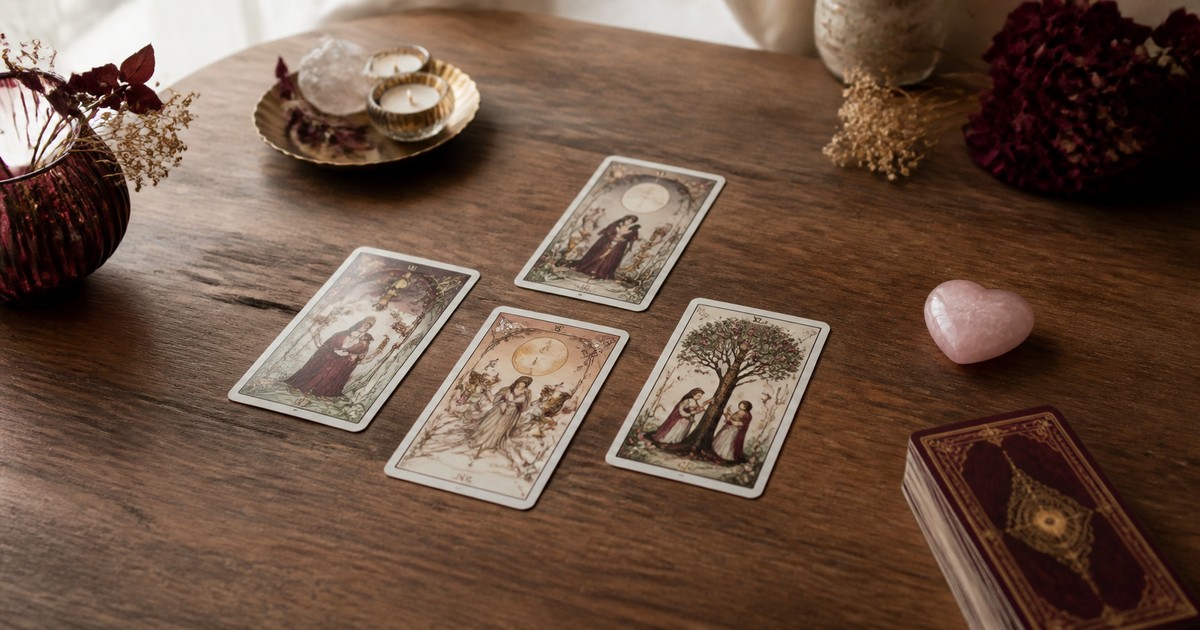
A love tarot reading uses the symbolism of a 78-card tarot deck to explore relationship patterns, feelings, choices, and possible directions. It can offer a fresh framework for reflection, but it cannot verify another person’s private thoughts, guarantee a soulmate, or replace an honest conversation.
Quick Guide
- Best questions: ask about your patterns, boundaries, choices, and next steps.
- Before booking: check the full price, timing, privacy terms, reader method, and refund policy.
- During the reading: request plain-language interpretations and distinguish possibility from fact.
- Afterward: write down what resonated, verify claims, and decide in your own time.
- Stop immediately: if a reader uses fear, guarantees, curses, secrecy, or escalating payments.
What Is a Love Tarot Reading?
Tarot decks usually contain 22 Major Arcana cards and 56 Minor Arcana cards. Readers interpret imagery, card position, the spread, surrounding cards, and sometimes upright or reversed orientation. Major Arcana cards often frame broad themes; Minor Arcana cards tend to describe everyday emotions, communication, conflict, and action.
Interpretation is contextual rather than fixed. The same card may invite different questions depending on whether you are dating, rebuilding trust, considering a breakup, or reflecting on a recurring pattern. If you are new to the deck, this guide to learning how to read tarot explains the basic structure.
What Love Tarot Can and Cannot Tell You
Tarot may help you name an emotion, notice an assumption, consider a boundary, or imagine an option you had overlooked. Its value is often in the questions it opens. It cannot establish that someone is faithful, prove that an ex will return, diagnose a partner, or obtain another person’s consent on your behalf.
Cards such as the Lovers, Two of Cups, Devil, Tower, or Three of Swords do not have one automatic relationship verdict. A skilled, ethical reader explains several plausible meanings and invites you to test them against reality rather than announcing a frightening certainty.
Questions That Keep the Reading Empowering
- What relationship pattern am I ready to understand?
- What boundary would support mutual respect?
- What am I assuming that deserves a direct conversation?
- Which part of this situation is within my control?
- What would emotionally safe communication look like?
- What strength can I bring to my next step?
A yes-or-no question may feel efficient, but it can flatten a complex relationship. If you still want that format, learn how readers approach Major Arcana yes-or-no meanings, then follow it with an open question.
Choosing an Ethical Reader
- Look for a clear rate, session length, cancellation policy, and privacy statement.
- Read both positive and critical reviews for recurring patterns.
- Choose a reader whose description explains their method and limits.
- Avoid guaranteed accuracy, guaranteed reconciliation, or claims to control another person.
- Never pay to remove a curse or emergency that the reader introduced.
If you are using tarot alongside emotional self-care, keep the practice proportionate. The site’s discussion of tarot and mental wellness explains why reflection should complement—not replace—qualified support.
Preparing for a Love Tarot Reading
- Write a one-sentence description of the issue without including unnecessary identifying details.
- List two open questions and one practical follow-up.
- Set a time and spending limit before the session begins.
- Decide which topics are private or off-limits.
- Keep a notebook nearby and avoid recording anyone without consent.
After the Cards Are Drawn
Separate the interpretation into three columns: what the reader said, what you know from evidence, and what you want to explore. Wait before making a major decision, especially when you feel frightened, euphoric, or pressured. Healthy guidance should leave room for your agency.
If a relationship includes coercion, stalking, threats, or violence, prioritize real-world safety planning and qualified local help. Do not use a tarot reading to assess immediate danger.
Key Takeaways
- Love tarot is a symbolic practice for reflection, not proof of another person’s feelings or future behavior.
- Open questions about your choices are usually more useful than demands for certainty.
- Card meanings depend on spread, position, context, and reader approach.
- Transparent pricing, privacy, consent, and realistic language are trust signals.
- Verify important claims and keep medical, legal, safety, and financial decisions with qualified sources.
Frequently Asked Questions
Can love tarot predict whether a relationship will last?
No. It may frame possibilities or patterns, but it cannot guarantee an outcome.
Can tarot reveal what someone secretly thinks?
It cannot verify another person’s private thoughts. Direct, consent-based communication is more reliable.
Which cards mean true love?
The Lovers, Two of Cups, Ten of Cups, and others may be read positively, but no card proves “true love” by itself.
Do reversed cards mean something bad?
Not necessarily. Depending on the reader, they may suggest delay, internal focus, imbalance, or a modified expression.
How long should a reading be?
Choose enough time for your questions without exceeding your budget. A focused short session can be useful.
Should I share my partner’s personal details?
Share as little identifying information as possible, especially without that person’s permission.
Can I read tarot for myself?
Yes. Write the question and interpretation down so you can notice wishful thinking or repeated assumptions.
How often should I ask the same question?
Avoid repeated readings for reassurance. Give yourself time to act, observe, and gather real information.
What is a red flag in a love reading?
Fear, guaranteed reconciliation, curse claims, secrecy, pressure, or demands for escalating payment are major red flags.
Can tarot replace couples counseling?
No. A licensed counselor offers evidence-based help for communication, conflict, trauma, and relationship decisions.