

A spiritual awakening can describe a change in how you understand yourself, your beliefs or what makes life meaningful. It may feel hopeful, unsettling or both. You do not have to prove that you are “awake,” follow a fixed sequence or abandon your ordinary life to explore it.
Tarot, prayer, quiet time and journaling can give that exploration a shape. The aim here is to make room for meaning while keeping your choices, relationships and everyday care in view.
What spiritual awakening can mean
People use the phrase differently. For one person, it means a deeper relationship with an existing faith. For another, it means questioning inherited beliefs, rethinking work after burnout or discovering a stronger connection with nature. A loss, illness or life transition may bring those questions forward; there need not be one dramatic turning point.
Spirituality and religion are not opposites. A 2017 Pew Research Center survey found Americans describing themselves in several ways, including both spiritual and religious. That historical survey was not a test of awakening or evidence that one path is more advanced.
There is no need to rank yourself against someone else’s account. A useful measure is whether your exploration leaves room for kindness, uncertainty and responsibilities—not whether you match an online list of signs.
Common experiences, without a checklist to pass
These are possible experiences people connect with change, not diagnostic signs. Consider what is happening in your actual life alongside any spiritual interpretation.
- Old goals feel less compelling
- Ask which part no longer fits: the goal, the pace or somebody else’s expectations. Before discarding everything, name one value you want to keep and one small change you can try.
- Emotions feel closer to the surface
- Leave room for grief, stress and tiredness rather than assuming every feeling is an energy shift. Note when it happens and what support you need; persistent or disruptive changes deserve care.
- You want more quiet or different company
- Solitude can make space to think. It need not mean cutting off everyone who does not share your vocabulary. Keep contact with people who respect your boundaries and can listen honestly.
- Dreams, numbers or coincidences stand out
- You may find personal meaning in them. Record what happened separately from what you think it means, and notice examples that do not fit. A coincidence need not become an instruction.
Words such as energy, karma, old soul, chakras and past lives belong to different spiritual traditions and contemporary practices; they are not interchangeable. You can explore them without treating a personal interpretation as a verified explanation of an event or a medical condition. Our guide to past-life feelings explores that distinction through familiar experiences.
A small tarot-and-journal practice
The Major Arcana offer images of change, reflection and renewal. Read them through your deck’s tradition and your own spiritual perspective, not as a test that certifies an awakening. Start with one card rather than repeatedly drawing until you get a reassuring answer.
- Describe the day. Write what changed in ordinary words: “I felt distant from work,” rather than “Everything is falling apart.”
- Draw and observe. Note three details in one card before consulting its guidebook. Ask what each detail brings to mind, without forcing a connection.
- Choose a modest response. End with one action you can actually take. Review the note later: what helped, and what did not fit?
- The Hermit: purposeful solitude
- What do I need time to consider, and when will I reconnect with someone?
- Death: an ending or transition
- What am I ready to release, and what deserves a careful goodbye? The card is not a prediction of physical death.
- The Tower: a challenged structure
- Which assumption needs checking? What practical support would help if a plan changes? The image does not establish that a disaster is coming.
- The Star: renewal and hope
- What restored a little steadiness this week, and can I make room for it again?
- Judgement: review and response
- What can I acknowledge honestly, and what is one response I can choose without punishing myself?
For example: after a job change, you draw the Hermit and notice the lantern. “I need a little light, not the whole route,” becomes your journal line. Your next step is a short walk and a conversation with a trusted friend—not cancelling every commitment or deciding the card demands isolation.
If a card does not resonate, record that too, or put it aside. The notebook is a place to explore, not evidence that every image must describe your life. For a broader routine, see tarot as a reflective wellbeing practice.
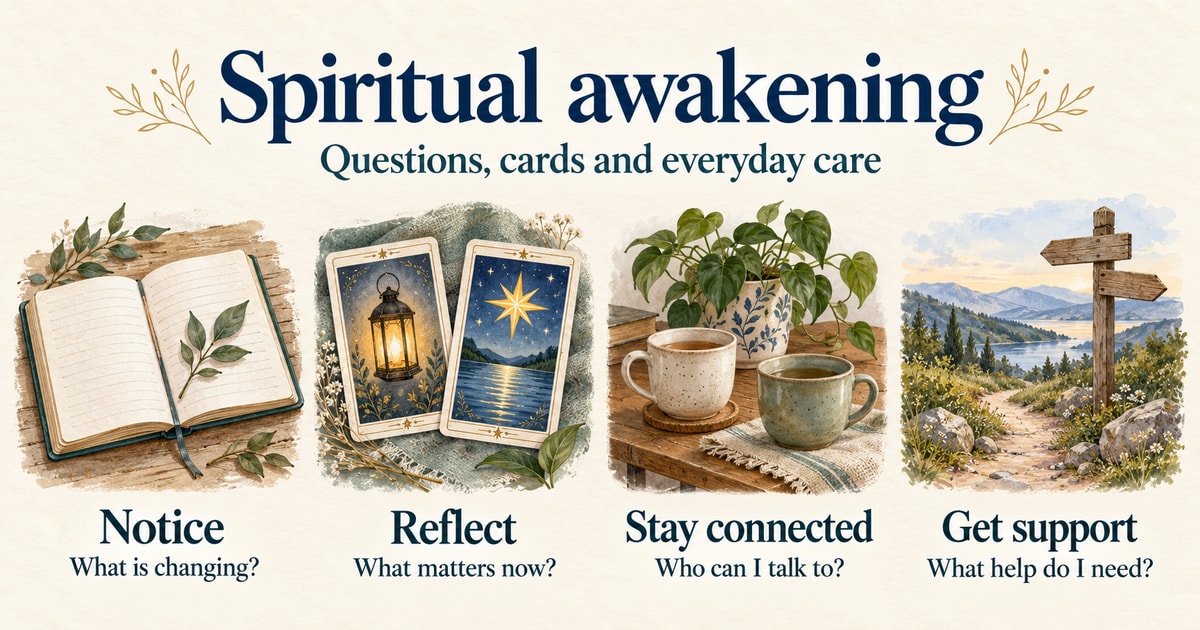
Four supports for everyday grounding
These can work alongside a spiritual practice. They are parallel options, not required stages or a timetable for awakening.
Notice
Ask “What is changing?” Keep a brief note of circumstances, feelings and questions. You can leave the explanation undecided.
Reflect
Ask “What matters now?” Choose a manageable amount of prayer, journaling or card work, with permission to stop.
Stay connected
Ask “Who can I talk to?” Keep supportive relationships, meals, rest and ordinary commitments in the picture.
Get support
Ask “What help do I need?” That may be practical help, a trusted faith leader or a qualified health professional, depending on the concern.
For a major, non-urgent decision, write down the practical costs and alternatives and choose a review date. A month may be a useful pause, not a rule that overrides safety, deadlines or urgent care. Limit content that makes you feel pressured to achieve the next spiritual level.
Meditation is optional. The NCCIH overview of meditation describes possible benefits, research limitations and negative experiences. Do not push through a practice that increases distress or use it to postpone needed care.
When to get support before interpreting
A spiritual explanation cannot determine why your sleep, mood or perception has changed. Seek prompt professional assessment for greatly reduced sleep with unusual energy, racing thoughts or risky behaviour, or experiences such as hearing voices or feeling watched. The NIMH guides to bipolar disorder and psychosis explain why assessment matters. You do not need to wait a set number of nights.
In the United States, call or text 988 for emotional distress, crisis or thoughts of suicide; it is free and available around the clock. Call 911 for immediate life-threatening danger. Outside the US, use local crisis or emergency services.
Discuss medication changes with your prescriber, not a reader or coach. Getting care does not require giving up your beliefs.
Choosing paid help without pressure
A paid reading or class can have a clear price, duration and scope. Before booking, ask what you receive, what the total can be and whether you can decline further sessions. A spiritual label, warm manner or impressive testimonial is not a professional health qualification.
Be wary if someone says only they can remove a hidden curse, attachment or past-life contract, threatens harm if you refuse, demands secrecy or keeps escalating the fee. Those are concrete warning signs of exploitation—not proof of a spiritual problem. The issue is the pressure and deception, not simply that a service charges money.
If you suspect a scam, stop sending money, keep messages and receipts, and promptly contact the payment provider. The FTC’s recovery guidance explains options and how to report it; recovery is not guaranteed.
Questions and answers
1. What is a spiritual awakening?
It is a phrase people use for a change in meaning, beliefs or identity. It can describe a deepening faith or a period of questioning. There is no universal certificate, required experience or ranking to achieve.
2. Do I need to experience every commonly reported sign?
No. Dreams, emotional changes or a wish for solitude do not form a test. Start with your own circumstances and needs rather than trying to make your life match somebody else’s checklist.
3. How long does an awakening last?
There is no standard timetable. You may describe a sudden insight, an extended transition or several periods of reflection. Do not postpone help for distress because you think you must complete a spiritual stage first.
4. Why might I feel tired or emotional?
There can be several reasons, including what is happening in your life. Do not assume an energy shift explains it. Keep notes about changes and seek appropriate care if they persist, trouble you or disrupt daily life.
5. Can grief or illness lead me to question my beliefs?
Yes, a major change can prompt questions about meaning or faith. It does not oblige you to find a spiritual lesson in suffering. Practical care, grief support and your chosen spiritual practices can coexist.
6. Does a dark night of the soul mean I have depression?
The spiritual phrase does not establish a diagnosis or rule one out. Describe the actual feelings and difficulties to a qualified professional rather than assuming either a necessary spiritual trial or a particular illness.
7. Can tarot confirm that I am awakening?
A card cannot certify a life stage. You can use its imagery to explore what is changing, compare interpretations and choose a response. A reading should leave room for your judgment and real-world information.
8. Which cards can help me reflect on change?
The Hermit, Death, Tower, Star and Judgement provide the prompts above. Other cards may be useful too. Choose meanings from your deck’s tradition; drawing a dramatic card does not establish an approaching event.
9. How much should I write in a tarot journal?
A few lines are enough: what happened, what you noticed in a card and one possible response. Include uncertainty or a lack of connection. Review earlier entries without rewriting them to fit later events.
10. Should I act on repeated numbers or coincidences?
They can prompt reflection if that is meaningful to you. They do not independently verify an instruction. Use practical information, consent, costs and safety when deciding what to do, especially with money or relationships.
11. Do old-soul and lightworker labels make someone more advanced?
No label establishes greater worth or authority over another person. Use a description only if it helps you understand yourself without creating pressure, superiority or a duty to rescue everyone around you.
12. How can I tell when professional support matters?
Focus on changes in sleep, functioning and safety, not the label. Unusual energy with very little sleep, risky behaviour or changes in perception warrant prompt assessment. A spiritual interpretation cannot diagnose their cause.
13. What if I have barely slept and feel unusually wired?
Contact a health professional promptly and tell someone you trust. Do not wait for three nights or try to intensify the experience. If you feel unsafe or in crisis, use crisis or emergency support.
14. Should I change medication to become more spiritually aware?
Do not change or stop a prescription on spiritual advice. Discuss concerns with your prescriber, including side effects or how a practice makes you feel. A reader or coach cannot make that decision for you.
15. What should I ask before paying a coach or reader?
Ask about the full price, session length, relevant qualifications, boundaries and cancellation terms. Decline promises of guaranteed activation or pressure to buy another level. You can take time to decide or choose no paid service.
16. What if someone says I must pay to remove a block?
Do not treat their claim as proof of a hidden threat. Pause when fear, secrecy or escalating fees enter the conversation. Keep records, stop suspicious payments and seek independent support or payment-provider advice.
17. Must I leave my job or relationship?
An awakening label does not decide that. Separate values from immediate feelings, consider practical options and get relevant support. A review period can help with non-urgent choices; threats or abuse need safety-focused help without a forced waiting period.
18. What if meditation makes me feel worse?
Stop or reduce the practice rather than forcing yourself through it. You can choose ordinary activities and conversation instead. Seek qualified support for distress, and do not use meditation as a reason to delay care.