

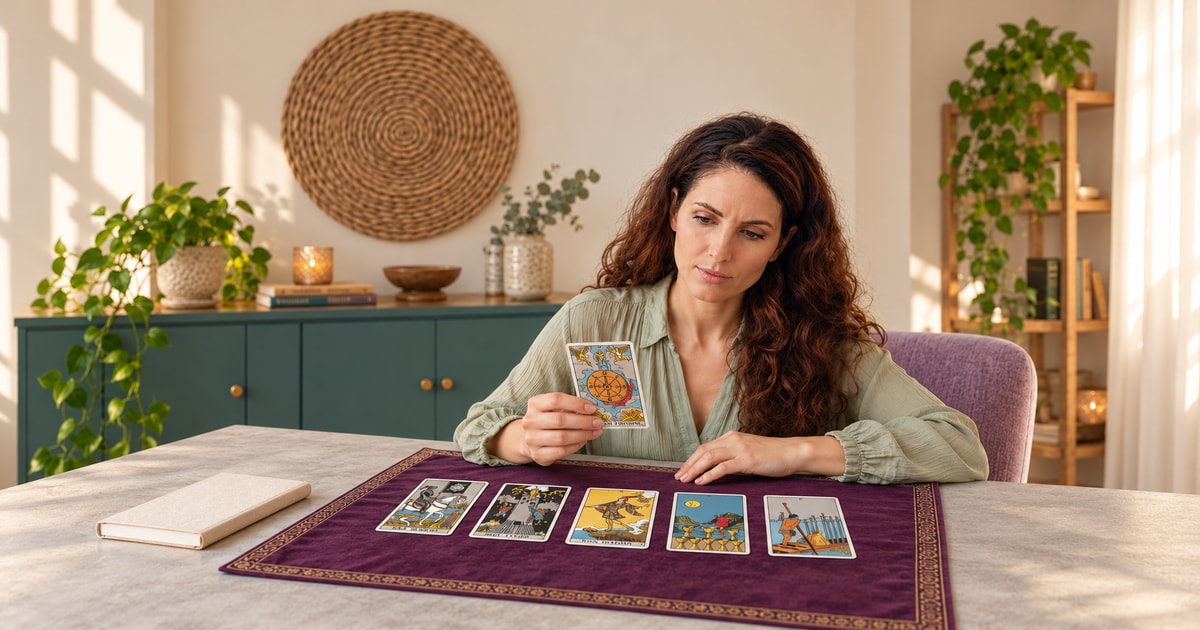
Death, the Tower, the Wheel of Fortune, the Fool, the Eight of Cups and the Six of Swords each offer a different way to think about change. An ending is not quite the same question as choosing to leave; a sudden disruption is not the same as a gradual passage. Noticing those differences can make a reading more useful than treating all six as “something is about to happen”.
These are symbolic reading possibilities, not evidence that a change is coming—or that something must already be wrong. You can value tarot’s spiritual language while leaving the timing and outcome open.
Six cards, compared in three pairs
The descriptions below use the Rider-Waite-Smith images as a starting point and a contemporary reflective approach. They are not a complete list of meanings or a ranking of the cards most likely to appear. Other decks and reading traditions may give them a different emphasis.
1. An ending, or a decision to leave?
Death (XIII)
An ending or transition
The armoured rider and rose banner can invite reflection on a chapter changing: a role, routine or way of understanding yourself. An ending may involve grief, relief or both. It does not have to reveal an exciting replacement immediately.
Try asking: What may be ending, and what would help me acknowledge it?
Eight of Cups
Stepping away or reassessing
The departing figure can prompt a question about withdrawing attention from something that no longer feels worthwhile. Leaving is one interpretation to consider, not an obligation. You may be reconsidering an expectation rather than a person or place.
Try asking: What am I continuing, and what reasons do I have for staying or stepping back?
The distinction: Death puts the idea of an ending in focus; the Eight of Cups can put attention on your relationship with staying or leaving. Neither establishes that a relationship is over, that departure is possible or that someone will die.
2. Disruption, or a turn in circumstances?
The Tower (XVI)
An assumption disrupted
Lightning, falling figures and a displaced crown make a forceful image. A reflective reading might examine a plan or belief being challenged. It need not mean an actual disaster, and it does not prove that anyone built their life badly.
Try asking: Which assumption would be worth checking against what I know?
Wheel of Fortune (X)
Cycles and changing conditions
The turning wheel can prompt reflection on circumstances you influence only partly: a schedule, a wider situation or a pattern you have noticed. You can explore adaptation without assuming every turn is fate or that events must repeat.
Try asking: What is changing around me, and where do I still have a choice?
The distinction: The Tower can focus a reading on the experience of disruption; the Wheel can focus it on changing conditions or cycles. These are different lenses, not a scale from worse luck to better luck, and neither supplies a date.
3. Beginning, or making a passage?
The Fool (0)
Meeting something unfamiliar
The traveller near a cliff can open a reflection on curiosity, inexperience and taking a first step. The edge belongs in the image too: enthusiasm does not remove practical risks. A beginning can be a small experiment rather than a leap.
Try asking: What could I begin, and what preparation would make it more manageable?
Six of Swords
A transition and its support
The boat, passengers and ferryman offer a way to think about moving through a change with help. A journey may be literal or metaphorical in your reading. The card does not confirm that a transition has begun or guarantee a calmer destination.
Try asking: What support would help with this passage, and how could I check whether it is available?
The distinction: The Fool can draw attention to entering unfamiliar territory; the Six of Swords can draw attention to the process and support of a passage. You may be physically staying in place while considering either theme.
Historical texts are not one reassuring rulebook. Waite’s Eight of Cups entry, for example, describes a departing figure while recording differing interpretations. His Six of Swords entry includes the ferryman and a journey. The practical questions here are ways to explore those images, not claims that every older author taught this exact approach.
If Death or the Tower has frightened you, our guide to interpreting difficult tarot cards looks more closely at the pictures and their limits. You do not have to turn an unsettling card into either a warning or a compulsory positive lesson.
The position changes what you ask
A card’s role in the spread matters as much as its keyword. Consider Death in three different positions. These are alternatives for different layouts, not three simultaneous messages.
- A past position
- Ask whether Death connects with an ending you actually remember. If it does not, do not invent a forgotten event to make the card fit.
- An advice position
- Explore what might be useful to finish, accept or approach differently. Treat the interpretation as an option to examine, not an order to cut something off.
- A possible-outcome position
- Consider one scenario and how you would respond. The card does not establish that the scenario will occur or make it inevitable.
Neighbouring cards can add another question, not certainty. The Wheel beside the Fool might invite reflection on responding to unfamiliar circumstances. It does not promise an opportunity, tell you which offer to accept or prove a new chapter has begun. Two change-associated cards are not a countdown.
Reversed does not automatically mean delayed
Some readers explore resistance, inward change or a theme expressed too strongly or too weakly. Others use a deck’s guidebook or do not read reversals. There is no universal rule that an upside-down Death, Tower or Wheel is simply a softer version of the upright card.
Choose a convention before the reading, and describe it honestly. “I am considering whether I feel stuck” is different from “this card proves my change is blocked”. A reversal cannot set a timetable or diagnose why something has not happened.
Turn the theme into a useful question
- Record the question and position. “What support could help with this move?” gives the Six of Swords a different job from “What am I reluctant to begin?” Write that context before interpreting.
- Name a possible kind of change. Try ending, stepping away, disruption, changing conditions, beginning or passage. Use the comparison that fits your chosen method, and allow “none of these fits yet”.
- Separate the image from your evidence. Write what you actually know beside what the card makes you wonder. A strong feeling, repeated card or dramatic combination does not verify an event.
- Choose a proportionate response. You might ask a question, check a practical detail, seek support or leave the reading unresolved. Revisit the choice when new information arrives rather than waiting for a card to grant permission.
A short practice example
Imagine you already have a confirmed start date for a new role. You draw the Six of Swords in a position called “Support to consider”. The known fact is the start date; the card did not reveal it.
You might use the boat scene to ask who can help with a handover, what information you still need and which part of the transition feels demanding. A practical next step could be asking for a handover checklist. It is not proof that the new role will be calmer or that all difficulties will be left behind.
If you want a fuller exercise after comparing the cards, try our keep, release, start practice. It separates what you want to retain from what you might change, then gives you a way to check in on the plan.
What if no change card appears?
You do not need one of these six cards to think about a real transition. A familiar routine, a conversation or a practical task may be the most relevant part of your question. Nor do you need to keep drawing until you find a card that matches the story you hoped for.
The same applies if a change-associated card appears when life feels settled: you can leave its relevance uncertain. Do not search for a hidden problem just to make it fit. For decisions involving health, finances, legal matters or safety, check the real-world information and seek appropriate qualified advice rather than using a card as permission to act.
Let the difference sharpen the question
Ending, stepping away, disruption, changing conditions, beginning and passage are six useful lenses—not six promised events. Choose the question that genuinely helps you reflect, and give yourself room to revise the answer.
For choosing a layout and weighing options, continue with Tarot Card Reading for Hard Decisions.