

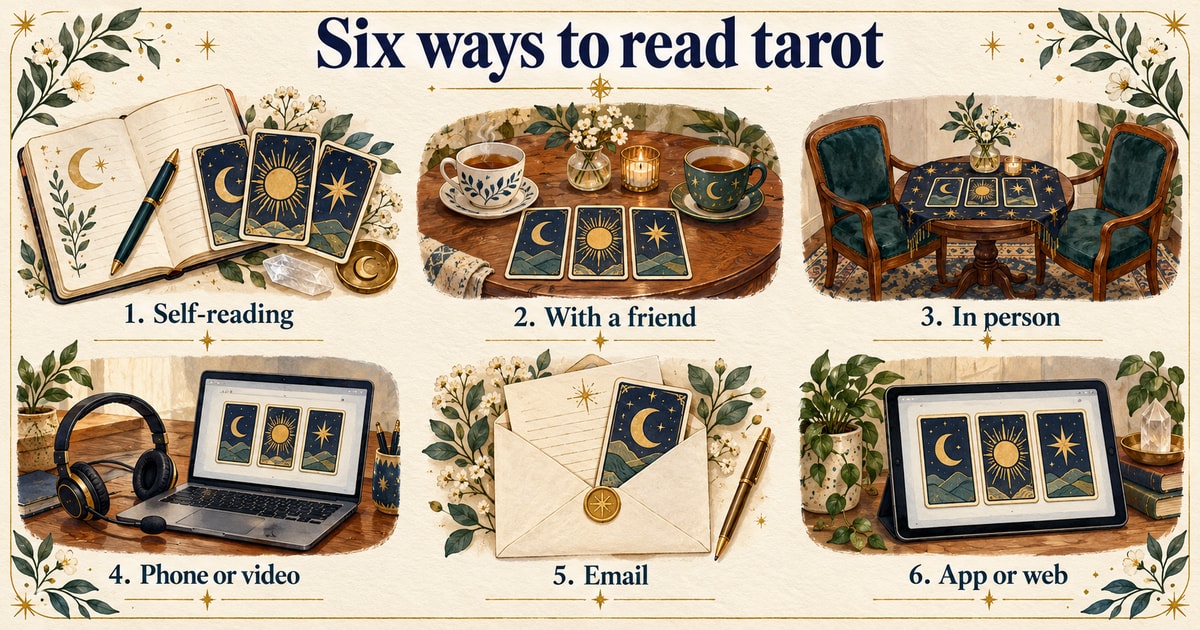
Choose a tarot reading by the kind of exchange you want, not by promises of certainty. Reading alone, sharing cards with a friend and booking a professional session offer different experiences. So do a live conversation, a written response and an automated draw.
A standard tarot deck has 78 cards, but decks, reading traditions and personal approaches vary. The format changes how you communicate, what you pay for and what record you keep. It does not establish that an interpretation can reliably predict events or reveal someone else’s private thoughts.
Six ways a tarot reading can work
The same format can be offered in different ways. Confirm the actual service rather than assuming every reader or app follows one model.
1. Self-reading
The exchange: You choose a question, draw cards and interpret them using their images and a matching guidebook. You control the pace and can pause to study.
Useful when: You want to learn the deck or reflect privately without booking a session. A notebook preserves your first interpretation.
Check first: Notice repeated reshuffling or changing the question to obtain a preferred answer. Set a stopping point. Our ten beginner habits give you a manageable starting routine.
2. With a friend
The exchange: You agree who asks, who reads and whether you will take turns. Either person may handle the cards; choose what feels comfortable.
Useful when: You want to practice explaining an image aloud or hear another perspective. A friend’s familiarity can make conversation easier.
Check first: Agree on privacy and permission to decline a topic. Friendship does not remove bias. Separate what the card suggests from what your friend already knows or personally wants for you.
3. Professional, in person
The exchange: You meet a reader at an agreed venue and discuss the cards together. Sessions may have a fixed duration or another clearly stated fee arrangement.
Useful when: You prefer a face-to-face conversation and seeing the physical spread as it develops.
Check first: Ask about the location, accessibility, duration, price and any recording. “Professional” describes a service, not proof of psychic ability or a regulated counseling qualification. You can end a session that becomes uncomfortable.
4. Professional, phone or video
The exchange: A reader speaks with you remotely, or you use live text chat. The reader may draw physical or digital cards; ask if that matters to your experience.
Useful when: Travel is difficult or you prefer a conversation from your own space. Video can show a spread; phone and text have different access needs.
Check first: Confirm whether billing is per minute or per session, when it starts and how to stop. A remote call is not automatically private: consider your surroundings and the platform’s recording or transcript policy.
5. Email reading
The exchange: You submit a question and receive a written interpretation, sometimes with photographs of the cards. Delivery is not necessarily immediate.
Useful when: You prefer time to formulate a question and a response you can reread at your own pace.
Check first: Agree on the reply time, scope, price and whether clarification is included. Some readers allow follow-up questions; others charge separately. Share only the personal details needed for the question, not identity documents or account credentials.
6. App or website draw
The exchange: Software selects or displays cards and supplies interpretations. Some tools use fixed text; others generate conversational responses. A human reader may not be involved.
Useful when: You want quick access to images, keywords or a practice journal. Look for explanations that match the deck being displayed.
Check first: Distinguish a human service from automated text, even when it sounds personal. Check subscriptions, data use and cancellation terms. A follow-up response from software is not evidence that it knows your circumstances.
Choose the exchange you actually need
If your aim is learning, start with self-reading or a willing practice partner. If you want to ask questions as the interpretation unfolds, a live session may fit better. If you prefer writing and time to reflect, compare email services and their clarification policies.
For example: someone preparing for a career change might prefer email so they can reread the spread later. Someone unsure how to phrase the question might prefer a live conversation. Neither choice makes a job offer more certain; the difference is how they want to explore their choices.
Three checks before paying
- Define the service. Confirm the format, question scope, delivery time and what is included. Ask whether a human reader is responding.
- Set the total limit. Check the rate, minimum charge, renewal terms and any separate follow-up fees. Decide your maximum spend before the session, and keep it.
- Plan the finish. Know how to end the call or chat, cancel a subscription and contact support. Save the agreed terms and receipt.
The guide to preparing for a tarot reading helps you bring a focused question. For the deck’s structure and first spreads, use Tarot Cards for Beginners.
Recognize pressure, whatever the format
Be wary of threats that harm will follow unless you pay to remove a curse or “blocked energy.” Do not let fear turn an agreed reading into escalating payments. Keep decisions about treatment, legal action or major spending connected to appropriate professional advice, not a reader’s claimed certainty.
If you believe you paid a scammer, the FTC’s recovery guide explains whom to contact for different payment methods and how to report fraud. A refund is not guaranteed. You can value tarot and still insist on transparent terms, consent and control over your money.