


“When?” can be the question that brings you to a reading. Tarot timing methods explore pace, seasons and the conditions around a possible event. You might read a suit as a season, pair a number with a chosen time unit, or notice the movement and stillness in a card’s imagery.
Choose your approach before drawing, then give your intuition room to respond within that framework. Timing symbolism can be spiritually meaningful without turning a possible window into a promised date.
It also helps to name what you need: a sense of the pace, reassurance about an uncertain outcome, or a next step you can take. Those are different questions. Keep real appointments and deadlines in view while you explore what the cards bring to the conversation.
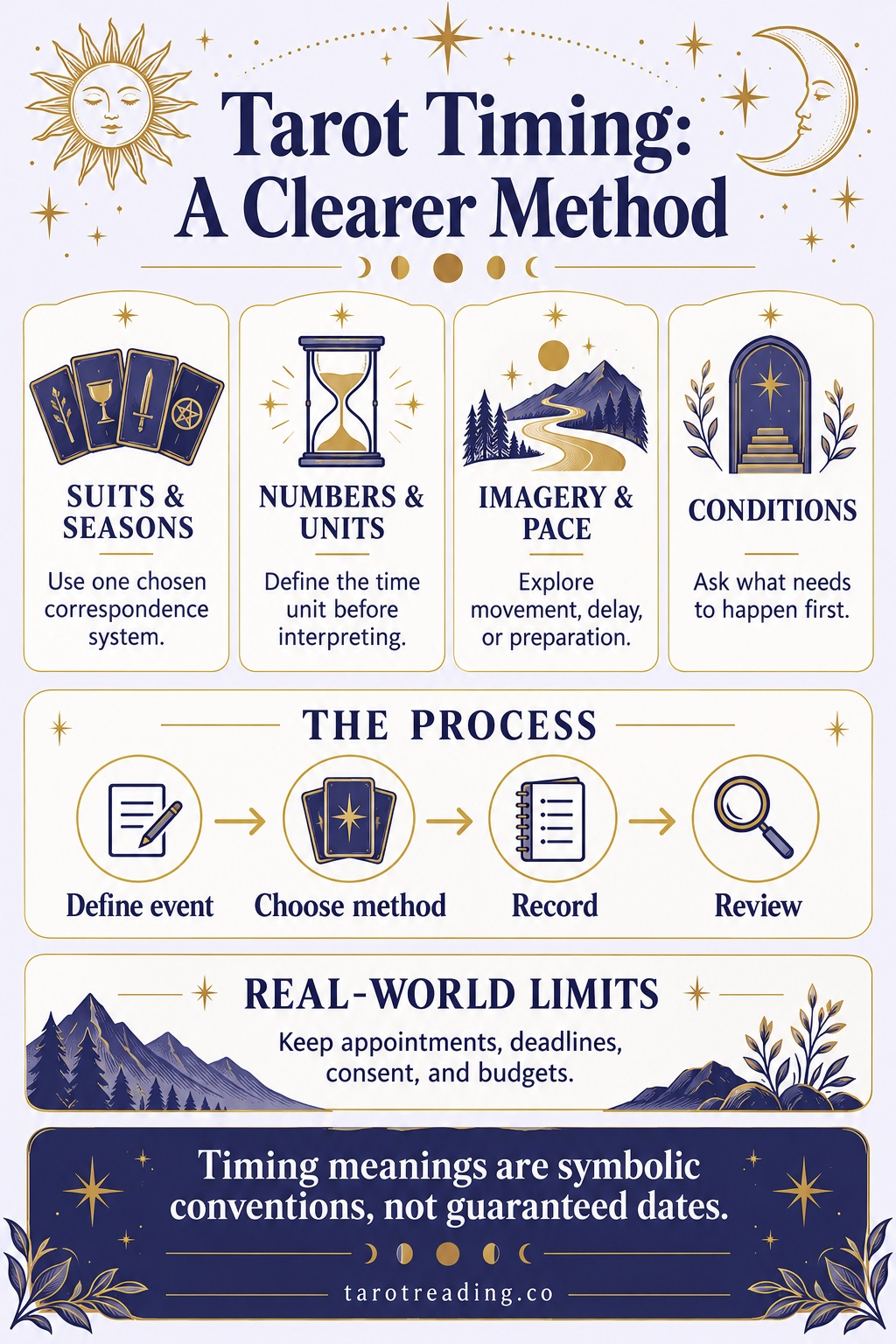
Read the infographic as text
- SUITS & SEASONS: Use one chosen correspondence system.
- NUMBERS & UNITS: Define the time unit before interpreting.
- IMAGERY & PACE: Explore movement, delay, or preparation.
- CONDITIONS: Ask what needs to happen first.
- THE PROCESS: Define event → Choose method → Record → Review
- REAL-WORLD LIMITS: Keep appointments, deadlines, consent, and budgets.
Timing meanings are symbolic conventions, not guaranteed dates.
Timing and Disagreements
Tarot card decks don’t come with one universal calendar system that is used by all readers. People have developed different associations with traditions, imagery, astrology, and personal practice. Even familiar suit correspondences can be different between the books and the readers.
One teacher might use the Wands with spring, and another might put them in the summer. A reader might use the Swords as a suit that moves fast in one method and put it in a season in another. This doesn’t mean that someone is being dishonest, but it means that the system has to be told instead of just assumed.
Keep a short key beside your deck: the method, the associations you have chosen and the kind of answer you are seeking. That makes it easier to compare two readings without accidentally switching from seasons to days halfway through.
When you compare two interpretations, first check that they answer the same question using the same method. A symbol of slow progress and an exact date are different kinds of answer; comparing them as though they are interchangeable can create a conflict that comes from the methods rather than the cards.
Suits and Seasons
For one seasonal exercise, you could choose Wands for spring, Cups for summer, Swords for autumn and Pentacles for winter. Write that key down before shuffling. It is the framework for this exercise, not a rule that every tarot reader or deck must follow.
If you pick seasonal symbolism, figure out what the season means in the reading. Does it refer to the occurrence of the season, a general atmosphere, or a time of preparation? The interpretation is unclear when the meanings change after the results.
Geography matters. Spring in one area might be different in another hemisphere, going into autumn. A reader and a client who live in different places need to clarify what the seasonal calendar means. Climate and personal experiences can make the image of winter feel different depending on the location.
You can also use seasonal imagery to explore a process: beginning in spring, tending growth in summer, reviewing in autumn and resting or preparing in winter. These are optional reflection themes, not fixed meanings or a calendar prediction.
Number and Time Units
In a number-and-unit method, the card number gives the count and your chosen rule supplies the unit. If your rule is Wands = days, the Three of Wands suggests three days within that system. Another reader may choose a different key. Keep yours consistent for the reading.
The important point is to figure out the rules before you draw the cards. Do not change the Three of Cups from three days to three weeks, three months, or a third season after learning what happened. The method that is too flexible misses out on honesty.
For a low-stakes reading, try to use a card to choose a reflection interval instead of predicting an event. If your rule suggests three weeks, schedule the review in three weeks. You are setting your own review date and not saying that the card has told you when someone else will act.
Make that distinction in your notes. “I will check my progress again after three weeks” is a review date you choose. “I will receive an offer in three weeks” is a prediction about an uncertain event. The same number can serve very different purposes.
Correspondences and Context
Some tarot traditions connect cards with zodiac signs or planets. A reader may use those correspondences to suggest a part of the year. This is a different approach from simply noticing a seasonal scene in the artwork, so be clear about which one you are using.
Pick a guide that matches your deck or the traditions and the records that you use. Different systems can assign cards in different ways. Don’t combine different tables that are incompatible just because one has a date that you like.
If a reading looks at a sign’s season, look at the year and if the reader means symbolism or a real time window. You don’t have to add a detailed astrology system if your purpose is a simple reflection. Complexity doesn’t mean a prediction will be more reliable.
An astrological association can be looked at as a quality instead of a date. A card linked with a certain sign, for example, might prompt you to reflect on your actions. If you use that approach, state it clearly so that the client doesn’t think that this is an actual date on the calendar.
Card Imagery
Images of waiting, building, resting, or movement can talk about pace. A reader might see activity in one card and work in another. These impressions need to be looked at in the context of the question instead of being exact units.
Suppose you’re reflecting on a language that you’re learning. A card that is associated with practice can lead to a discussion about routines. It doesn’t mean a day when you will become fluent, but it’s more about your starting level, study time, and opportunities to keep the practice relevant.
A card read as preparation in one position may speak about your next action in another. For example, an image of patient work might invite you to build a study routine rather than name the day you will master a skill. Keep the question and the spread position beside the image as you interpret it.
Describe the impression in language that leaves room for interpretation: “This card feels like a pause for preparation” or “I read this movement as encouragement to act.” You can honor the spiritual meaning you find without declaring that an unseen force has fixed or delayed the event.
Ask About the Event
If you ask, “When will my ex come back?” You’re assuming that this is going to happen. A timing answer can reinforce this accidentally even if the reader only wanted it to be seen as a possibility. The same issue happens when asking about job offers, pregnancy, promotions, and uncertain outcomes.
You can ask the question around preparation or choice, such as, “What should I think about when my contact is uncertain?” This allows room for different outcomes. “What should I do before applying,” is a question that focuses on taking action without assuming you’re getting a job.
Try separating the event from your own action. “Will we speak again?” concerns an uncertain outcome; “How can I handle the uncertainty while respecting their boundaries?” concerns your response. A yes or no reading may suit the first kind of question, while an open spread can give the second more room.
If you still want to use predictive timing, ask the reader to be honest even if there’s uncertainty. Write down if the event is conditional and if nonoccurrence is a possibility. Then keep the answer from becoming an expectation that controls your choices.
Look at Conditions
A good timing conversation can look at practical conditions that you can look at. If you want to move home, ask questions about leases, finances, transport, and housing that is available. Symbolic reflections can help you to see what part of the preparation you have avoided, but the timeline depends on these conditions.
Separate that reading note into two sentences, where the first talks about symbols and the second names a practical question. The connection between them is about reflection and not proof that the card read the contract.
Don’t make uncertainty the client’s fault. Even if an event doesn’t happen, don’t just assume that they failed to let their energy align or that they caused the blockage to stop the prediction from happening. Some outcomes depend on other people, institutions, chance, and conditions outside of the client’s control.
This is important especially when it comes to sensitive situations. A timing reading shouldn’t suggest that someone can guarantee medical outcomes or reproductive issues. Encourage the right professional guidance when issues need it.
Combining Timing Methods
If you combine timing clues, give each one a clear role. Use one primary method for the time window, then read the other cards for context, conditions or the pace of your next step. Avoid collecting several unrelated dates and choosing whichever feels most reassuring.
For example, a suit-and-number rule might supply a possible window while a Major Arcana card invites attention to readiness or a turning point. If an intuitive impression differs from the chosen rule, record both rather than quietly replacing the original interpretation.
In your journal, separate the method from the impression: “My chosen rule suggests three weeks; the imagery feels like preparation.” This lets you explore both parts of the reading without pretending they are the same kind of information.
Readers often describe timing as conditional on choices and circumstances. If you interpret a spread as a possible direction, name the conditions that matter: a conversation, a decision or a practical step. Treat the timing as part of that interpretation rather than an appointment everyone else must keep.
Suits and Timing Clues
The four tarot suits can give the readers a way to look at timing. Wands, Cups, Swords, and Pentacles have their own energy, and some of the readers connect this energy with how fast a situation can develop or change.
- Wands: action and momentum; consider where a first step or focused effort is possible.
- Cups: feelings and connection; consider emotional readiness and the pace of a relationship.
- Swords: thought and communication; consider a conversation or decision that could change the situation.
- Pentacles: practical work and stability; consider what needs steady attention over time.
Different tarot card traditions show different timing systems in the suits. Some readers will connect them with days, weeks, months, or seasons, and others use the suits to understand the pace of a situation. Choose a system that works with your reading style but always explain it clearly instead of changing it as you go.
Look at the Cards Together
One card doesn’t always give the entire timing message. Look at the surrounding cards and the overall spread before deciding what the timing might mean.
For example, several Wands could create a strong feeling of movement and suggest that events are developing quickly. A spread filled with Pentacles might feel slower and more focused on building something over time. Cards connected with waiting, pauses, decisions, or major changes can also affect how the timing feels.
Numbers can add another layer when the unit is already defined. If you chose weeks before drawing, a Three suggests a three-week window within that method. Use the surrounding cards and your intuitive impressions to explore context, not to change weeks into months simply because a different answer feels more appealing.
Major Arcana cards can sometimes point toward a larger stage or turning point instead of giving an easy calendar date. In those cases, the event might connect more strongly with reaching a certain point in the situation than with a particular day.
Keep Realistic Limits Around Exact Dates
Tarot timing can give meaningful clues, but exact dates can be difficult. A reader might strongly sense a season, month, number, or general time frame without receiving an exact day.
When a reading suggests communication “soon,” explain whether you mean a feeling of momentum, a chosen timing window or a condition that needs to be met. Leave “soon” broad if that is all your interpretation offers; do not turn it into “Tuesday at 4:00” for the sake of precision.
Free will can affect timing too. Someone might delay a conversation, accept another job, change their mind, or make another choice that changes how quickly a situation develops. Outside circumstances can shift as well.
This is especially important with major decisions. A tarot timing prediction shouldn’t be the only reason someone quits a job, spends money they don’t have, ignores a medical concern, or makes another decision that could seriously affect their life. Spiritual guidance can be meaningful while practical information still has an important place.
Practice With Different Timing Methods
Pick a tarot card and an everyday question that involves timing. For example, you might ask when progress around a new learning opportunity is likely to begin.
Choose one method before shuffling and write down its rules. Then draw a card and consider the suit, number or imagery relevant to that method. Record the time frame you interpret and a short explanation. If you are reading imagery for pace rather than assigning time units, say so instead of adding a calendar date afterward.
Try the exercise again using another card from a different suit. Notice how the feeling changes. A Wand might suggest movement and action, while a Pentacle could show something developing more gradually. A Cup might make emotional readiness important, while a Sword could connect the timing with a conversation or decision.
The goal is to become more comfortable recognizing timing themes and explaining your reading. You do not have to force every card into an exact day. For a useful journal exercise, record one possible window or a description of the pace, one condition to watch and one action you can take. Later, compare your original note with what happened, including where the interpretation did not fit.
As you practice, you can find the timing methods that work best with your reading style. Staying consistent while still leaving room for psychic impressions can help you give timing messages in a way that feels natural, clear, and useful.
Allow for Uncertainty
Tarot timing can be interesting if the method is clear and the limits are known. Seasons, suits, numbers, and astrology can offer different ways to look at your pace and preparation. They don’t take away uncertainty from future events.
Choose a method, explain it and record your interpretation. Keep real deadlines in your calendar, respect other people’s choices and use relevant practical information for health or money decisions. That gives spiritual reflection a place in your life without making the reading a timetable you must obey.
Final Thoughts: Timing Draws and Rules
Before a reading, decide how many cards you’re going to use for the timing question and if any clarification draw is included in the reading. A stop rule stops the spread from going further each time an answer feels uncertain. Write down every draw, including the ones you don’t like.
If the cards don’t give you an interpretation that you understand, you can say that the method didn’t give you a useful answer. This is better than drawing cards until a good date appears for you. A reading is allowed to end with uncertainty instead of inventing a timetable.
For a paid reading, the reader needs to honor the duration and cost. A hard timing question isn’t a reason to keep billing the reading. Clear limits help to protect the client’s budget and make the method easier to review in an honest way.