


Tarot timing methods attach time meanings to cards with a chosen system. The reader might use a suit with a season, combine a number with a time unit, or use an astrological correspondence. Treat these as symbolic conventions rather than reliable calendar forecasts.
The limit doesn’t stop thoughtful spiritual practices, though, and timing symbolism can help you to reflect on things like pace, preparation, and patience. It isn’t useful, though, when it is suggested that the season should be a guarantee or that deadlines are ignored because the cards say there needs to be more time.
If you ask when, you should identify what you need. You might want a calendar date, reassurance that something will happen, or help deciding when to take action. These are different questions. A tarot card reader might support reflection about that action, but it doesn’t replace appointments, application deadlines, or conversations with the person who is involved.
The best way explains the chosen method, allows for uncertainty, and leaves room for an event not to happen. You can like symbolism without making your life depend on a timetable.
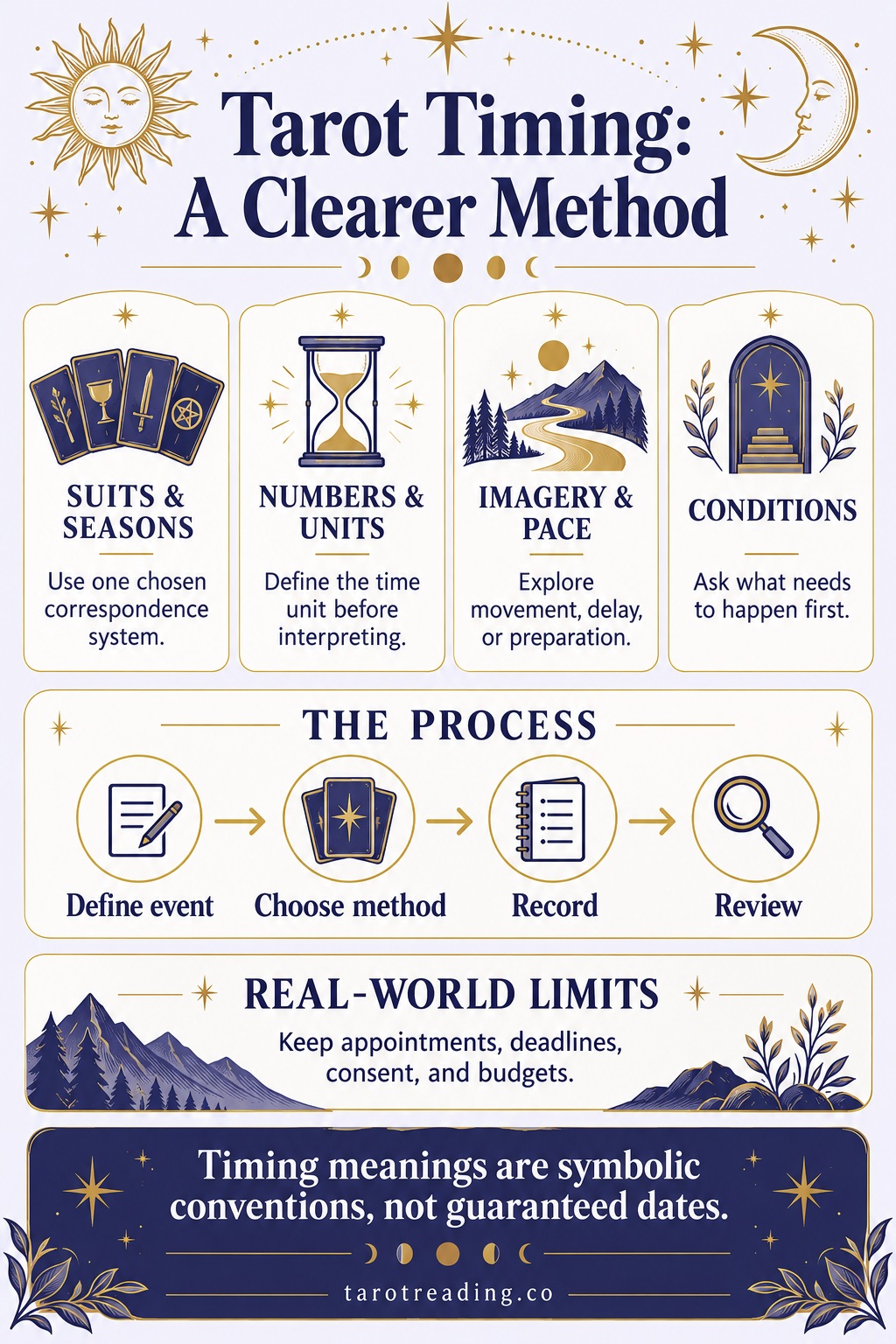
Read the infographic as text
- SUITS & SEASONS: Use one chosen correspondence system.
- NUMBERS & UNITS: Define the time unit before interpreting.
- IMAGERY & PACE: Explore movement, delay, or preparation.
- CONDITIONS: Ask what needs to happen first.
- THE PROCESS: Define event → Choose method → Record → Review
- REAL-WORLD LIMITS: Keep appointments, deadlines, consent, and budgets.
Timing meanings are symbolic conventions, not guaranteed dates.
Timing and Disagreements
Tarot card decks don’t come with one universal calendar system that is used by all readers. People have developed different associations with traditions, imagery, astrology, and personal practice. Even familiar suit correspondences can be different between the books and the readers.
One teacher might use the Wands with spring, and another might put them in the summer. A reader might use the Swords as a suit that moves fast in one method and put it in a season in another. This doesn’t mean that someone is being dishonest, but it means that the system has to be told instead of just assumed.
Brigit Esslemont’s discussion of tarot timing techniques presents several practitioner approaches, including suits and elements. It offers an example of modern reading conventions, not scientific validation of predictive timing. Other readers may use different associations.
When you look at the two interpretations, ask if they use the same questions and timing. Look at the symbols of pace and the exact date so that you can see conflict that was built into the methods.
Suits and Seasons
The convention described by Biddy Tarot associates Wands with spring, Cups with summer, Swords with autumn, and Pentacles with winter. Look at the named approach. It’s not a rule that each tarot card reader has to follow.
If you pick seasonal symbolism, figure out what the season means in the reading. Does it refer to the occurrence of the season, a general atmosphere, or a time of preparation? The interpretation is unclear when the meanings change after the results.
Geography matters. Spring in one area might be different in another hemisphere, going into autumn. A reader and a client who live in different places need to clarify what the seasonal calendar means. Climate and personal experiences can make the image of winter feel different depending on the location.
An original reflection can translate the season into questions about the process. Spring can bring attention to the beginning, summer to the activity, autumn to reviewing, and winter to effort. These are just suggested themes and aren’t universal meanings.
Number and Time Units
Some of the timing systems add the card number with the unit that is associated with the suit. In one convention, a numbered Wand card might suggest days while the Cups might mean months. Other methods show order or look at the number as a pace indicator.
The important point is to figure out the rules before you draw the cards. Do not change the Three of Cups from three days to three weeks, three months, or a third season after learning what happened. The method that is too flexible misses out on honesty.
For a low-stakes reading, try to use a card to choose a reflection interval instead of predicting an event. If your rule suggests three weeks, schedule the review in three weeks. You are setting your own review date and not saying that the card has told you when someone else will act.
Keep the differences in your notes. Say something like, “I will check my progress again after three weeks.” This is a way to be in control instead of saying, “I will get an offer in three weeks,” which is just a prediction that has to have later knowledge. The same number can have a different purpose depending on how you use it.
Correspondences and Context
Some tarot card traditions connect the cards with zodiac signs, planets, or other parts of the zodiac. The reader might use these things to look at part of the year. This kind of method uses a recognized seasonal image on a card.
Pick a guide that matches your deck or the traditions and the records that you use. Different systems can assign cards in different ways. Don’t combine different tables that are incompatible just because one has a date that you like.
If a reading looks at a sign’s season, look at the year and if the reader means symbolism or a real time window. You don’t have to add a detailed astrology system if your purpose is a simple reflection. Complexity doesn’t mean a prediction will be more reliable.
An astrological association can be looked at as a quality instead of a date. A card linked with a certain sign, for example, might prompt you to reflect on your actions. If you use that approach, state it clearly so that the client doesn’t think that this is an actual date on the calendar.
Card Imagery
Images of waiting, building, resting, or movement can talk about pace. A reader might see activity in one card and work in another. These impressions need to be looked at in the context of the question instead of being exact units.
Suppose you’re reflecting on a language that you’re learning. A card that is associated with practice can lead to a discussion about routines. It doesn’t mean a day when you will become fluent, but it’s more about your starting level, study time, and opportunities to keep the practice relevant.
Joan Bunning’s lesson on interpreting a single card is useful practitioner guidance about considering the card alongside the question and spread position. It supports contextual reading rather than a fixed timetable for every image.
Keep the descriptions known. Say something like, “This image tells me to consider if I’m rushing preparation.” This is better than “The universe has delayed the events.” The first is about reflection, and the second one is about something that can’t be verified.
Ask About the Event
If you ask, “When will my ex come back?” You’re assuming that this is going to happen. A timing answer can reinforce this accidentally even if the reader only wanted it to be seen as a possibility. The same issue happens when asking about job offers, pregnancy, promotions, and uncertain outcomes.
You can ask the question around preparation or choice, such as, “What should I think about when my contact is uncertain?” This allows room for different outcomes. “What should I do before applying,” is a question that focuses on taking action without assuming you’re getting a job.
Joan Bunning’s lesson on writing tarot questions offers a practitioner perspective on retaining responsibility for decisions. Its relevance is the way question wording shapes a reading. It does not establish that a revised question produces verified knowledge of the future.
If you still want to use predictive timing, ask the reader to be honest even if there’s uncertainty. Write down if the event is conditional and if nonoccurrence is a possibility. Then keep the answer from becoming an expectation that controls your choices.
Look at Conditions
A good timing conversation can look at practical conditions that you can look at. If you want to move home, ask questions about leases, finances, transport, and housing that is available. Symbolic reflections can help you to see what part of the preparation you have avoided, but the timeline depends on these conditions.
Separate that reading note into two sentences, where the first talks about symbols and the second names a practical question. The connection between them is about reflection and not proof that the card read the contract.
Don’t make uncertainty the client’s fault. Even if an event doesn’t happen, don’t just assume that they failed to let their energy align or that they caused the blockage to stop the prediction from happening. Some outcomes depend on other people, institutions, chance, and conditions outside of the client’s control.
This is important especially when it comes to sensitive situations. A timing reading shouldn’t suggest that someone can guarantee medical outcomes or reproductive issues. Encourage the right professional guidance when issues need it.
Tarot Timing
One of the common things clients ask about during tarot card reading is timing. They might wonder if they’ll hear from someone or when a new relationship should start. Tarot card readers use different methods for looking at timing, and the method can depend on the questions, deck and their own practices.
Some readers are able to connect cards with seasons, zodiac signs, numbers, and periods of time. Others look at the energy of the spread and how something feels. A reader might also use psychic impressions about timing when looking at the cards.
It can help to have a timing method that you understand and are able to explain. If you use card numbers, suits, astrology, or other systems, try to use a method that is consistent instead of changing the rules over and over again when you know what happened.
Timing can change because people make their own choices and because situations change. A tarot card reading might show the direction that something is moving in right now, but it doesn’t mean that it will stay the same or will happen on the exact date. This doesn’t mean timing isn’t important; it just means that timing can be better understood as an overall message instead of a guaranteed deadline.
Suits and Timing Clues
The four tarot suits can give the readers a way to look at timing. Wands, Cups, Swords, and Pentacles have their own energy, and some of the readers connect this energy with how fast a situation can develop or change.
Wands are often associated with movement, action, passion, and moving energy. In a timing reading, they can suggest that something is starting to move or can happen fast.
Cups are connected with emotions, relationships, intuition, and personal connections. Timing that involves Cups can depend more on emotional readiness or how a relationship changes instead of something happening right away.
Swords are often connected with thoughts, communication, conflict, and decisions. They can point towards fast development especially if the question is about messages, decisions, realization or conversations.
Pentacles are often associated with work, stability, money, and the world. They can suggest that slower progress or developments can happen steadily instead of all at once.
Different tarot card traditions show different timing systems in the suits. Some readers will connect them with days, weeks, months, or seasons, and others use the suits to understand the pace of a situation. Choose a system that works with your reading style but always explain it clearly instead of changing it as you go.
Look at the Cards Together
One card doesn’t always give the entire timing message. Look at the surrounding cards and the overall spread before deciding what the timing might mean.
For example, several Wands could create a strong feeling of movement and suggest that events are developing quickly. A spread filled with Pentacles might feel slower and more focused on building something over time. Cards connected with waiting, pauses, decisions, or major changes can also affect how the timing feels.
Numbers can add another layer. A Three might stand out as three days, three weeks, three months, or another period connected with the question. Before deciding which one fits, look at the suit, surrounding cards, question, and any psychic impressions that come through.
Major Arcana cards can sometimes point toward a larger stage or turning point instead of giving an easy calendar date. In those cases, the event might connect more strongly with reaching a certain point in the situation than with a particular day.
Keep Realistic Limits Around Exact Dates
Tarot timing can give meaningful clues, but exact dates can be difficult. A reader might strongly sense a season, month, number, or general time frame without receiving an exact day.
If the cards suggest communication is coming soon, for example, the reading can explore what the cards show about that communication and the energy surrounding it. There is no need to force every message to fit.ed to turn “soon” into “Tuesday at 4:00” unless that level of detail actually comes through.
Free will can affect timing too. Someone might delay a conversation, accept another job, change their mind, or make another choice that changes how quickly a situation develops. Outside circumstances can shift as well.
This is especially important with major decisions. A tarot timing prediction shouldn’t be the only reason someone quits a job, spends money they don’t have, ignores a medical concern, or makes another decision that could seriously affect their life. Spiritual guidance can be meaningful while practical information still has an important place.
Practice With Different Timing Methods
Pick a tarot card and an everyday question that involves timing. For example, you might ask when progress around a new learning opportunity is likely to begin.
Start by looking at the suit. Think about the pace and type of energy connected with it. Then look at the number, imagery, surrounding cards, and any other timing method you normally use. Write down the time frame that comes through and a short explanation of how you reached it.
Try the exercise again using another card from a different suit. Notice how the feeling changes. A Wand might suggest movement and action, while a Pentacle could show something developing more gradually. A Cup might make emotional readiness important, while a Sword could connect the timing with a conversation or decision.
The goal is to become more comfortable recognizing timing clues and explaining how you read them. You don’t have to force every card into an exact day or date. Sometimes the clearest message is that something feels close, delayed, dependent on another development, or likely to unfold over a longer period.
As you practice, you can find the timing methods that work best with your reading style. Staying consistent while still leaving room for psychic impressions can help you give timing messages in a way that feels natural, clear, and useful.
Allow for Uncertainty
Tarot timing can be interesting if the method is clear and the limits are known. Seasons, suits, numbers, and astrology can offer different ways to look at your pace and preparation. They don’t take away uncertainty from future events.
Pick one method, explain it, write it down, and write down what you interpret. Keep real deadlines, consent, health, and finances that are grounded in information. This allows timing to remain part of spiritual reflection instead of being a calendar you have to follow.
Final Thoughts: Timing Draws and Rules
Before a reading, decide how many cards you’re going to use for the timing question and if any clarification draw is included in the reading. A stop rule stops the spread from going further each time an answer feels uncertain. Write down every draw, including the ones you don’t like.
If the cards don’t give you an interpretation that you understand, you can say that the method didn’t give you a useful answer. This is better than drawing cards until a good date appears for you. A reading is allowed to end with uncertainty instead of inventing a timetable.
For a paid reading, the reader needs to honor the duration and cost. A hard timing question isn’t a reason to keep billing the reading. Clear limits help to protect the client’s budget and make the method easier to review in an honest way.