


When the same tarot cards keep showing up, it can feel like a personal message for you. You might wonder if the deck is trying to teach you a lesson, show concern, or ask for a different response. These are reasonable questions in spiritual practices. Repetition alone, though, doesn’t establish a prediction, a curse, or something you have to obey.
There are many explanations that can work together. The subject might stay important to you, and your attention might be tuned into one image. Your shuffling habits can allow some of the cards to stay close to each other. Random draws also can produce repeats. You can look at the symbolism while considering these practical factors.
If a reader likes intuition, curiosity is helpful when there is an urgency. Instead of asking, “Will this card ever leave me alone?” say, “What do I notice about this image now, and why is it making its appearance?” This allows the experience to have room for meaning without making it scary.
It’s important to try to understand your reading practices and your situation clearly. A card should help you reflect, and it should not become a reason to get rid of evidence, ignore boundaries, or keep paying for readings to make your answer feel better.
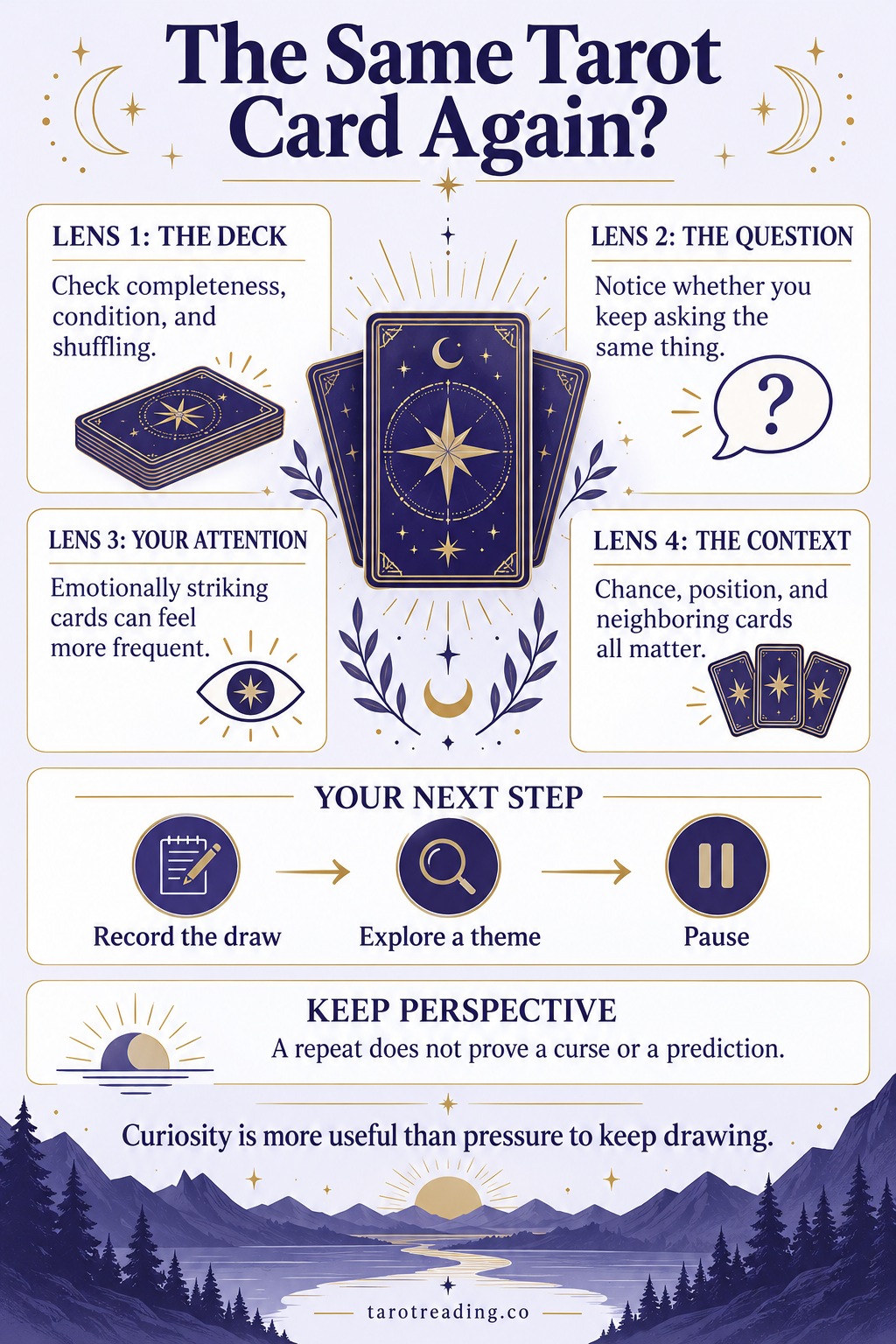
Read the infographic as text
- LENS 1: THE DECK: Check completeness, condition, and shuffling.
- LENS 2: THE QUESTION: Notice whether you keep asking the same thing.
- LENS 3: YOUR ATTENTION: Emotionally striking cards can feel more frequent.
- LENS 4: THE CONTEXT: Chance, position, and neighboring cards all matter.
- YOUR NEXT STEP: Record the draw → Explore a theme → Pause
- KEEP PERSPECTIVE: A repeat does not prove a curse or a prediction.
Curiosity is more useful than pressure to keep drawing.
Checking Your Cards
Start by looking at the pattern. Is the same card showing up in your draws, in readings from other people, or in social media videos? These are all different situations. A personal shuffle isn’t the same as watching a video that’s selected by a system.
You might also see images that are related instead of the exact card. There are many cards that have the same themes of withdrawal, cooperation, or change. Write down the names so that the broad theme doesn’t become a memory that’s inaccurate about a single card showing up each time.
Pay attention to whether the card appears in the same position. The Four of Cups in a position about attention might mean that you need a different reflection from the Four of Cups in a different option. Repetition of the image doesn’t change the structure of the spread.
If you use more than one deck, see if the guidebooks frame the card differently. Even if they have similar titles, they can have different images and traditions. Your interpretations need to account for the deck that you bought instead of assuming that every version has the same message.
Paying Attention When the Same Cards Keep Appearing
With 78 cards in a standard tarot deck, seeing the same card more than once is naturally going to happen sometimes, especially if you read tarot regularly. At the same time, a card that continues appearing can feel meaningful, particularly when it shows up around the same question, person, or situation.
Instead of immediately deciding that a repeated card is either completely random or definitely carrying one specific message, take a closer look at what was happening each time it appeared. Think about the questions you were asking, the surrounding cards, and anything in your life that connects with the card’s meaning.
For example, if the Eight of Cups appears several times while you’re thinking about the same relationship, you might notice the repeated themes of emotional change, walking away, or searching for something more fulfilling. If the card begins appearing around completely different questions, you might look for a larger theme connecting those areas of your life.
Your own reaction can be meaningful too. Sometimes a card appears and immediately makes you think about a particular person, situation, or conversation. Write that first impression down before looking through a guidebook. As time goes on, you can see if the same connection continues to appear.
Repeated suits can stand out as well. Several Cups might draw your attention toward emotions or relationships, while repeated Pentacles could bring more focus to work, money, stability, or everyday responsibilities. Wands can highlight action, motivation, and passion, while Swords can bring attention to thoughts, communication, decisions, or conflict.
There is no need to force every message to fit.ed to force every repeat into a dramatic message. Sometimes a card might appear again just because you’re working with the same 78-card deck. Other times, the repetition might feel especially connected with what you’re experiencing. Tarot practice leaves room to notice those patterns and explore what they mean to you.
Check Your Deck and Find a Shuffling Style That Works
If one card seems to appear much more often than the others, take a quick look at the physical deck too. Tarot cards can stick together because of moisture, wear, bending, or frequent use. A card with a worn edge or different texture can also move differently while you shuffle.
This practical check doesn’t take anything away from the spiritual side of tarot. Your deck is also a physical tool, and taking care of it can help keep your readings comfortable and consistent.
How you shuffle can affect where the cards end up too. If you regularly place used cards back in the same part of the deck and only shuffle briefly, some cards can stay fairly close together. Try shuffling until the deck feels ready rather than rushing through it.
Some tarot readers also pay special attention to cards that jump or fall from the deck while shuffling. If that’s part of your practice, decide how you normally want to work with them. You might read the first card that falls, look at a small group of cards that come out together, or return them to the deck and continue shuffling.
There isn’t one rule that every tarot reader has to follow. What matters is finding a method that feels comfortable and meaningful to your practice instead of changing your method every time something unexpected happens.
If something about the deck feels physically unusual, count the cards and make sure all 78 are there. You can also check for duplicates, damaged cards, or cards that are sticking together. Fixing a problem with the deck doesn’t mean that the repeated cards you noticed had no spiritual meaning. It just helps you understand your tarot deck better and gives you more confidence in the way you work with it.
Tarot can have both practical and spiritual parts. Caring for your deck, developing a shuffling routine, and paying attention when certain cards continue appearing can all become part of building a stronger connection with your tarot practice.
Emotionally Charged Cards
Emotionally charged cards are easier to remember than regular ones. If the Tower worries you, the appearance might be vivid in your mind, and other cards might fade from your memory. The feeling of repetition can become stronger than what a written record shows.
research review on hindsight bias discusses how knowing an outcome can affect how people reconstruct earlier judgments. It is not a study of tarot. Its relevance here is the value of preserving what you originally observed rather than relying entirely on later memory.
Write down the full draw, including cards that don’t seem important. This allows you to pay attention to whether the repeated card was shown in every session or just in a few that you remember. Include the readings that didn’t fit the pattern. A record is most useful when it can surprise you in either direction.
If you see cards and videos, think about how your viewing habits influence what happens next. Spending time on one theme can lead to more related content. A big, circulated collective reading isn’t tailored evidence about your life.
Asking New Questions
If you ask the same question over and over again, a repeated interpretation might reflect the same situations. A concern about whether someone is going to contact you can stay active even if nothing has changed. Drawing cards again might not give new information.
Try moving from prediction to reflection. Asking, “Will they return?” should become something like, “What do I need to decide while the contact is uncertain?” A recurring card might give a different perspective because the question has changed in a better way.
According to Joan Bunning’s lesson on writing tarot questions it is a practitioner resource that emphasizes the question’s role and the reader’s responsibility for choices. Its spiritual framework is a reading approach, not evidence that cards can reliably predict outcomes.
You can keep the question for a certain period and go back to it when your situation changes. A career reflection might be revisited, for example, after an interview or a conversation with the manager. A new event allows you to have something to reflect on instead of just anxiety.
Read the Context
Start with the image, the question, and the spread position. Write down an interpretation that fits all three areas. If you use reversals, use this method and pick it beforehand. Don’t decide to change the recurring card or say it has a darker meaning just because it’s upside down later.
single-card interpretation lesson identifies several sources of meaning, including personal response, established symbolism, position, and the question. You can use that general idea to avoid reading a repeated image as an isolated verdict. Different practitioners use different methods.
If the Eight of Pentacles, for example, shows up while you’re reflecting on learning a skill, a good question might be whether your practice routine is manageable. If it shows up in a relationship spread, the reflection could be a concern about effort and habits in a different context. Neither of these means a guaranteed event.
Don’t expand the meaning until it fits everything. A card interpreted as work, love, health, money, or other possible changes is hard to evaluate. A focused reading can stay flexible and still explain why an interpretation fits the question.
Keep a Tarot Journal and Notice What Repeats
One of the easiest ways to become more familiar with your tarot deck is to keep a journal of your daily card pulls. For a week or two, draw one card each day using the same deck and write down what comes through before looking at a guidebook or going back through your earlier entries.
For each card, write down the question you asked, the card you pulled, and if you use reversals, which direction it appeared. Then add your first impression. You might notice a particular symbol, color, feeling, person, memory, or message before you even begin thinking about the traditional meaning of the card.
You can also make a short note about what’s happening in your life that day. When you look back later, you might notice that certain cards appeared during similar situations or that one suit showed up more often while you were focused on a particular part of your life.
If the same card keeps appearing, pay attention to it. Repeated cards can feel especially meaningful, and many tarot readers see them as a sign that a particular theme or message deserves more attention. Instead of immediately deciding what the repetition has to mean, look at what was happening each time the card appeared and notice what the card brings up for you.
Try not to immediately pull another card just because you don’t like the first one. Give yourself time to sit with its message. If you do feel drawn to pull a clarification card, write that one down too and notice how the two cards work together.
At the end of your journal period, look back through everything you recorded. You might discover repeated cards, suits, numbers, symbols, or themes that you didn’t notice from one day to the next. You could also see how your understanding of a particular card changed as you became more familiar with it.
The goal isn’t to get a perfect pattern. It’s to build a stronger relationship with your tarot practice and become more comfortable recognizing the messages, symbols, and patterns that stand out to you.
Explore a Repeated Card from Different Angles
When the same tarot card keeps appearing, try looking at its message from a few different directions instead of immediately giving it one fixed meaning. Start with what the card seems to describe in your life right now. Then think about what it might be asking you to notice. Finally, consider if there’s an action or change that connects with its message.
For example, imagine that the Hermit keeps appearing. You might first recognize that you’ve been spending more time alone and thinking about something important. Then you could ask yourself, “Is this quiet time helping me find the answers I need, or have I been pulling away from people more than I really want to?”
From there, think about what action feels connected with the card. Maybe you need more peaceful time alone to reflect. You might journal, meditate, work with a crystal, or spend some time away from distractions. On the other hand, the Hermit could help you realize that you’ve already spent plenty of time thinking and that you’re ready to talk with someone you trust.
The same card can carry different layers of meaning depending on your question and what’s happening in your life. A repeated Hermit doesn’t automatically mean that you need to isolate yourself. It could point toward reflection, inner guidance, wisdom, spiritual growth, solitude, or the need to find a healthier balance between time alone and connection with other people.
Pay attention to your first reaction when the card appears too. If you immediately think, “There it is again,” ask yourself what makes that particular card feel important. Sometimes your reaction can help you understand why its message continues to stand out.
Repeated cards can be an interesting part of tarot practice because they encourage you to look more closely at a theme instead of rushing past it. Give the card room to speak through its traditional meaning, imagery, your own associations, and any psychic impressions that come through. As time goes on, you might begin to understand why that particular card kept finding its way into your readings.
Repetition and Pressure
You should take a pause if a reading starts to feel compulsory. Signs can include:
- repeatedly drawing until you feel relieved
- delaying decisions because the right card hasn’t shown up
- believing that a misreading will cause harm
You can reduce pressure by setting a reading limit and putting the deck away afterwards. Keep a note about the question so you don’t feel that you have to hold it in your mind all day. Go back to regular activities that connect you with your everyday situation.
If a reader says that the repeat proves that you need an expensive cleansing service, ask for a better explanation and take a pause before you buy it. Repetition doesn’t mean that a curse or payment obligation is needed. You can keep your spiritual interests and still decline when feeling pressured.
When you have constant worry that interferes with your sleep, work, or relationships, get professional support. You don’t have to resolve a card’s meaning before getting help with distress.
Let Patterns Ask Questions
The same tarot card can be a familiar companion in your reflection practices. It might draw your attention to a subject you want to look at, or it might appear again in a regular series of draws. These are possibilities that don’t have to be forced into one explanation right away.
Look at the deck, write down the session, and interpret the cards in context. Then pick a useful reflection or action that fits in your everyday life. A recurring image can invite curiosity, but your decisions are your own to make.
Final Thoughts: Avoiding Repeated Drawings
Instead of constantly drawing to see if a card disappears, pick a practical reflection and then review it later. If the card reminds you of overworking, the reflection might be whether your schedule allows you time to rest. You can make one change and review its effect in the real world.
After you review it, look at your experience. Did the adjustment help you? What was still hard? The card doesn’t need to disappear for action to be useful. It also doesn’t have to come back and appear again to prove that you did the task right.
This kind of approach lets the pattern start and end in your practice. It avoids an open-ended search for a perfect sign. You can still enjoy an image, act sensibly and move on without waiting for your deck to show your progress.
If the same card returns later in another context, start again with a new question and situation. A familiar image doesn’t mean that you have to keep old interpretations in your life. The flexibility allows repetition to stay interesting while keeping limits.