
A tarot session usually moves from a question to a set of cards, then to an interpretation and a closing conversation. Knowing that shape can make a first reading feel more approachable, whether someone reads for you or you try a small spread yourself.
Readers differ in style. Some work with spiritual guidance or intuition; others emphasise symbolism and reflection. Those beliefs do not establish that a reading can verify the future or someone else’s private thoughts. You can ask how a reader works and decide whether that approach feels right for you.
Start with a focus and a few boundaries
Bring a subject you want to explore, not a perfectly worded question. “My relationship” can be a starting point; “How can I approach a recurring disagreement?” gives the reading a clearer focus. Questions about your choices and responses leave you more room to act than attempts to uncover another person’s secrets.
For a paid session, agree the price, length, format and any recording arrangements before it begins. You may decline a topic, keep personal details private or ask to stop. You do not need to prove your openness by accepting every interpretation.
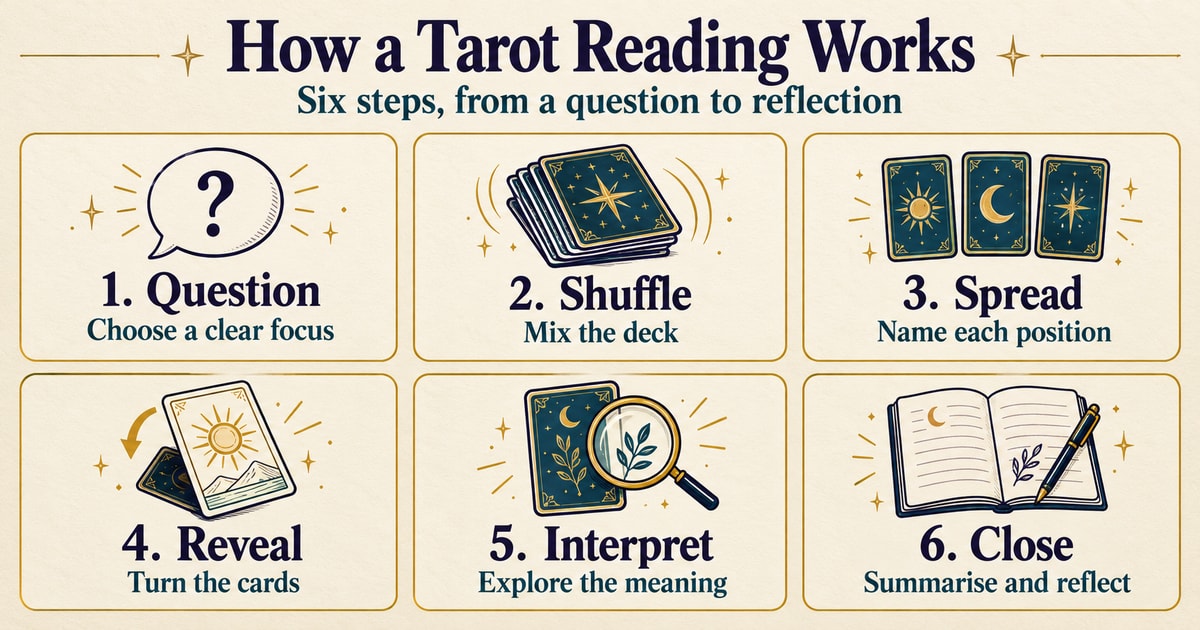
What happens in a reading: six common steps
This is a useful outline, not a rule every reader must follow. The order, number of cards and amount of conversation can vary.
1. The question
You explain the situation as much as you wish. The reader may help turn it into an open question and clarify what the session will cover. A self-reading begins the same way: give the cards a subject instead of asking everything at once.
Try: “What would help me handle this conversation more thoughtfully?”
2. The shuffle and cut
The deck is mixed, sometimes followed by a cut into smaller piles. You might handle the cards, or the reader may do this. Some people add a settling ritual or intention. There is no single required shuffle; our shuffling guide explains practical options.
Ask: “Who draws the cards, and do you use reversals?”
3. The spread
A spread gives each card a role. For example, three positions might mean situation, challenge and constructive next step. Naming the positions before interpreting helps you understand why the same card could be discussed differently in another place. A one-card reading is possible too.
Ask: “What does each position stand for?”
4. The reveal
The cards are turned face-up, either together or one at a time. Pause to notice the pictures, colours, figures and your first associations. A reversed card is not automatically bad, and a dramatic image is not a literal forecast of an event.
Notice: “What detail catches my attention before I look up a meaning?”
5. The interpretation
The reader brings together the deck’s symbolism, the spread position and the question. They may also describe an intuitive impression. You can say what fits, ask how they reached a conclusion or disagree. An interpretation is something to explore, not a fact you must accept.
Ask: “How does that meaning relate to my question?”
6. The close
Return to the original focus and summarise the most useful themes. Choose a realistic next step or a question to think about later. If you want notes or a photograph, check permission; agree separately before recording another person’s voice or video.
Leave with: “What can I actually do with this insight?”
A worked example: a conversation about shared chores
Your question is, “How can I discuss our household chores without another argument?” You choose three positions before drawing: situation, challenge and constructive next step.
Situation — Two of Pentacles: its juggling imagery could suggest competing demands. You note which tasks and schedules are actually involved, rather than concluding that your housemate does not care.
Challenge — Seven of Cups: the many possibilities might prompt you to separate assumptions from facts. “They expect me to do everything” becomes something to discuss, not something the card has confirmed.
Next step — Three of Pentacles: a common association with shared work suggests asking for a specific division of tasks. Your action is to arrange a calm conversation and propose a plan you can both review.
Another reader might see different themes. What makes this example useful is the link between the question, each position and an action you can choose—not proof that the cards have read your housemate’s mind.
What changes in a phone, video or email reading?
The basic process can remain similar, but the presentation changes. On a call, the reader can name each card and explain its position. Video may let you see the layout. An email reading may provide the cards, interpretations and suggested reflection questions in writing, with less opportunity for immediate clarification.
Ask what is included, whether you can ask follow-up questions and how long you will wait for a written response. You do not need to own a deck for someone else to read. If you are learning on your own, a small spread and our beginner’s guide are enough to start practising.
What to do after the session
Write down the question, cards, positions and anything that felt useful or unclear. Separate the reader’s interpretation from what you already know. Try one small action, then review the outcome in ordinary life rather than repeatedly redrawing the same question for certainty.
If a reading leaves you frightened, pause before making decisions or buying another session. You are free to reject pressure, claims that only a particular reader can fix your situation or demands for extra payments to remove a supposed curse. A reading should leave room for your judgment and boundaries.
Where the cards and meanings come from
A standard tarot deck has 78 cards: 22 Major Arcana and 56 Minor Arcana. Tarot’s history includes fifteenth-century Italian playing cards; its use for divination came later. The Rider–Waite–Smith deck, with illustrations by Pamela Colman Smith, was first published in 1909. The V&A’s history of tarot explores that changing visual tradition. Meanings can differ between decks and readers, so ask which system is being used.
Keep learning at a comfortable pace
Our introduction to tarot cards explains the deck’s structure and reading approaches. You can learn the steps without having to agree with every claim made about tarot.