

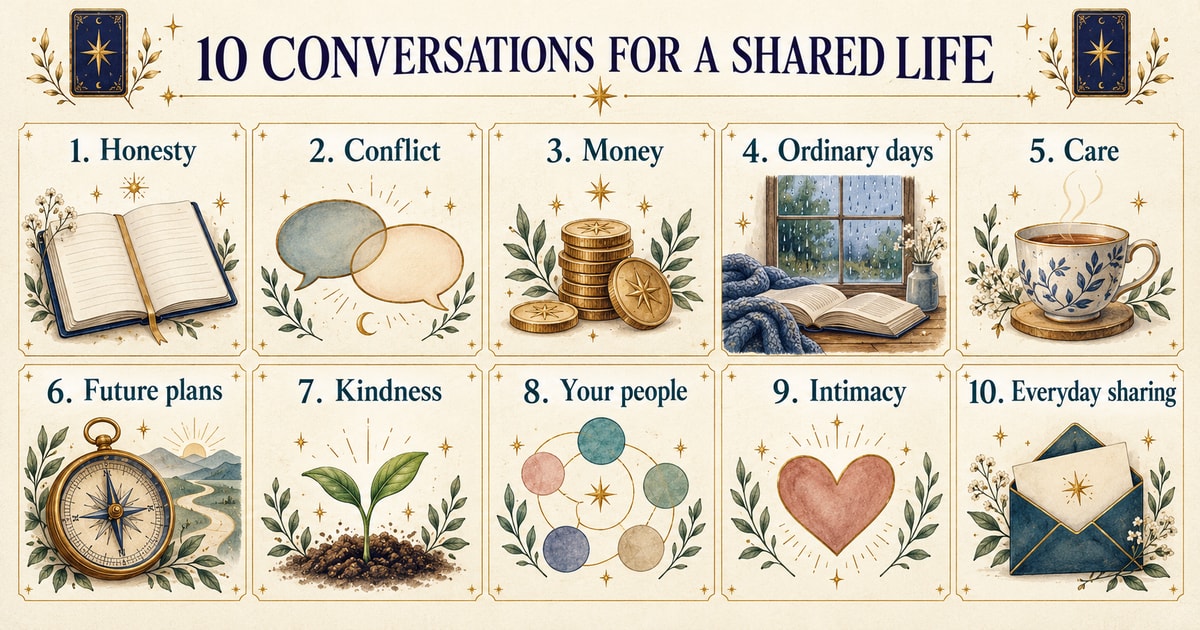
Meeting someone you can imagine a life with is exciting. Knowing how that life might work takes more than chemistry or a reassuring tarot card. These ten areas offer practical conversations about the partnership you are building—not a test that guarantees someone will stay forever.
You do not have to live together, marry or wait a prescribed number of years to take your needs seriously. Look at patterns, discuss what matters to each of you and stay open to what you learn. Both people should be free to choose the relationship.
Ten conversations for a possible life partnership
Choose one topic at a time, rather than turning an evening into an interview. The aim is understanding, not identical answers. Love is respect’s relationship guidance puts communication, boundaries, respect and support at the centre. Keep those qualities in view while discussing the ordinary details below.
1. You can be honest about uncomfortable things
Fears, jealousy, doubts and mistakes can be discussed without humiliation or retaliation. Being honest does not require surrendering every private thought or accepting hurtful behaviour.
Ask: when something is difficult to admit, how can we make room to hear it and respond respectfully?
2. You can recognise a recurring disagreement
Perhaps chores or timekeeping keeps coming up. Naming the pattern can help you discuss what needs to change; laughing about it is not required, and an apology without change may leave the problem intact.
Ask: what keeps happening, and what will each of us try differently next time?
3. Money has been discussed concretely
“We will manage” can hide different expectations. Discuss relevant costs, existing commitments, debt and how you would divide shared expenses before making shared plans.
Ask: what would each of us pay, what obligations already exist, and which decisions need another conversation before either person commits?
4. Ordinary days have room for both of you
A quiet Sunday, errands or separate hobbies shows a different side of life from a holiday. You do not have to enjoy every dull moment together; companionship can include comfortable space.
Ask: what makes an ordinary week feel workable for each of us, including time alone?
5. Care is discussed when life gets difficult
Illness, tiredness and embarrassment can reveal needs you do not notice on a great date. You need not wait for a crisis or create a test. Consider abilities and limits as well as willingness.
Ask: what support helps when one of us is struggling, and when might we need help beyond the two of us?
6. Important future questions are spoken aloud
Children, where to live, beliefs, caring responsibilities and career moves can shape a shared life. Do not assume the other person secretly wants your answer or will eventually change.
Ask: which plans are flexible, which are essential, and where might our wishes be incompatible?
7. Everyday treatment of others matters to you
Notice courtesy, accountability and how someone responds when disappointed. How they treat service workers or handle a difficult interaction can start a useful conversation, but one awkward moment is not the whole person.
Ask: how do we want to behave when stressed, frustrated or unable to get our way?
8. Your wider connections have space
Partners need not be close to every friend or relative. Making room for trusted connections is different from tolerating harmful family behaviour or demanding that someone choose between all friends and a partner.
Ask: how can we respect time with others, privacy and boundaries without controlling each other?
9. Attraction and intimacy can be discussed
Preferences and desire can change. A lasting relationship is not a promise of constant attraction, and previous intimacy never removes anyone’s right to say no.
Ask: what helps us discuss comfort, affection and boundaries without pressure, guessing or embarrassment being used against us?
10. Everyday sharing still feels welcome
You may enjoy telling them good news, a worry or something funny. They do not have to be your first or only confidant for the connection to matter. The Two of Cups can offer an image of exchange, not proof of a lifelong bond.
Ask: how do we make space to listen, and how can either of us say when we need a better time?
Use tarot to find a question, not a verdict
If a topic feels hard to approach, try one card for “What might help me speak clearly about this?” Describe the image and check your guidebook before connecting it to your own experience.
The Seven of Swords might prompt a question about what feels unspoken; it does not establish deception. The Three of Pentacles might suggest cooperation, but it does not prove you already share responsibilities fairly. Put the interpretation alongside actual examples, not in place of them.
Imagined example: you draw the Three of Pentacles while thinking about household work. Instead of concluding “we are a perfect team,” you list who currently handles shopping, cooking and cleaning. You discover one task neither person thought was theirs. The next step is agreeing who will handle it and when to review the arrangement.
For help keeping a personal reading from becoming repeated reassurance-seeking, see reading your own tarot without forcing an answer.
A simple way to talk together
- Choose a suitable moment. Ask whether the other person has time for one topic. Avoid treating the card as an authority they must accept.
- Share an observation and a need. For example: “We have both missed this task. Can we decide who is taking it on?” Give the other person room to describe their view.
- Agree on something specific. Note what you have decided, what remains unresolved and when to revisit it. A clear incompatibility deserves attention, not a more favourable draw.
Disagreements can happen without making the relationship a failure. Respectful conflict guidance helps distinguish differences of opinion from personal attacks or fear of retaliation. A relationship also remains a choice: you do not need to prove someone is bad before deciding you want a different future.
Safety is not another box to balance against the good
If a conversation brings threats, control or fear, the positive points elsewhere do not cancel that out. You need not confront someone or continue a joint exercise to prove your commitment.
In the United States, the National Domestic Violence Hotline is available at 1-800-799-7233, or text START to 88788. If you are concerned about monitoring, seek help using a safer device when possible. In immediate danger, call 911 or your local emergency number.
Continue to Love Tarot Readings: A Grounded Guide for relationship questions and spreads. Let the cards support honest attention to your shared life, while your decisions remain grounded in consent, behaviour and what each of you actually wants.