

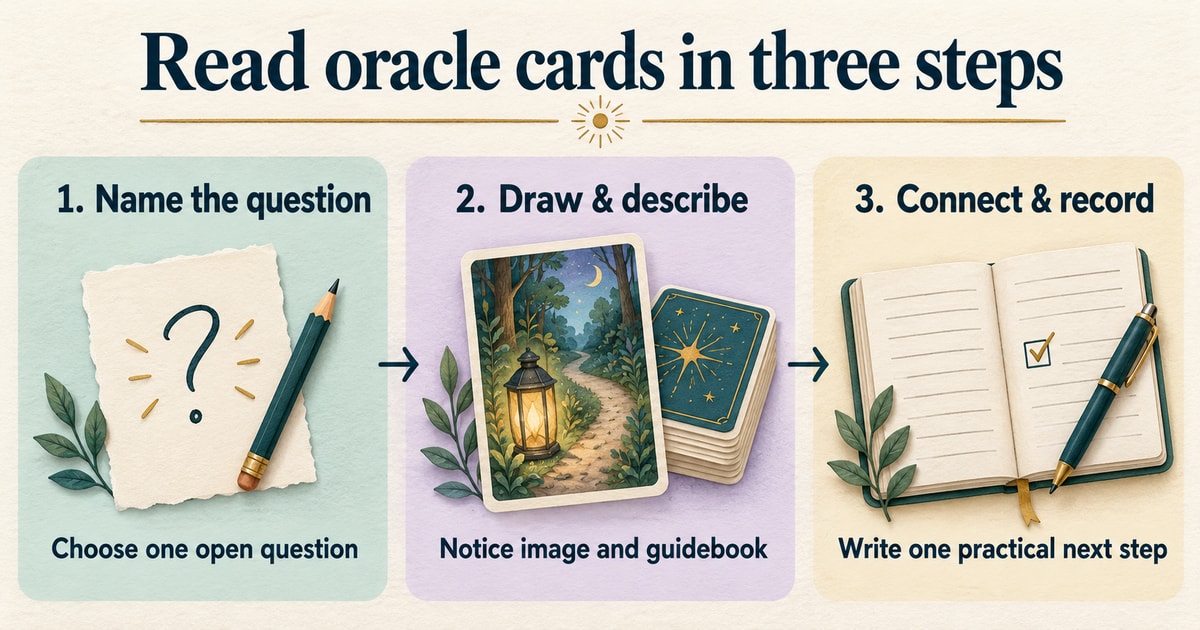
Try reading one oracle card in three steps: name the question, draw and describe, then connect and record. The aim is to leave with a thought you can explain in your own words, not just a guidebook passage you have read.
You can make space for intuition or spiritual meaning while keeping the reading connected to your circumstances. The example below follows one imagined question through all three steps, so you can see how a picture becomes a practical response.
Read your deck’s instructions first
Oracle decks do not all use the same system. Some have numbered cards, categories or suits, and some assign separate meanings to reversed cards. Check the introduction to your particular deck instead of assuming there is nothing to learn or that tarot rules automatically apply.
Have the guidebook if one is supplied and somewhere to make a short note. You do not have to memorise every meaning before starting. This is a flexible one-card exercise; if your deck uses a specific reading method, begin with its instructions and adapt only when you understand the difference.
The three-step method
The lantern and Patience examples are imagined, not quotations from a named deck. Use your own card’s artwork and guidebook rather than looking for that exact combination.
1. Name the question
Write one question before drawing. For this method, choose something that helps you consider your own response: what to notice, what to prepare or what you might do next. Keep it narrow enough to explore with one card.
Instead of asking a card to establish someone else’s feelings, you could ask “What do I need to communicate clearly?” That leaves room for a real conversation rather than treating an interpretation as access to another person’s mind.
Example: “What do I need to remember before Monday’s meeting?”
2. Draw and describe
Shuffle in a way you can comfortably manage, then draw one card. If hand shuffling is difficult, mix the cards on a clean surface or cut the deck. Decide your method before drawing rather than changing it to seek a preferred result.
Describe one or two visible details, silently or aloud, before reading the guidebook. Then compare the creator’s explanation with your own response. This separates what is pictured, what the book says and what you are adding.
Example: “I see a lantern beside a dark path. The guidebook’s keyword is Patience. The light makes me think about taking one step at a time.”
3. Connect and record
Return to the original question. Write one sentence about the connection you see and one manageable action—or an honest note that you do not see a connection. Date it and record the card’s name so you can review the reading without relying on memory.
Keep the action within your control. You can decide to listen, prepare questions or ask for more information; you cannot make the meeting go well merely by drawing a reassuring card.
Example: “Patience: I will listen to the whole update before replying. My next step is to prepare two questions, not a speech.”
Looking before reading the guidebook is an exercise in noticing, not a test of psychic ability. If you need the written entry first, start there and then look again at the image. A useful note makes clear which part came from the deck and which part came from your own experience.
When the card does not seem to fit
- No connection appears: write “I do not see a link to this question.” You can stop without treating that as a failure.
- You want to draw again: first ask what information is missing. A factual question may need a conversation, a document or qualified advice rather than another card.
- The guidebook and your response differ: record both. You can study the intended meaning without forcing yourself to agree with it.
- The meaning seems clearer later: keep the original note and add a dated follow-up. Record mismatches too; a later association is not, by itself, proof that the card predicted an event.
A repeat draw can be part of a method you have chosen, but it need not become a search for reassurance. If reading leaves you increasingly frightened or unable to leave a question alone, put the deck aside and seek support from someone you trust or a qualified professional.
Move from one card to three when you want more detail
You do not have to use a larger spread. If a three-card line would help you explore a situation, name its positions before drawing, then apply the same describe, compare and record process to each card.
- Where I am: what aspect of my situation does this image bring to mind?
- What is in the way: what concern, assumption or practical constraint might need attention?
- A next step: what could I do, ask or check within my control?
The second position is a prompt to investigate, not confirmation of a hidden obstacle. A card does not establish another person’s intentions. For a health, legal, money or safety decision, keep practical evidence and qualified help at the centre; the spread can organise the questions you want to ask.
Keep practising without making it a test
End by choosing what, if anything, you want to carry from the reading. “I need more information” is a valid conclusion. You can return to the note later, shorten the exercise or leave it for another day. There is no requirement to produce a profound message every time.
For a repeatable habit, try our daily oracle-card routine. If you also want to study tarot, the tarot beginners’ guide introduces that different structure. The full oracle cards guide covers deck types, choosing a deck and the differences from tarot.