

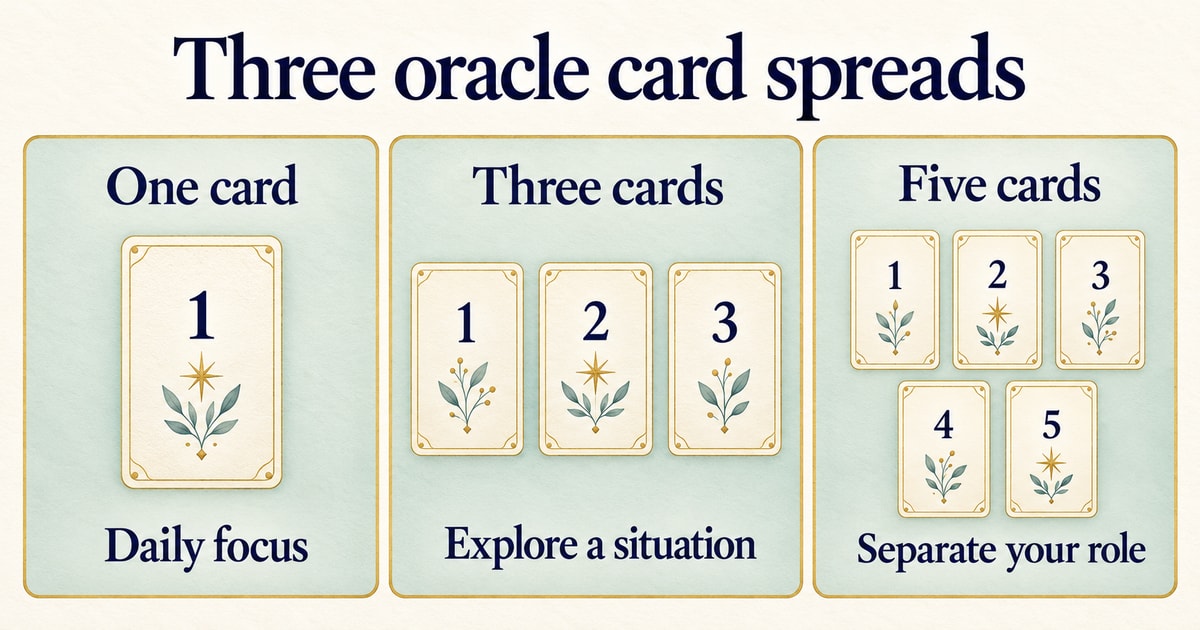
Start with one oracle card for a daily focus, three cards to explore a situation, or five to separate your own choices from things outside your control. A spread is simply a set of named positions: each card is read in relation to the question assigned to its place.
These are flexible beginner exercises, not rules for every deck. Choose the smallest layout that gives you enough room to think. More cards do not automatically mean a clearer message, and one thoughtful note can be enough.
Before you lay out the cards
Read your deck’s introduction first. Oracle decks use different creator-defined systems; some have categories, numbered cards or specific reversal meanings. If your guidebook recommends its own spread, you can begin there. There is no need to assume a large layout will fail or that every deck follows the same method.
Write a question and the position labels before drawing. Shuffle in a way your hands can comfortably manage, then use your chosen draw method. For these exercises, place the cards face up in numbered order. Leave space between them, or put numbered paper labels beside them so you can remember each role.
Look at a card’s image and compare it with the guidebook, if supplied. You may read the written meaning first if that helps. Keep the creator’s explanation separate from your personal association, and connect both to the position rather than treating a striking picture as a fact about your situation.
Choose one of these three short spreads
1. One-card draw: a daily focus
Use this when you want a small check-in or are learning how your deck communicates. Place one card in front of you and give it one job:
- What to keep in mind today: what does this card invite me to notice, practise or question?
Write the card’s name, one observation and an action within your control. A card associated with rest might prompt you to review your schedule and protect a break, not predict that the day will be easy. For a repeatable version, try our daily oracle-card routine.
2. Three-card line: a situation and a next step
Use this for a question you can act on, such as preparing for a visit or approaching a tense week at work. Lay three cards in a line, left to right:
- Where I am now: what aspect of my present experience does this card bring to mind?
- What is getting in the way: what concern, assumption or practical constraint might need attention?
- A next step I can take: what could I do, ask or check?
The middle card suggests something to consider; it does not confirm a hidden obstacle. Read the three positions separately before writing a short summary.
Worked example: imagine asking “How do I handle my sister’s visit?” and drawing cards called Rest, Honesty and Play. These are illustrative titles, not a reading from a named deck.
Rest: “I already know I am tired; what can I simplify?” Honesty: “Is there a practical need I should explain?” Play: “Could we choose one easy activity we both enjoy?”
Journal takeaway: “I will explain that I need a quiet evening and suggest one relaxed outing.” This is a possible plan to discuss, not knowledge of what your sister wants or how she will respond.
3. Five-card situation: separate your role
Choose this when several parts of a situation feel tangled. Put cards 1–3 across the top, then cards 4–5 beneath them from left to right. A single line also works if you have room; the labels matter more than the shape.
- The situation as I see it: how am I describing the issue?
- What might I be overlooking: which question or assumption could I investigate? This is a hypothesis, not revealed information.
- What I can control: which choice, preparation or boundary is mine?
- What I cannot control: which outcome or decision belongs to someone else, or remains uncertain?
- One thing to let go of: is there an unhelpful expectation or repeated mental argument I could loosen?
For a work disagreement, your part might include preparing examples and asking for a meeting; the other person’s response is not yours to choose. Letting go of an expectation does not mean abandoning responsibilities or accepting unsafe behaviour. Finish by naming one action and one piece of information you still need.
When a card does not fit the position
Leave the card in place long enough to note the mismatch. Check its guidebook entry and the question you wrote. If no useful connection appears, record “unclear” and stop; you do not have to keep drawing until every position produces a satisfying message.
Intuition and spiritual reflection can be part of your practice without making every interpretation certain. When a question depends on someone else’s feelings, a factual decision or your safety, seek the relevant conversation, evidence or qualified help. A spread can organise your questions, but it cannot establish those answers.
Date your notes and add later observations without changing the original reading. To adapt positions across other card systems, see our guide to simple card spreads. For deck types and choosing a deck, return to What Are Oracle Cards?