

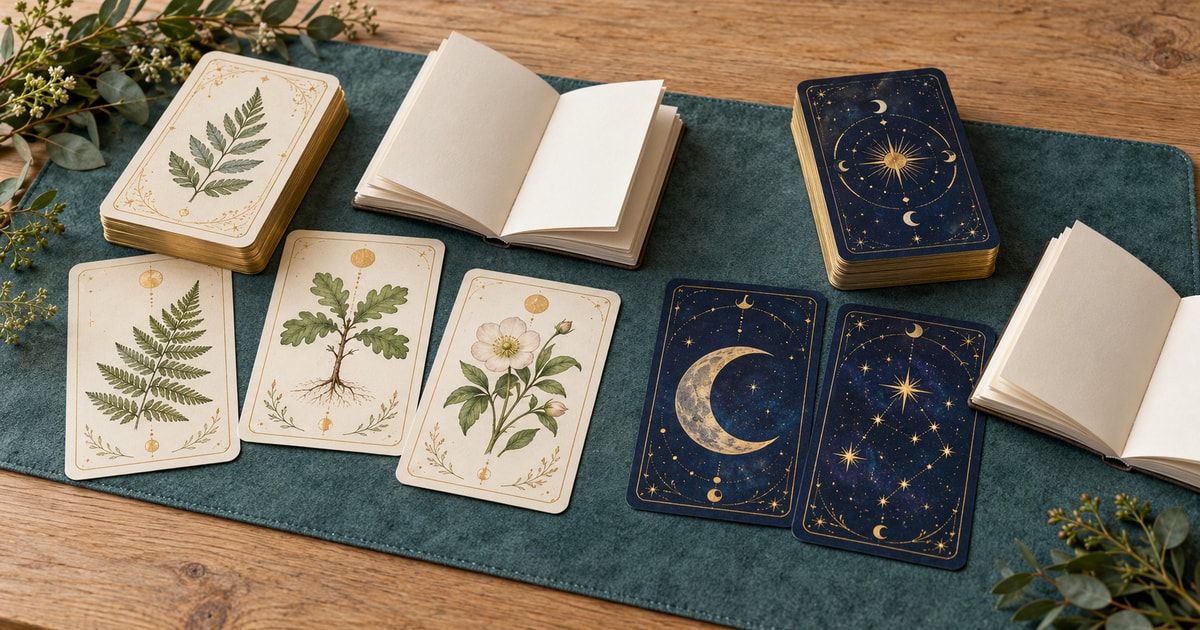
Oracle cards are decks used for symbolic reading, spiritual reflection or journaling. This guide focuses on modern themed decks sold as oracles: their creators choose the card set, imagery and suggested meanings. A deck might explore animals, plants, angels, seasons or everyday qualities.
Some readers approach the cards as spiritual guidance; others use them as prompts for thinking. You do not need to settle that personal question before trying a reflective exercise. What matters is knowing your deck’s system and not treating an interpretation as verified information about the future or another person.
How oracle cards differ from tarot
The distinction is about the system, not whether one kind of card is more spiritual. The V&A’s tarot overview describes the familiar 78-card structure: 22 cards in the Major Arcana and 56 in the Minor Arcana, with four suits. Modern oracle decks do not all share that template.
1. Card count and structure
Oracle: check the individual deck. Its creator may use one collection of themes, several categories, numbers or suits. A deck can have a clear internal structure without following a system shared by other oracle decks.
Tarot: the familiar Major-and-Minor arrangement gives you a framework that can carry between decks. Variations exist, so check what is included rather than assuming every box contains exactly the same set.
A theme alone does not identify the system. A plant-themed deck might be tarot or an oracle; look for its card list and instructions.
2. Meanings and guidebooks
Oracle: the guidebook explains this creator’s approach. A word such as Release or a moon image may have a particular meaning in that deck. Do not assume another deck uses it the same way, or that every upside-down card has a separate meaning.
Tarot: traditions such as Rider–Waite–Smith supply shared reference points, but they are not the only tarot tradition. Artwork and interpretations still vary. A new deck’s guidebook can help even an experienced reader.
With either system, distinguish what the guidebook says from your own association. Both can be part of a reading without being interchangeable.
3. Learning and everyday use
Oracle: a single image or phrase can provide a simple starting point. That does not mean reading the guidebook once teaches you everything: some decks have detailed systems, exercises or specialised language.
Tarot: suits, numbers and recurring figures give you more relationships to learn, but you can still begin with one card. You do not have to master a large spread first.
Both can be used for daily reflection or longer layouts. Oracle does not always mean faster or gentler, and tarot is not automatically deeper. Choose a deck whose language and structure you are willing to spend time with.
Try a one-card reflection
Start with a question about something you can explore or act on, such as “What could help me approach this conversation thoughtfully?” Keep the deck’s guidebook nearby, if one is supplied.
- Read the introduction. Check the creator’s instructions, including any categories, drawing method or reversal meanings.
- Draw and look. Shuffle comfortably, draw one card and describe a detail before deciding what it means.
- Compare interpretations. Read the entry, then note your own association. Where does either fit your question, and where does it not?
- Choose a next step. Write one action or question within your control. Date the note so later observations remain separate from the original reading.
Imagined example: a card shows a bridge. Its guidebook theme might be Connection, while the image reminds you of a conversation you have postponed. You could write: “I will ask whether there is a suitable time to talk, and listen before assuming what the other person wants.”
This is a possible interpretation, not a named deck’s meaning or a prediction that the conversation will go well. If no useful connection appears, record “unclear” rather than forcing an answer or repeatedly drawing.
For a repeatable check-in, see our daily oracle-card routine. If you already use tarot, an oracle card can open a reading with a theme or close it with a reflection. Our guide to combining oracle cards and tarot explains how to keep those roles distinct.
Choose a usable deck, not just an attractive box
- Sample the voice: read an entry and check whether its spiritual language and approach suit your practice.
- Check the practical details: card size, lettering, contrast and a guidebook you can comfortably read matter during an actual draw.
- Check the system: look for clear instructions and a card list. Decide whether you want a light daily prompt or a more involved study.
For comparison with a structured deck, explore picking the right tarot deck. You may prefer oracle, tarot or both; choosing one does not require dismissing the other.
What a reading cannot establish
A personally meaningful card is not evidence of someone else’s feelings, a future date or a guaranteed outcome. Use conversation and relevant facts for those questions. A reading can help you phrase a concern, but it should not decide whether a health, legal, financial or safety issue needs proper attention.
For more on deck types, questions and reading methods, continue to What Are Oracle Cards? Keep your notes open to revision: a good reflection can end with a clearer question rather than a certain answer.